Is Mercury Theia? Evidence, Theories, and What Scientists Know
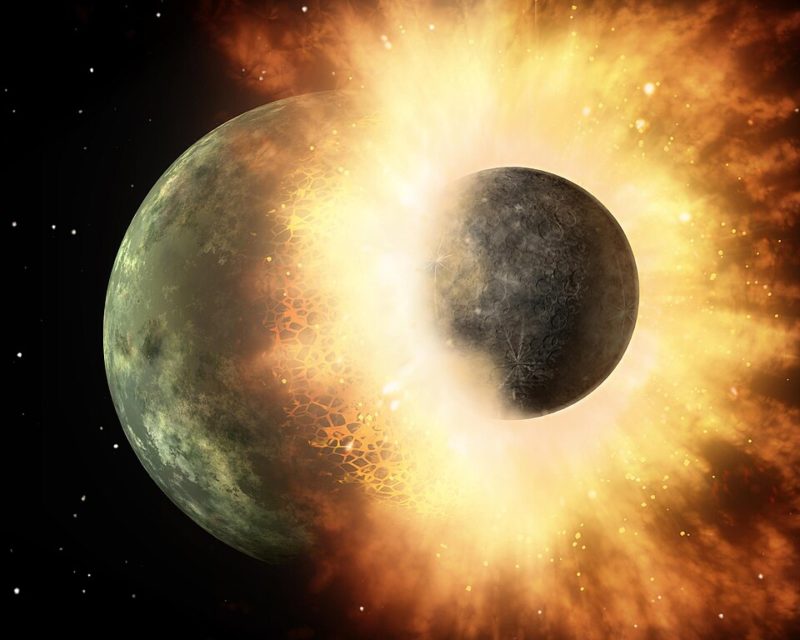
Mercury is sometimes described as a surviving piece of Theia, the hypothetical planet believed to have struck the young Earth. That idea is attractive because both bodies are associated with violent early impacts, but current planetary science does not identify Mercury as Theia. Mercury is a separate planet, while Theia is a proposed protoplanet whose collision with Earth may have created the Moon.
The confusion comes from a broader truth: the inner Solar System was a chaotic construction site. Protoplanets collided, merged, lost material, and changed orbit. Mercury’s unusually large metallic core suggests that something dramatic happened during its formation, although scientists still debate whether that event involved one enormous impact, several collisions, unusual solar chemistry, or a combination of causes.
Is Mercury Theia?
Short Answer
No. Mercury is not Theia, and there is no accepted evidence that Mercury is the surviving remnant of that hypothesized body. Theia is generally modeled as a Mars-sized protoplanet that existed about 4.5 billion years ago. Mercury formed as one of the Solar System’s terrestrial planets, but its exact path from planetary embryo to present-day world remains unsettled.
What Theia Was
Theia is a name given to a proposed planetary body in the giant-impact hypothesis is the leading explanation for the Moon’s origin. It probably formed in the same broad region as Earth, where countless planetesimals and planetary embryos orbited the young Sun. Its orbit eventually became unstable, bringing it into a collision with Earth.
The impact likely occurred early in Earth’s history, when both worlds were still hot and partly molten. Debris thrown into orbit then gathered into the Moon. Theia itself would have been destroyed as an intact planet, with some of its material mixing into Earth and the lunar system.
Why Scientists Separate Them
Mercury still exists as a recognizable planet with its own orbit, crust, mantle, core, magnetic field, and geological history. Theia, by contrast, is a reconstructed entity inferred from impact models and lunar evidence. It has never been observed.
A planet can preserve chemical clues about an ancient collision, but those clues do not automatically reveal the complete identity of the impactor.
What Role Did Theia Play?
Giant-Impact Hypothesis
The giant-impact hypothesis is the leading explanation for the Moon’s origin. It accounts for the Moon’s relatively small iron core, its depleted volatile elements, and its close chemical relationship with Earth. Some modern models propose a high-energy collision that mixed material from Earth and Theia more thoroughly than older simulations suggested.
The theory is powerful, although not perfectly finished. Questions remain about angular momentum, the Moon’s composition, and how quickly the debris disk formed and cooled.
Moon Formation
Theia’s proposed collision transformed the early Earth-Moon system. Material from the impactor and Earth entered orbit, where gravitational forces gathered it into the Moon. Over time, the lunar surface cooled, differentiated, and developed the structure recognized today.
Oddly enough, the Moon’s similarity to Earth creates part of the problem. If Theia formed elsewhere, scientists might expect stronger isotopic differences between lunar and terrestrial material. The near-match suggests either that Theia formed close to Earth or that the collision mixed both bodies extremely efficiently.
Planetary Accretion
Theia also represents a normal stage in planetary formation: planetary embryos colliding during accretion. Earth, Venus, Mars, and Mercury were not built gently, grain by grain, like a snowball rolling downhill. They grew through repeated impacts involving objects ranging from small planetesimals to bodies hundreds or thousands of km across.
Mercury’s history belongs to this same violent era, but that does not make it Theia.
How Did Mercury Form?
Core-to-Mantle Ratio
Mercury has an extraordinary core-to-mantle ratio. Its iron-rich core occupies roughly 85 percent of the planet’s radius and contributes about 60 percent of its mass, making Mercury far denser than the other terrestrial planets.
NASA’s MESSENGER mission found evidence of a chemically unusual surface, including abundant sulfur and volatile elements. Mercury also has a global magnetic field, which indicates that at least part of its metallic core remains molten and electrically active.
Impact Scenarios
One explanation proposes that a giant impact stripped away much of Mercury’s rocky mantle, leaving behind a metal-rich remnant. Another suggests repeated collisions gradually removed silicate material. A third possibility involves evaporation or chemical sorting near the young Sun, where intense radiation and high temperatures could have influenced the materials available to Mercury (Clement et al. 2021).
Each scenario solves part of the puzzle. None explains every observation without complications.
Solar-System Location
Mercury formed close to the Sun, inside Earth’s orbit. That location matters because the early inner Solar System contained strong heat, intense radiation, and complex gravitational interactions involving the young Venus and Earth. Mercury’s building materials may have differed from those that formed the outer terrestrial planets.
Some models even suggest that Mercury began farther from the Sun and migrated inward. Such movement could have altered its collision history, though the evidence is still model-dependent. Recent simulations show Earth and Venus may have formed closer to the Sun and migrated outward, sculpting Mercury’s isolated orbit (Clement et al. 2022).
What Evidence Links Mercury to Theia?
Isotopic Comparisons
Isotopes act like geological fingerprints. Ratios involving oxygen, silicon, magnesium, titanium, and other elements can reveal whether planetary materials formed in similar regions of the Solar System.
Earth and the Moon show remarkably close isotopic relationships, which supports a shared impact history. Mercury, however, is not known to match Earth and the Moon closely enough to identify it with Theia. Nor is there a confirmed isotopic signature proving that Mercury contains a surviving, dominant portion of Theia.
Chemical Composition
Mercury’s surface chemistry distinguishes it from both Earth and the Moon. Its crust contains unusual proportions of sulfur and other volatile elements, while its enormous iron core sets it apart structurally.
These traits may reflect impacts, but they do not point to one specific impactor. Planetary chemistry is messy. Similar outcomes can arise from different starting materials and different collision conditions.
Modeling Limitations
Computer simulations are useful, not magical. They test how impacts might redistribute mass, angular momentum, heat, and chemical elements, but their conclusions depend on assumptions about initial composition, impact speed, angle, and planetary temperature.
That leaves room for several histories. Future measurements from ESA and JAXA’s BepiColombo mission may improve estimates of Mercury’s interior, magnetic field, gravity, and surface composition.
A minority hypothesis even suggests that the ancient Mercury may have been the very body that struck Earth 4.5 billion years ago—that Mercury is the surviving remnant of Theia. This idea remains speculative and is not supported by mainstream isotopic evidence, which shows Mercury’s composition differs from the Earth-Moon system.
Why Does Mercury Have Such a Large Core?
The short answer is that Mercury either lost much of its mantle or formed from unusually metal-rich material. A high-speed impact could have blasted silicate rock into space, while iron remained gravitationally bound. Repeated impacts may have produced a similar result more gradually.
Yet mantle-stripping alone is not a complete answer. Mercury retains volatile elements that some violent-impact models would expect to remove. That tension has pushed researchers toward hybrid explanations involving both accretion chemistry and later impacts.
What Remains Uncertain About Its Origin?
Scientists still do not know Mercury’s original distance from the Sun, how many major impacts it experienced, or whether its core formed from locally metal-rich material. The planet’s exact bulk composition is also difficult to measure because its dense atmosphere-like exosphere and harsh environment complicate observation.
The strongest conclusion is modest but important: Mercury is not Theia. It is an independent terrestrial planet whose large core records an unusual formation history. Theia remains central to theories of Moon formation, while Mercury offers a separate case study in how planetary worlds can be reshaped before their surfaces ever become stable.
FAQ
Did Theia become Mercury?
No. Theia is thought to have been destroyed in a collision with the early Earth. Mercury formed separately, although it may also have experienced major impacts.
Is Mercury made from Earth?
There is no evidence that Mercury formed from material removed directly from Earth. Its composition and orbit indicate a distinct planetary history.
Could Mercury be the remains of a larger planet?
Possibly. Some models suggest that Mercury lost much of its rocky mantle through giant impacts. That does not mean the original planet was Theia.
What planet did Theia hit?
The leading hypothesis says Theia struck the young Earth, producing debris that later became the Moon.
Conclusion
Mercury is not Theia. Theia is a hypothetical protoplanet tied primarily to the giant-impact origin of the Moon, while Mercury is a separate world with an unusually massive iron core. Both stories involve collisions and planetary violence, but the evidence does not connect them as the same object.
Mercury’s origin remains an open scientific question, and that uncertainty is useful. It invites better models, sharper measurements, and fresh insights into how the rocky planets formed near the Sun.
Would you like to receive similar articles by email?

Paul Tomaszewski
Paul Tomaszewski is a science & tech writer as well as a programmer and entrepreneur. He is the founder and editor-in-chief of CosmoBC. He has a degree in computer science from John Abbott College, a bachelor's degree in technology from the Memorial University of Newfoundland, and completed some business and economics classes at Concordia University in Montreal. While in college he was the vice-president of the Astronomy Club. In his spare time he is an amateur astronomer and enjoys reading or watching science-fiction. You can follow him on LinkedIn and Twitter.


You May Also Like
How Did Dwarf Planet Sedna Get Its Name
December Leonis Minorid Meteor Shower Guide