Indus Constellation Guide
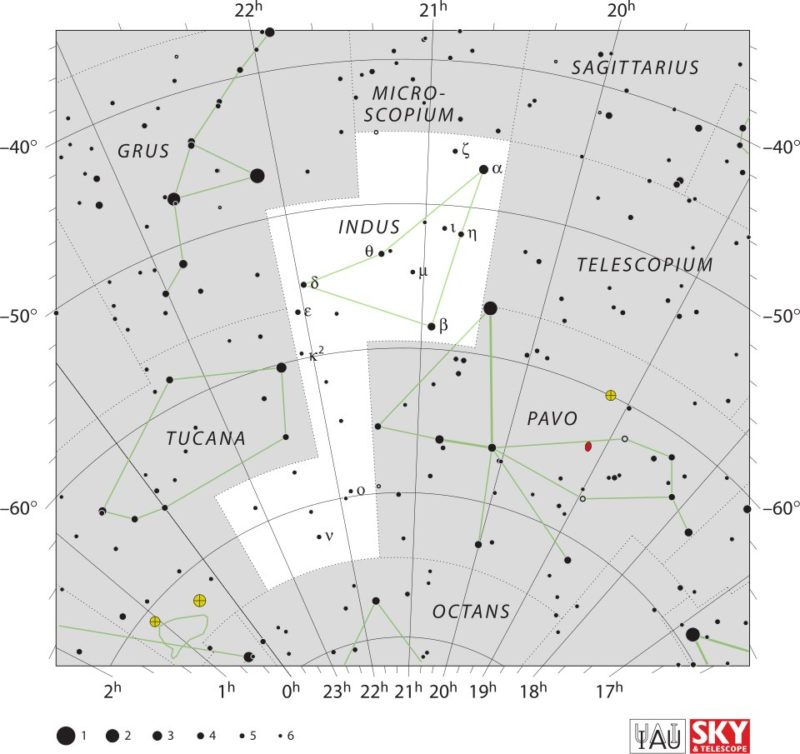
The Indus constellation is a faint southern-sky constellation created during the great European mapping of the southern heavens. It represents an Indigenous figure, although its original identity was never clearly defined. Indus is difficult to recognize because it lacks bright stars and a dramatic outline, yet the region contains scientifically valuable systems such as Epsilon Indi and several distant galaxies.
For practical observing, remember these essentials:
- Best season: late summer through early fall
- Brightest star: Alpha Indi, with an apparent magnitude near 3.1
- Location: southern sky, between Microscopium, Telescopium, Pavo, Tucana, and Octans
- Visibility: easiest from the Southern Hemisphere and difficult from far-northern locations
- Equipment: binoculars help with star fields, while a telescope reveals deep-sky targets
What Is Indus in the Night Sky?
Southern Hemisphere Constellation
Indus is one of the 88 officially recognized constellations listed by the International Astronomical Union. Its official abbreviation is Ind, and its Latin genitive is Indi, used in formal star names such as Alpha Indi. The IAU’s constellation system treats Indus as a defined region of sky, not merely the stick-figure pattern drawn between its stars.
The constellation sits far south of the celestial equator. That matters immediately at the eyepiece. From Australia, New Zealand, southern Africa, or South America, Indus climbs comfortably above the horizon. From the United States and Europe, only part of it may appear, and trees, buildings, and atmospheric haze can erase the lowest stars altogether.
Shape and Boundaries
Indus has no unmistakable outline. Western charts often depict a human figure, while modern star maps show a loose arrangement of stars that can resemble a narrow triangle or irregular quadrilateral. The NOIRLab constellation map follows the familiar western stick-figure tradition, though the pattern is more interpretive than obvious.
The surrounding sky provides better clues than Indus itself. Look near the brighter constellations of Pavo and Grus, then work inward toward Alpha Indi. Frankly, Indus is one of those regions that becomes recognizable only after repeated visits.
Size and Ranking
Indus covers about 294 square degrees, placing it around the middle of the 88 constellations in area. Its borders were standardized in the 20th century, so every star and deep-sky object inside those boundaries has a formal constellation association, even when the figure drawn on a chart seems rather fanciful.
What Does Indus Mean?
European Origins
Indus does not come from Greek or Roman mythology. Dutch navigators Pieter Dirkszoon Keyser and Frederick de Houtman recorded southern stars during voyages in the late 16th century, and the resulting observations helped European cartographers fill in previously unfamiliar sections of the sky.
Petrus Plancius placed the figure on a 1598 celestial globe, and Johann Bayer helped popularize it through Uranometria in 1603. The historical sequence is described in more detail by Ian Ridpath’s account of Indus, which also highlights how uncertain the figure’s cultural identity remained.
Historical Depictions
Early illustrations often portrayed a person holding arrows, sometimes without a bow. The figure was drawn with little consistency. Some interpretations suggested a native of Madagascar, southern Africa, or the East Indies, while others treated it as a generalized Indigenous person encountered in European exploration narratives.
That ambiguity is part of the constellation’s history, not a hidden myth waiting to be recovered. The name “Indus” reflects European categorization rather than a specific Indigenous tradition. Richard Hinckley Allen’s historical discussion of Indus records those changing interpretations.
Mythology and Interpretation
There is no ancient legend attached to Indus in the way Orion, Scorpius, or Andromeda carry established mythic narratives. Its meaning belongs to the era of celestial cartography, navigation, and global exploration. That makes Indus historically important, though not mythological in the classical sense.
Which Stars Form Its Main Pattern?
Alpha Indi
Alpha Indi is the brightest star in Indus, shining at approximately magnitude 3.1. It is an orange giant, cooler in surface color than the Sun but far larger and more luminous. Under a genuinely dark sky, it is visible without optical aid, though it does not dominate the heavens like Sirius or Achernar.
The star’s orange tone becomes easier to notice through binoculars or a small telescope, especially when viewed against a darker background.
Epsilon Indi
Epsilon Indi is the scientific celebrity of the constellation. Roughly 12 light-years away, it is an orange dwarf with high proper motion, meaning it shifts noticeably against distant background stars over long periods. It also has a pair of brown dwarf companions, making the system valuable for studying objects that occupy the murky boundary between planets and stars.
Its position will eventually carry it across the formal constellation border into Tucana, a reminder that constellation boundaries are human mapping tools, not permanent fences in space.
Supporting Stars
Theta Indi and several fainter stars complete the conventional pattern. None is especially bright, so the constellation’s figure can dissolve under suburban skyglow. A planisphere or astronomy app is more useful here than relying on memory alone.
Where Can You Find It?
Neighboring Constellations
Indus lies near Pavo, Telescopium, Microscopium, Sagittarius, Tucana, and Octans. Pavo and Grus are particularly helpful visual landmarks, although Grus sits just beyond the constellation’s immediate boundary.
Northern Viewing Limits
The northern edge of Indus reaches roughly 45 degrees south declination. At latitude 40 degrees north, that edge barely rises above the southern horizon, reaching only about 5 degrees altitude at best. Atmospheric turbulence, haze, and obstructions make the view poor.
At mid-northern latitudes, use the constellation’s transit, when it reaches its highest point, and choose an unobstructed southern horizon. Farther north, Indus becomes effectively impractical.
Southern Sky Position
From southern locations, Indus appears high enough for comfortable observation. In Australia and New Zealand, it can be found beneath or near the bright Milky Way regions around Sagittarius and Scorpius, although the constellation itself is quieter and less star-packed.
When Is It Visible?
Best Months
Indus is best placed for evening observation from August through October, with September often providing a convenient balance between darkness and altitude. It remains visible outside that window, but it may appear too low after dusk or set earlier in the night.
Latitude Effects
The farther south you travel, the higher Indus rises and the longer it remains visible. At tropical latitudes, it can reach a useful altitude, while from northern Europe or much of Canada only the extreme southern sky offers any chance.
Light Pollution
Light pollution removes the faint supporting stars first. Alpha Indi may survive from a bright suburban site, but the full pattern probably will not. A rural location with a clear southern horizon is far better than a powerful telescope used beneath city lights.
How Can You Identify It?
Use Bright Landmarks
Begin with the southern sky’s more conspicuous constellations, especially Pavo and Sagittarius. Use a current star chart to locate Alpha Indi rather than sweeping randomly. The official constellation overview is useful for confirming the formal region.
Trace the Triangle
Once Alpha Indi is found, connect it with the nearby second- and third-magnitude stars. The resulting shape is loose, but a triangle-like structure often becomes apparent under dark skies. Binoculars can reveal the supporting stars without narrowing the field as aggressively as a telescope.
Confirm the Location
Check the star field against an app or planisphere, then allow your eyes several minutes to adapt. If the pattern seems absent, the problem is usually altitude, haze, or light pollution rather than the constellation moving somewhere unexpected.
How Should You Observe It?
The naked eye is enough to see Alpha Indi from a dark site. Binoculars are arguably the best tool for the constellation itself because they brighten faint stars while preserving a broad field of view. A telescope becomes more valuable when you move beyond the pattern and inspect galaxies such as NGC 7049, whose dust lanes appear dramatically in Hubble imagery.
Do not expect a showpiece like the Orion Nebula. Indus rewards patient identification, wide-field scanning, and an interest in the geography of the sky.
What Makes Its Stars Scientifically Important?
Epsilon Indi gives Indus unusual scientific weight. Its proximity, orange-dwarf classification, rapid proper motion, and brown dwarf companions make it a useful laboratory for stellar evolution and substellar physics. The region also includes LHS 3844, the host star of the rocky exoplanet LHS 3844 b, linking this faint constellation to modern exoplanet research.
That is the odd charm of Indus: visually subdued, scientifically rich. The sky does not always advertise its best material with fireworks.
FAQ
Is Indus a zodiac constellation?
No. Indus is a southern constellation and is not part of the zodiac.
Can you see Indus without a telescope?
Yes. Alpha Indi is visible to the naked eye under dark conditions, but the complete pattern is faint.
Does Indus have ancient mythology?
No established ancient mythology is associated with it. The constellation originated in late-16th-century European sky mapping.
What is the brightest star in Indus?
Alpha Indi is the brightest star, with an apparent magnitude of about 3.1.
Conclusion
Indus is easy to overlook, yet it rewards anyone willing to explore beyond spectacular constellations. Its faint triangular pattern, complicated colonial history, nearby Epsilon Indi system, and distant galaxies connect naked-eye astronomy with cartography, astrophysics, and space science. Find a dark southern horizon, start with Alpha Indi, and let the surrounding stars slowly take shape.
Would you like to receive similar articles by email?

Paul Tomaszewski
Paul Tomaszewski is a science & tech writer as well as a programmer and entrepreneur. He is the founder and editor-in-chief of CosmoBC. He has a degree in computer science from John Abbott College, a bachelor's degree in technology from the Memorial University of Newfoundland, and completed some business and economics classes at Concordia University in Montreal. While in college he was the vice-president of the Astronomy Club. In his spare time he is an amateur astronomer and enjoys reading or watching science-fiction. You can follow him on LinkedIn and Twitter.


You May Also Like
What Causes Dips in Exoplanet Reflected Light Curves
Pickering’s Triangle: Unveiling the Beauty of Stellar Remnants