Hydrus Constellation Guide
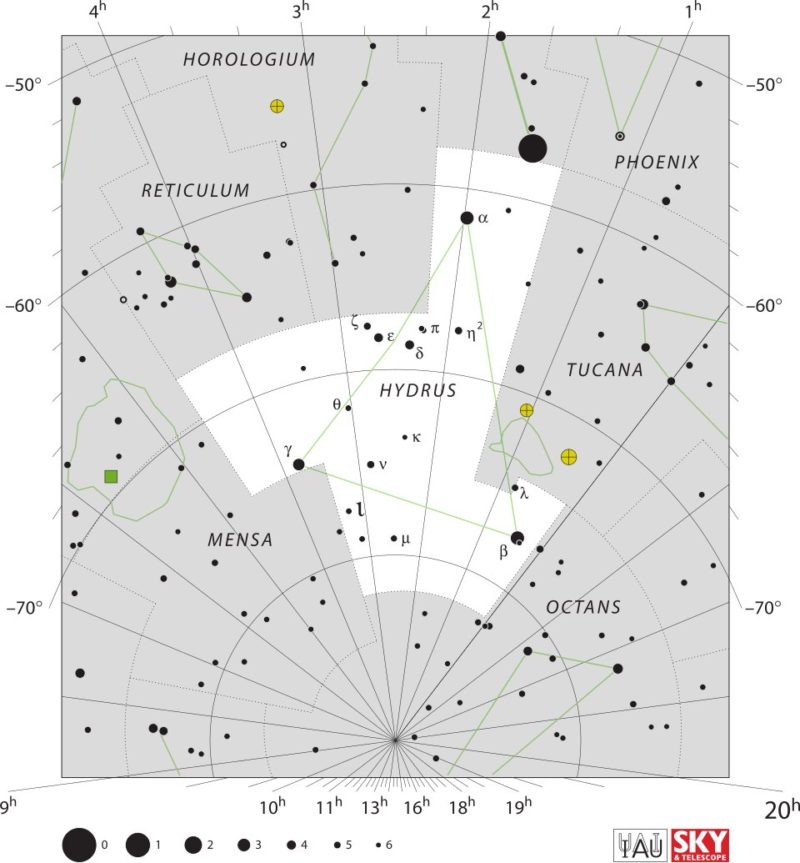
Hydrus is easy to overlook. Its stars are modest, its outline is vague, and its name is often confused with Hydra, the much larger northern constellation. Yet this small southern pattern has a sharp historical identity, a useful position near the south celestial pole, and a surprisingly rich collection of galaxies and star-forming regions. Hydrus is the “Male Water Snake,” a constellation created during the great era of southern-sky exploration.
For quick reference:
- Official abbreviation: Hyi
- Genitive form: Hydri
- Area: about 243 square degrees
- Best visibility: southern spring and summer evenings
- Brightest star: Beta Hydri
What Is Hydrus and Where Is It Located?
Male Water Snake
Hydrus occupies a deep-southern patch of sky between roughly right ascension 0 and 2 hours and declination -75° to -57°, according to the Chandra constellation map. The name comes from the Greek word for a water snake, although the constellation has no connection to the famous Hydra of Greek mythology.
Its stars form a thin, crooked trail rather than a bold animal shape. That makes Hydrus more of a celestial marker than a dramatic naked-eye portrait.
Southern Celestial Hemisphere
Hydrus sits firmly in the southern celestial hemisphere. From much of Europe, Canada, and the northern United States, it never rises above the horizon. Observers in southern Australia, New Zealand, southern Africa, and South America have a much better view.
At sufficiently southern latitudes, Hydrus behaves as a circumpolar constellation, circling the celestial pole without setting. The exact visibility depends on the observer’s latitude and the star’s declination.
Neighboring Constellations
Hydrus borders several southern constellations, including Tucana, Mensa, Octans, Chamaeleon, Apus, Reticulum, Horologium, and Eridanus. Its location also places it near the Small Magellanic Cloud, although that nearby satellite galaxy lies mostly within Tucana.
How Did Hydrus Get Its Name?
Keyser and de Houtman
Hydrus was mapped from observations made by Dutch navigators Pieter Dirkszoon Keyser and Frederick de Houtman between 1595 and 1597. Their work filled in large sections of the southern sky that European astronomers could not see from northern latitudes. The constellation later appeared in Johann Bayer’s 1603 star atlas, Uranometria. The NOIRLab guide to Hydrus provides the historical thread.
No Classical Myth
There is no surviving ancient Greek or Roman myth attached to Hydrus. Its story is cartographic rather than legendary, born from maritime exploration and the practical need to map unfamiliar stars.
That distinction matters. Modern constellation names often inherit classical mythology, but Hydrus belongs to a later generation of sky figures created during the European mapping of the southern hemisphere.
Contrast With Hydra
Hydrus is the smaller male water snake. Hydra is the enormous female water snake stretching across the northern sky. The names sound similar because they share an ancient linguistic root, but the constellations are unrelated in origin.
What Does Its Shape Look Like?
Three Main Stars
Hydrus is usually traced through three principal stars: Beta Hydri, Alpha Hydri, and Gamma Hydri. They do not produce a crisp geometric figure. Instead, they suggest a bent or curling line, with Beta Hydri acting as the most useful anchor.
Faint Curved Line
The constellation’s outline can vanish in suburban light pollution. Even under good conditions, its third-magnitude stars lack the punch of Orion or Scorpius. A dark rural sky makes the difference between recognizing the pattern and merely knowing it should be there.
Southern Celestial Pole
Beta Hydri lies relatively close to the south celestial pole and can help observers orient themselves. It is not the southern equivalent of Polaris, however. No bright star marks the pole directly. Sigma Octantis is closer, but it is much fainter and notoriously difficult to see.
Which Stars Matter Most?
| Star | Approximate magnitude | Why it matters |
|---|---|---|
| Beta Hydri | 2.8 | Brightest star; useful southern reference |
| Alpha Hydri | 2.9 | Bright blue-white star in the main pattern |
| Gamma Hydri | 3.3 | Helps complete Hydrus’s curved outline |
Beta Hydri
Beta Hydri is a subgiant star older and more evolved than the Sun. Its age and solar-like character make it scientifically valuable because it offers a glimpse of the sort of later life the Sun may experience billions of years from now. It is also the most practical starting point for identifying Hydrus.
Alpha Hydri
Alpha Hydri is a blue-white giant or bright subgiant, depending on classification details used. It appears prominent because it contrasts with the warmer color of nearby stars, though the color is easier to appreciate through binoculars than with the naked eye.
Gamma Hydri
Gamma Hydri completes the principal triangle-like arrangement. It is fainter than Alpha and Beta Hydri, so urban observers may need a carefully dark-adapted eye to hold it steadily.
What Deep-Sky Objects Does It Contain?
Hydrus 1
Hydrus 1 is a faint dwarf galaxy discovered within the wider Magellanic Bridge region. Its importance is far greater than its visual appearance. Dwarf galaxies are valuable laboratories for studying dark matter, star formation, and the gradual assembly of larger galaxies. It is far beyond ordinary amateur equipment.
Magellanic Bridge
The Magellanic Bridge is a stream of gas and stars linking the Large and Small Magellanic Clouds. Hydrus lies close to this active environment, which is why the region attracts professional surveys and space telescopes.
Small Galaxies
Several remote galaxies fall within Hydrus’s boundaries. Hubble observations show the peculiar spiral galaxy NGC 1511 interacting with a neighbor, while the elliptical galaxy PGC 6240 displays remarkable shell-like structures, described in this Hubble observation. These objects are faint smudges visually, but they reveal violent gravitational histories in long-exposure images.
How Can You Find and View It?
Southern Viewing Latitude
Hydrus is easiest from latitudes south of about 20° north, and it becomes especially well placed in southern Australia, New Zealand, South Africa, and southern South America. Look during the local spring and summer, when the surrounding southern constellations are well positioned after dark.
Dark-Sky Conditions
Choose a moonless night away from city lights. Let your eyes adapt for at least 20 minutes, then use Beta Hydri as the first reference point. A planisphere or astronomy app set to your exact location will prevent a great deal of needless guessing.
Binoculars and Telescopes
The main constellation requires no optical equipment, though binoculars sharpen its star pattern. A small telescope will not transform Hydrus into a showpiece. Its real rewards are photographic and scientific, including faint galaxies such as the quasar system cataloged by the Chandra X-ray Observatory. Never expect Hydrus 1 or distant shell galaxies to appear as obvious visual targets.
Why Does It Matter to Astronomy?
Hydrus demonstrates that a constellation can matter without being bright or mythologically famous. It preserves the history of southern exploration, offers a useful orientation point near the south celestial pole, and sits beside a galaxy-rich region shaped by interactions among the Magellanic Clouds.
That combination makes Hydrus a quiet but valuable piece of the universal sky map. It rewards patience more than spectacle, which, frankly, is often where the best astronomical insights begin.
FAQ
Is Hydrus visible from the United States?
Only from the far southern United States, and even there it stays very low above the horizon. Most of the constellation is invisible from northern locations.
Is Hydrus the same as Hydra?
No. Hydrus is a small southern constellation representing a male water snake. Hydra is a much larger northern constellation associated with classical mythology.
What is the brightest star in Hydrus?
Beta Hydri is the brightest star, with an apparent magnitude near 2.8.
Can beginners observe Hydrus?
Yes. Beginners can identify its main stars with the naked eye under dark skies, though a star chart makes the process much easier.
Conclusion
Hydrus is faint, southern, and easy to underestimate. Its crooked stars carry the history of Dutch sky mapping, while its surrounding field opens onto dwarf galaxies, interacting systems, and the Magellanic Bridge. Explore it under a genuinely dark sky, and this offbeat constellation becomes less a snake than a doorway into the deeper structure of the southern heavens.
Would you like to receive similar articles by email?

Paul Tomaszewski
Paul Tomaszewski is a science & tech writer as well as a programmer and entrepreneur. He is the founder and editor-in-chief of CosmoBC. He has a degree in computer science from John Abbott College, a bachelor's degree in technology from the Memorial University of Newfoundland, and completed some business and economics classes at Concordia University in Montreal. While in college he was the vice-president of the Astronomy Club. In his spare time he is an amateur astronomer and enjoys reading or watching science-fiction. You can follow him on LinkedIn and Twitter.


You May Also Like

Stargazing Calendar for February 2026

Interstellar Comet 2I/Borisov: The First True Comet from the Stars