Hydra Constellation Guide
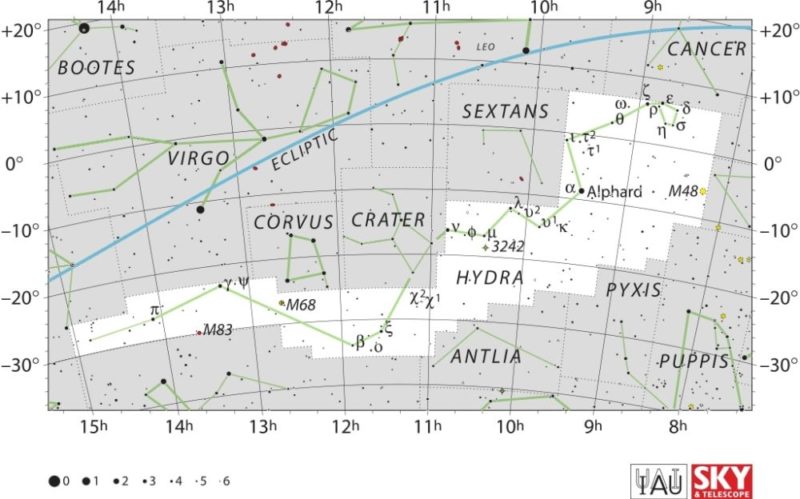
The Hydra constellation is easy to underestimate. It is the largest of the 88 modern constellations, covering about 1,303 square degrees, yet most of its stars are faint and scattered across more than 100 degrees of sky. Hydra represents the female water snake from Greek mythology, but it is also a useful landmark for finding galaxies, star clusters, and several neighboring constellations.
This Hydra is the astronomical constellation, not Hydra, Pluto’s small outer moon. NASA describes that moon as an irregular body discovered with the Hubble Space Telescope, a completely different entity from the immense star pattern visible from Earth. The International Astronomical Union’s constellation table lists Hydra under the abbreviation Hya.
What Does Hydra Represent in Greek Mythology?
Heracles and the Lernaean Hydra
In Greek mythology, Hydra was a gigantic serpent-like creature living near the springs of Lerna. The monster had multiple heads, poisonous blood, and a regenerative trick: when Heracles cut off one head, two more could grow back. One immortal head remained especially dangerous.
Heracles defeated the Lernaean Hydra during his second labor with help from his nephew Iolaus, also called Iolus. Iolaus cauterized each neck with burning branches, preventing new heads from appearing. Heracles buried the immortal head beneath a heavy rock and used the creature’s toxic blood on his arrows.
The constellation’s story is tangled with nearby figures. Hera, who hated Heracles, supposedly sent the Hydra against him, while a crab attacked his foot during the struggle. The crab became Cancer. In another myth, Hydra appears with Corvus, the raven, and Crater, the cup, forming a story about Apollo and a delayed water-fetching mission. A historical account of Hydra’s origin captures how these legends overlap rather messily.
Ancient Greek Origins
Hydra’s Greek identity probably grew from older serpent imagery in the ancient Near East. Babylonian sky traditions included large serpentine creatures, although the exact line between the Babylonian figure and the later Greek constellation remains uncertain. Ancient Greece did not invent every star pattern from scratch; it inherited, revised, and dramatized earlier sky maps.
The Greek astronomer Ptolemy included Hydra in his second-century catalog of 48 constellations. Modern astronomy retained the figure but fixed its official boundaries in the twentieth century. Mythology supplies the creature. The International Astronomical Union supplies the borders.
Constellation Significance
Hydra is significant because of its size, position, and contents rather than its visual drama. Its long body runs beneath several more recognizable constellations, making it a broad celestial guide. The head sits near Cancer, while the tail stretches toward Libra and Centaurus.
Where Is Hydra Located in the Sky?
Celestial Coordinates
Hydra extends roughly from right ascension 8 hours to 15 hours and from about +7 degrees to -35 degrees declination. Its northern end borders Cancer, while its southern sections approach the celestial equator and dip well into the southern sky.
The constellation crosses a wide range of declinations, so its visibility changes sharply with latitude. From the northern United States, the head and central body are reasonably placed, but the tail may sit low above the horizon.
Largest Constellation
Hydra is the largest modern constellation by area. That distinction can mislead new observers. Large does not mean bright. Alphard, the orange giant marking Hydra’s head, is the main visual anchor, while the rest of the snake dissolves into dimmer stars.
The practical approach is to treat Hydra as several connected zones:
- the head near Alphard and Cancer
- the middle body beneath Leo and Virgo
- the tail near Centaurus and Libra
Neighboring Constellations
Hydra borders Cancer, Leo, Sextans, Crater, Corvus, Virgo, Libra, Centaurus, and Canis Minor. Crater and Corvus are especially helpful because their compact shapes sit above Hydra’s body. The raven and cup from Greek mythology remain close together in the sky, perched beside the serpent.
How Can You Find Hydra at Night?
Locate Alphard
Start with Alphard, or Alpha Hydrae, a second-magnitude orange giant. Its name comes from Arabic and means “the solitary one,” a fitting label because it stands apart from many bright stars in this region.
In spring, look south after sunset. Find Regulus in Leo, then move southeast toward the dimmer region beneath Leo’s body. Alphard sits below Cancer and southwest of Regulus.
Trace the Body
Once Alphard is identified, follow a loose chain of stars southward and eastward. Do not expect a clean snake outline. The head is recognizable; the body is a long, faint procession; the tail becomes difficult under suburban light pollution.
A planisphere or astronomy app helps, but a dark site matters more. Hydra’s shape often appears only after your eyes adapt for 20 minutes or so.
Use Nearby Stars
Corvus resembles a small kite or crooked box. Crater looks like a faint cup. Their compact outlines provide better starting points than Hydra itself. From there, sweep downward through the sparse star field.
When Is Hydra Visible?
Northern Hemisphere
Observers in mid-northern latitudes see Hydra best from February through May. The head rises in the southeast during spring evenings, while the tail remains lower and may be blocked by trees, buildings, or haze.
Southern Hemisphere
Hydra is more favorably placed for southern observers. Much of the constellation rises higher, and the southern tail becomes easier to inspect. The best viewing season is still broadly autumn, from March through May.
Seasonal Timing
Hydra is most prominent around April. Its stars are visible during late winter and spring evenings in the Northern Hemisphere, then shift earlier in the night as the season advances.
Which Stars Stand Out in Hydra?
Alphard is the obvious star, with a warm orange color and a brightness that makes it useful even in imperfect skies. Gamma Hydrae, farther along the body, is another orange-yellow giant. Sigma Hydrae is fainter and less visually striking, but it helps define the constellation’s long western section.
Other cataloged stars include Beta Hydrae, Eta Hydrae, and Upsilon Hydrae. None rivals Alphard, which explains why observers usually identify the constellation from one star rather than from a complete pattern.
Which Deep-Sky Objects Are Worth Seeing?
M48, an open cluster near Hydra’s northern end, is one of the easiest targets. It contains many relatively young stars and can appear as a loose, granular patch through binoculars. Historical coordinate errors once caused M48 to become a “missing” Messier object; the Messier database history of M48 explains that curious cataloging failure.
M83, the Southern Pinwheel Galaxy, lies near Hydra’s southeastern tip. This face-on spiral galaxy has a visual magnitude of about 7.6, so binoculars may reveal only a soft glow, while a telescope under dark skies can expose its structure. The M83 profile from SEDS identifies it as the first galaxy discovered outside the Local Group.
Hydra also contains the Hydra A galaxy cluster, an immense system roughly 840 million light-years away. X-ray observations from the Chandra X-ray Observatory show extraordinarily hot gas and energetic activity around its central galaxy.
What Facts Make Hydra Distinct?
Hydra’s most remarkable fact is its contradiction: it is enormous, historically important, and scientifically rich, yet visually subdued. Its body crosses a huge region of sky, its brightest star is relatively isolated, and its best deep-sky objects require patience. The constellation rewards method rather than quick glances.
FAQ
Is Hydra the largest constellation?
Yes. Hydra covers about 1,303 square degrees, making it the largest of the 88 IAU constellations.
Is Hydra visible from the United States?
Yes. It is best seen during spring evenings, although the southern tail sits low for observers in northern states.
What is the brightest star in Hydra?
Alphard, or Alpha Hydrae, is the brightest star in the constellation. It is an orange giant and an excellent starting point for locating Hydra.
Conclusion
Hydra is a sprawling piece of the night sky, built from ancient myth but filled with modern science. Begin with Alphard, use Corvus and Crater as guides, and break the constellation into sections rather than trying to swallow the whole serpent at once. Its faint outline takes effort. That is precisely why finding it feels worthwhile.
Would you like to receive similar articles by email?

Paul Tomaszewski
Paul Tomaszewski is a science & tech writer as well as a programmer and entrepreneur. He is the founder and editor-in-chief of CosmoBC. He has a degree in computer science from John Abbott College, a bachelor's degree in technology from the Memorial University of Newfoundland, and completed some business and economics classes at Concordia University in Montreal. While in college he was the vice-president of the Astronomy Club. In his spare time he is an amateur astronomer and enjoys reading or watching science-fiction. You can follow him on LinkedIn and Twitter.


You May Also Like

Zombie Satellites: Risks, Impacts, and Mitigation Strategies
Alpha Monocerotid Meteor Shower Guide