How Did NASA Choose the First Astronauts to Walk on the Moon
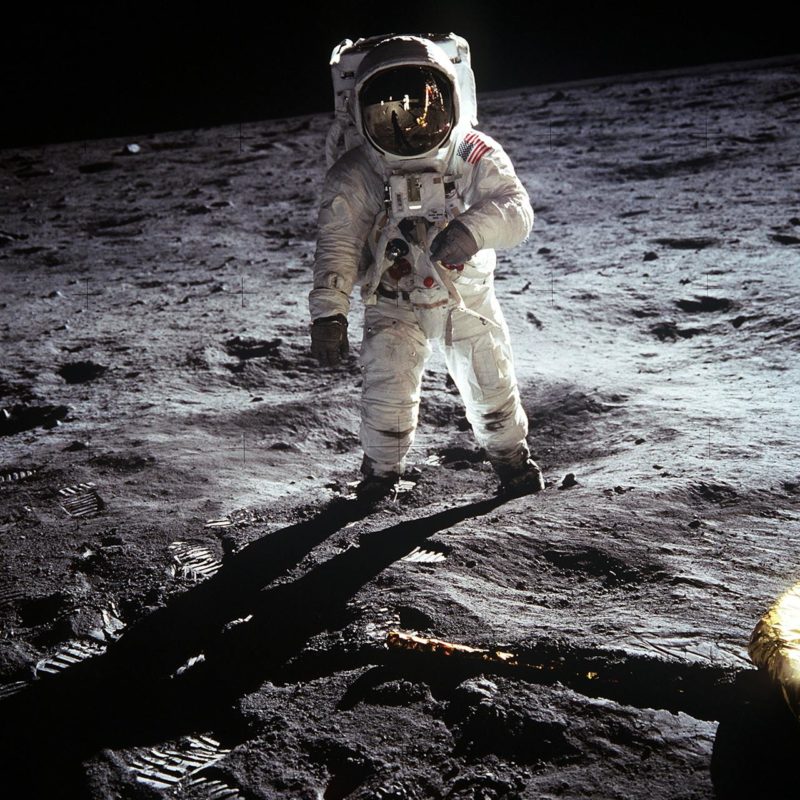
Right now, everyone is thinking about the Moon—how we’re going to get there and when the next set of astronauts from the Artemis missions will land. Additionally, people wonder whether we might really mine our nearest satellite for minerals.
While we’re excited to see the Artemis astronauts make their way to the lunar surface, they aren’t the first human beings to set foot on the Moon. How did NASA choose the astronauts for the Apollo program—and ultimately the crew who would walk on the Moon in 1969? Also, how has the selection process changed over the years? In addition, what is NASA looking for in its Artemis astronauts?
How Did NASA Choose Astronauts for Apollo Missions
The first human beings to set foot on the Moon took that one giant leap for mankind on July 20, 1969. On that iconic day, Neil Armstrong became the first person to walk on the surface of another world beyond Earth. What did it take for Armstrong and the generations of astronauts before him to earn the right to go to space?
Early astronauts faced extremely strict—but very narrow—requirements compared to today’s broader selection criteria. The ones that flew in the Mercury program were drawn from the military. Since test pilots were already used to many of the gravitational forces that they might encounter during launch, they were chosen more often. These pilots had made a career out of pushing aircraft to their extremes.
Other than that, Mercury astronauts also needed to be shorter than 5 feet, 11 inches, younger than 40, military test pilots with strong engineering backgrounds, and in excellent physical condition. Furthermore, they had to pass intense psychological screening.
Apollo and Gemini astronauts had more hoops to jump through. NASA still preferred high-performance pilots over other applicants. However, they needed to be relatively young, with preference often given to candidates in their 30s. In addition, they could be taller since there was more room in the capsules.
This was also the first time that the space program was opened up to civilians. The Apollo astronauts were the ones to finally land on the Moon. Though humans haven’t returned to the Moon since the end of the Apollo program, there have been numerous robotic missions in the decades since.
Understanding how did NASA choose astronauts also means looking at how crews were assigned to specific missions. NASA selected Apollo crews using a rotation system. In this system, backup crews for one mission often became prime crews three flights later. Factors like experience, leadership, and mission roles determined who would ultimately walk on the Moon. As a result, this process led to Neil Armstrong and Buzz Aldrin being chosen for the historic Apollo 11 moonwalk.
Astronaut Selection Through the Years
Back during the Mercury program, we were still learning the ropes of space travel. The selection process has changed dramatically over the years. The need for military pilots is still there, but there are plenty of opportunities for astronauts without flight time under their belt.
Today, astronaut candidates can come from all walks of life, and the lines between roles have blurred. Pilots still need to have military flight experience or will need to take an additional year of flight training before they can command or pilot a spacecraft.
Mission specialists are now often scientists, engineers, physicians or educators—with a strong background in STEM fields. International astronauts from other space agencies, and astronauts flying with commercial partners like SpaceX or Axiom Space, fall into their own categories.
Anyone can apply to become an astronaut, but the selection process is extremely competitive. Only a tiny fraction of applicants are chosen. For NASA applications, you have to be a U.S. citizen and have a minimum of a bachelor’s degree in a related field. In addition, you must meet the physical requirements for spaceflight. If you’re not applying to be a pilot, you need to have at least three years of related experience in another field. Teaching at any grade level from K-12 through college is considered to be an applicable experience for astronaut candidates.
If you want to be a pilot, you need at least 1,000 hours of flight experience in jet aircraft. While being a test pilot isn’t a requirement anymore, it is still a bonus and looks good on your application.
Modern astronaut selection also emphasizes teamwork, psychological resilience, and the ability to handle long-duration missions—especially as space agencies prepare for future missions to Mars.
Over time, astronaut corps have also become more diverse, with NASA aiming to land the first woman and the first person of color on the Moon as part of the Artemis program.
Explorers Wanted for Moon Mission
In 2020, NASA once again opened astronaut applications, this time for the Artemis mission that hopes to get people to the Moon and eventually Mars. Becoming an astronaut, even in this exciting time, is challenging. The last time NASA asked for applications before that was in 2015, and the space agency had more than 18,300 people apply for the chance. After two years, the graduating astronaut class was made up of 11 intrepid space travelers.
More than 12,000 applicants threw their hat in the ring to join the Artemis generation of astronauts. NASA announced the new astronaut candidates in December 2020. Those selected have since begun their training for future missions. That same year, NASA also introduced the Artemis Team. This group of 18 astronauts is eligible for future lunar missions.
Artemis II, the first crewed Artemis mission, launched on April 1, 2026. It orbited the Moon and paved the way for Artemis IV. That mission aims to land astronauts on the lunar surface. It’s an exciting time to be part of NASA or any space agency around the globe.
A Step in the Right Direction
The first thing we had to do to get astronauts back on the Moon was for the U.S. to regain the ability to launch astronauts from American soil. For years, since the end of the Space Shuttle program, we’ve relied on Russian Soyuz capsules to transport astronauts back and forth to the International Space Station. While these launches have been successful, restoring domestic launch capability became a key priority for NASA.
SpaceX, in conjunction with NASA, has been working toward that end, and now we’ve made it happen. On May 30, 2020, SpaceX’s Crew Dragon capsule was successfully launched aboard a Falcon 9 rocket, with test pilots Bob Behnken and Doug Hurley at the helm. It marked the first crewed launch from U.S. soil since the Space Shuttle program ended.
Since then, SpaceX has regularly flown astronauts to the ISS, and other commercial providers are preparing to join the launch roster. It’s also important to note that commercial spaceflight now includes both government astronauts and private individuals, depending on the mission.
Want to Be An Astronaut?
It might be too late to apply to be among the first batch of Artemis generation astronauts, but having the Moon as a tangible goal has reignited our desire to go to the stars. If you want to be an astronaut, start studying now and work on a degree in a STEM field. This, along with the relevant experience and fitness tests, will make it easier for you to apply to join the next batch of astronauts when NASA opens those doors again—or even consider applying with one of the new commercial space companies.
We’re going back to space, and it’s an exciting time to be alive. Get ready to enjoy the journey.
Would you like to receive similar articles by email?

Megan Ray Nichols
Megan Ray Nichols is a freelance writer, amateur astronomer, and science enthusiast. She loves to travel and read books.


You May Also Like

Canis Minor Constellation Guide

Pisces Constellation Guide