How Did Neptune’s Moon Triton Get Its Name
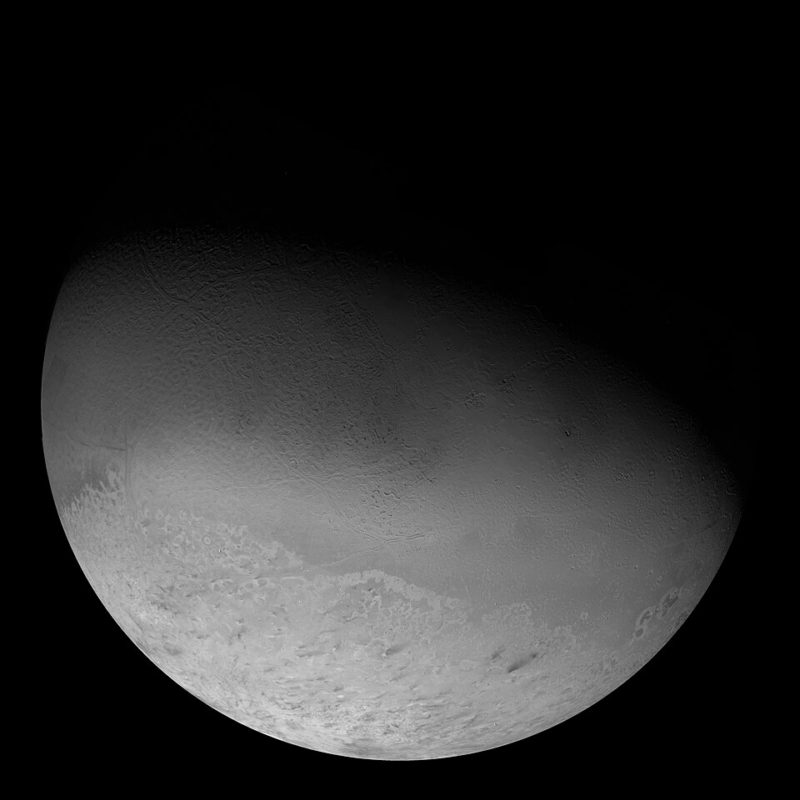
Triton got its name from Greek mythology, where Triton is the merman son of Poseidon, the sea god the Romans called Neptune. The logic is simple family arithmetic: if the planet is the ocean king, its largest moon should be his son. What is less simple is the timeline. The moon was found in 1846 and spent roughly seventy years drifting around without an official label, known mostly as “the satellite of Neptune,” until astronomers quietly settled on the name that the French writer Camille Flammarion had floated back in 1880.
Where Does the Name Triton Come From?
In Hesiod and later Greek sources, Triton is the herald of the deep, blowing a twisted conch shell to calm or stir the waves. He lives with his parents, Poseidon and Amphitrite, in a golden palace under the sea. That mythological pedigree matters because planetary nomenclature is not decorative. It is a filing system. The convention that Neptunian satellites carry the names of sea deities and water spirits keeps the neptunian system internally consistent, something the naming rules for planetary moons have preserved fairly strictly since the nineteenth century.
Who Discovered the Moon and When?
William Lassell
An English brewer with a serious telescope habit, William Lassell spotted Triton on October 10, 1846, using a 24-inch reflector he had built himself at his observatory near Liverpool. NASA Science’s account of that October night in 1846 notes that Lassell was actually chasing a rumored ring around Neptune when the moon turned up instead. The rings were real, as it happens. He just could not have resolved them.
Seventeen Days After Neptune
Neptune itself had only been confirmed on September 23, 1846, by Johann Galle in Berlin, working from Urbain Le Verrier’s calculations. Seventeen days later the ice giant already had a large moon on the books. Britannica’s reference entry on Triton puts that gap in perspective: no other outer planet satellite was found so fast after its primary planet.
Why Did the Moon Stay Nameless for Decades?
Because nobody needed a name. With a single known satellite, “Neptune’s moon” was unambiguous, and Lassell, who also named several Uranian and Saturnian moons, never pushed one. The pressure only arrived when Gerard Kuiper found the second moon, Nereid, in 1949. Two objects demand two labels. By then Triton was already in common use in the literature, so ratification was more of a formality than a debate.
How Neptune’s Moons Get Their Names
- Sea deity convention. Every confirmed moon draws from Greek and Roman water mythology: Nereid from the sea nymphs, Proteus the shape-shifting herdsman of seals, Larissa, Galatea, Thalassa, Naiad, Despina.
- IAU ratification. Since 1919 the International Astronomical Union has held final say, and the approved names are logged in the USGS Gazetteer of Planetary Nomenclature alongside every crater and ridge.
- Later moon names. Voyager 2’s 1989 flyby added six inner moons at once, and the survey of Neptune’s satellite family shows how the theme held even for distant irregular moons like Psamathe and Halimede.
Camille Flammarion and the 1880 Proposal
Flammarion suggested “Triton” in his 1880 book Astronomie Populaire, and the name sat there, unloved, for about fifty years before textbooks picked it up around the 1930s. I find that lag genuinely charming. A popularizer, not a discoverer, won the naming argument by simply outlasting everyone else’s indifference.
Retrograde Orbit and Captured Origin
Triton orbits backward relative to Neptune’s rotation, a retrograde orbit tilted roughly 157 degrees from the planet’s equator. No large moon forms that way. As NASA’s overview of Triton explains, the moon was almost certainly a Kuiper Belt object snared by Neptune’s gravity, which makes it a close cousin of Pluto that got caught. Tidal heating during capture would have melted its interior. An interior ocean may still survive under the icy mantle.
Size, Composition, and Surface Features
| Property | Value |
|---|---|
| Diameter | About 2,707 km |
| Rank | Seventh largest moon in the solar system |
| Albedo | Around 0.7, unusually high |
| Orbital period | 5.9 days, retrograde |
That reflectivity comes from fresh nitrogen ice and methane compounds. Voyager 2 mapped the wrinkled “cantaloupe terrain” and smooth volcanic plains almost free of impact craters, which the Planetary Society’s profile reads as evidence of a young, resurfaced crust.
Nitrogen Atmosphere and Cryovolcanic Plumes
The thin atmosphere is mostly nitrogen with traces of methane, under a hundred thousandth of Earth’s pressure. Voyager caught dark plumes rising five miles and streaking downwind for sixty, which the Goddard visualization archive still animates. Active ice volcanoes erupt nitrogen and slushy icy lava, putting Triton in a short club of geologically live worlds with Europa and Enceladus.
FAQ
Is Triton named after the Titans?
No, Triton is not named after the Titans of Saturn or anything Roman. Neptune is the Roman name; the moon is deliberately Greek.
Who named Triton?
Camille Flammarion proposed it in 1880; usage became standard decades later.
Did Lassell name it?
No. He never published a name for his own discovery.
Is it losing its orbit?
Yes. Tidal drag is slowly pulling it inward.
Conclusion
A brewer’s telescope, a French popularizer’s book, and a sea god’s son. That is the whole naming story, stretched across a century of indifference and one very odd orbit.
Would you like to receive similar articles by email?

Paul Tomaszewski
Paul Tomaszewski is a science & tech writer as well as a programmer and entrepreneur. He is the founder and editor-in-chief of CosmoBC. He has a degree in computer science from John Abbott College, a bachelor's degree in technology from the Memorial University of Newfoundland, and completed some business and economics classes at Concordia University in Montreal. While in college he was the vice-president of the Astronomy Club. In his spare time he is an amateur astronomer and enjoys reading or watching science-fiction. You can follow him on LinkedIn and Twitter.


You May Also Like
How Did Saturn’s Moon Mimas Get Its Name
Stargazing Calendar for September 2022