How Did Uranus’ Moon Titania Get Its Name
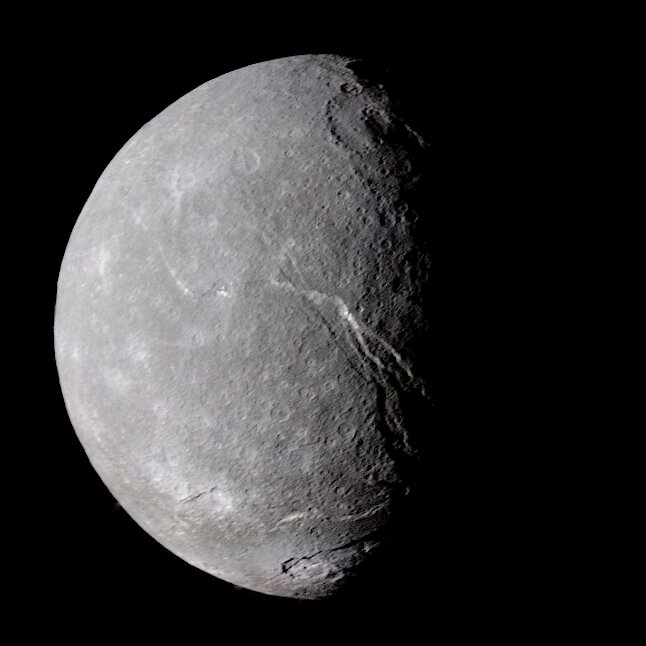
Titania, the largest moon of Uranus, takes its name from the fairy queen in William Shakespeare’s A Midsummer Night’s Dream. The name wasn’t assigned by the man who found it. William Herschel spotted the moon in January 1787, but it stayed nameless for over half a century until his son, John Herschel, proposed a set of literary names in 1852. That single decision set the tone for an entire moon system, and it’s the reason Uranus is the only planet in the solar system whose satellites answer to playwrights and poets rather than Greek and Roman gods.
Where Does the Name Titania Come From?
Shakespearean source
Titania is a character, not a myth. She’s the proud, stubborn queen of the fairies who spends most of the play feuding with her husband Oberon over a stolen changeling boy. The name itself carries a faint mythological echo, since Titania in Latin poetry means something close to “daughter of the Titans,” a form Ovid used. So there’s a thread back to classical antiquity, just a very thin one, stretched through Elizabethan drama.
A Midsummer Night’s Dream
The play matters here more than most people assume. Written around 1595, it’s a comedy of mistaken affections set in a moonlit wood, which is almost absurdly appropriate for naming satellites. Titania and Oberon rule that wood together. Pairing them in orbit around the same planet was a neat literary joke that has now outlived every astronomer involved.
John Herschel’s proposal
John Herschel published his suggested names in 1852, and the tradition he started is still followed by the naming committee that governs planetary features today. His reasoning was partly sentimental. His father had found two of these moons, and the younger Herschel had found nothing better to do with them than give them personalities. Frankly, I think it was the best call anyone made in nineteenth-century nomenclature.
Who Discovered Titania and When?
William Herschel, 1787
William Herschel, working with his large reflecting telescopes in England, observed Titania on January 11, 1787, six years after he had discovered Uranus itself. He found Oberon the same night. The Smithsonian’s air and space collection still marks that January anniversary, which tells you something about how much of modern planetary astronomy traces back to one man’s backyard in Slough.
Herschel later claimed to have seen four more moons. He hadn’t. Those sightings were almost certainly background stars, and nobody confirmed them.
Early designations
Before names, there were numbers, and the numbering was a mess. William Lassell, who discovered Ariel and Umbriel in 1851, assigned Roman numerals to the Uranian satellites in order of their distance from the planet, which meant Titania’s label shifted whenever someone found something closer in. Under Lassell’s final 1851 scheme, Titania settled at Uranus III and Oberon at Uranus IV, though earlier publications had used Herschel’s designations (Uranus II and IV). The historical record of these numerical designations shows just how unstable a system based on distance really is.
Consider the practical problems with numbering:
- Every new discovery closer to the planet renumbered everything outward.
- Different observers used different conventions simultaneously.
- Published papers from the same decade contradicted each other.
Path to official recognition
The International Astronomical Union eventually formalized what the Herschels and Lassell had improvised. Modern names go through a defined review and approval procedure, and once approved they land in the Gazetteer of Planetary Nomenclature, maintained jointly with the USGS. Titania was grandfathered in, essentially. It was already too entrenched to argue with.
Why Are Uranian Moons Named After Shakespeare?
Break from Greek mythology
Every other planet plays by the classical rules. Mars has Phobos and Deimos, fear and dread. Jupiter’s moons are the god’s various conquests. Uranus went sideways, literally and thematically.
Pope’s Rape of the Lock
Not all Uranian moons are Shakespearean, and this is where people trip. Umbriel and Ariel come from Alexander Pope’s mock-epic poem The Rape of the Lock, published in 1712. Ariel appears in The Tempest as well, which muddies the attribution nicely. The official naming rules and conventions describe the theme as characters from Shakespeare and Pope, not Shakespeare alone.
IAU naming rules today
The thematic categories used for planetary bodies are surprisingly rigid once a system has been established. Uranus got literature, and Uranus keeps literature. When the Voyager 2 flyby in 1986 turned up ten new moons, they all received names from the same well: Puck, Portia, Juliet, Cordelia.
How Titania Fits Among the Other Uranian Moons
They were found on the same night, they were named as a married couple, and they orbit as the two outermost of the five major moons. Titania has a diameter of about 1578 km, making it roughly half the size of Earth’s Moon and comfortably the largest object orbiting Uranus.
| Moon | Namesake source |
|---|---|
| Titania | A Midsummer Night’s Dream |
| Oberon | A Midsummer Night’s Dream |
| Umbriel | The Rape of the Lock |
| Ariel | Pope and The Tempest |
| Miranda | The Tempest |
The Uranian system currently stands at 29 confirmed satellites, though smaller ones keep surfacing in reanalyzed imagery. The most recently discovered, S/2025 U 1, was identified in February 2025 by the James Webb Space Telescope and announced in August 2025; it is estimated to be only 8–10 km across and awaits a formal name. The system’s smaller inner moons and their surface features are all catalogued in the same government nomenclature records that track the major five.
Common Mix-Ups About Titania’s Name
Titania is frequently confused with Titan, Saturn’s enormous moon with a thick nitrogen atmosphere, and the confusion is understandable given how similar the two names look. They share no relationship beyond a Titan-adjacent etymology, and the surface mapping references for Titan belong to an entirely different body of research.
What Titania’s Name Tells Us About Science and Culture
Naming is never neutral. A Folger Shakespeare Library discussion on the literary moons of Uranus makes the point better than I can: the choice embedded English drama into the permanent vocabulary of astronomy, and it did so at a moment when British science was busy defining itself. Astronomical journalism covering Titania’s fairy queen background often frames this as whimsy. It’s more than that. It’s a small proof that the people cataloguing the sky were also readers, and that measurement and imagination were never really separate activities.
FAQ
Who named Titania?
John Herschel, in 1852, sixty-five years after his father found it.
Is Titania the largest moon of Uranus?
Yes, at about 1578 km across.
Are all Uranian moons Shakespearean?
No. Two of the majors, Umbriel and Ariel, draw on Alexander Pope.
Conclusion
Titania’s name is a two-generation story: a father who found a faint point of light in 1787, and a son who gave it a queen’s identity decades later. That literary detour has held for nearly two centuries, and every new Uranian moon still gets pulled from the same shelf of English poetry and drama. Explore the Uranian system long enough and you start reading it like a cast list.
Would you like to receive similar articles by email?

Paul Tomaszewski
Paul Tomaszewski is a science & tech writer as well as a programmer and entrepreneur. He is the founder and editor-in-chief of CosmoBC. He has a degree in computer science from John Abbott College, a bachelor's degree in technology from the Memorial University of Newfoundland, and completed some business and economics classes at Concordia University in Montreal. While in college he was the vice-president of the Astronomy Club. In his spare time he is an amateur astronomer and enjoys reading or watching science-fiction. You can follow him on LinkedIn and Twitter.


You May Also Like
How Did Saturn Get Its Name
Space Technology Will Protect the Vatican’s Treasures