How Did Saturn’s Moon Tethys Get Its Name
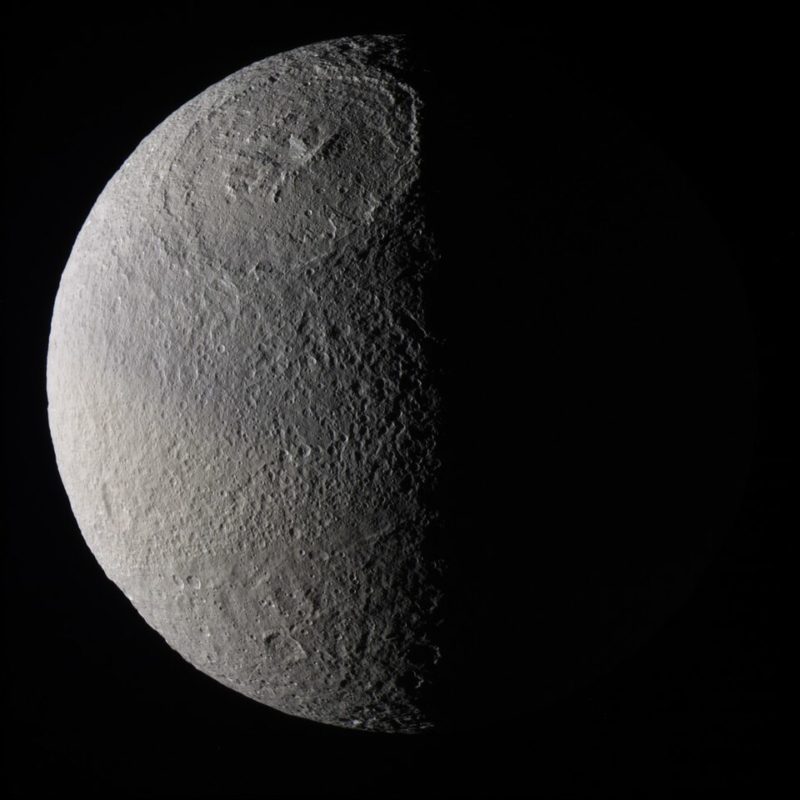
The moon Tethys got its name from a Titaness in Greek mythology, a watery goddess who fit perfectly with the wet, icy nature of Saturn’s family of satellites. The English astronomer John Herschel proposed the name in 1847, more than a century and a half after the moon was first spotted. Before that, this bright ball of ice went by the rather forgettable label “Saturn III.”
This article walks through the mythological roots of the name, the discovery itself, and how the naming conventions for Saturn’s moons came to hang together as a coherent story.
Who Was Tethys in Greek Mythology?
She was one of the old gods. Not an Olympian, but something older and stranger.
Titaness Origin
Tethys belonged to the generation of Titans, the children of Uranus (the sky) and Gaia (the earth). That makes her a sibling of Kronus, the Titan the Romans knew as Saturn. Her name, according to the detailed accounts of the Titaness Tethys, carries a sense of “nurse” or “grandmother,” which tells you a lot about how the Greeks saw her: not a warrior, but a nurturer, a source of life-giving water.
Oceanus Connection
Tethys married her brother Oceanus, the primordial river that the ancients believed encircled the whole world. Together they produced the Oceanids, thousands of water nymphs, plus the great rivers of the earth. So when astronomers went looking for a name for a small, ice-covered world made almost entirely of frozen water, a goddess whose entire mythology drips with oceans and springs felt like an obvious choice.
Mythological Legacy
Her legacy stretched well beyond the myths. Geologists borrowed her name for the ancient Tethys Ocean, and the adjective “Tethyan” still shows up in earth science today. That’s the funny thing about these old names. They keep echoing across totally unrelated fields, from the water nymphs of Homer’s verse all the way to a moon orbiting a gas giant hundreds of millions of miles away.
Who Discovered Tethys and When?
Giovanni Cassini
The moon owes its discovery to Giovanni Domenico Cassini, the Italian-French astronomer whose name would later grace the famous NASA and Italian Space Agency mission that spent years studying the Saturn system. Cassini was no casual observer. He found four of Saturn’s major moons, Tethys among them, alongside Rhea, Dione, and Iapetus.
1684 Observation
Cassini logged the discovery of Tethys on March 11, 1684. He was using an aerial telescope, one of those absurdly long instruments with the lens mounted far away from the eyepiece, which was the cutting-edge tech of the day. Given the equipment, spotting a moon roughly 1062 km across from that distance was genuinely impressive work.
Paris Observatory
The observations came out of the Paris Observatory, where Cassini served as director. He didn’t name the moon after himself or after mythology, though. Instead he called his four discoveries the Sidera Lodoicea, or “Stars of Louis,” a bit of flattery aimed at his royal patron, King Louis XIV. For the next 150-odd years, working astronomers simply numbered the satellites, and this one was known as Saturn III.
How Did Tethys Get Its Name?
John Herschel
The clean numerical system got messy fast. Every time someone found a new moon closer to the planet, the numbers had to shift. John Herschel, son of the astronomer who discovered Uranus, decided the whole thing needed a proper mythological scheme.
1847 Proposal
In his 1847 publication of astronomical observations, Herschel laid out names for the Saturnian moons, pulling Tethys straight from the family of Titans. The proposal stuck. Astronomers were relieved to have something memorable, and the numbers quietly faded into footnotes.
Titan Theme
Herschel’s logic had a certain elegance. Since Saturn was the Roman version of Kronus, king of the Titans, it made sense that the moons should carry the names of his mythological brothers and sisters. Tethys, as a fellow Titan, slotted right in.
How Are Saturn’s Moons Named?
That 1847 decision set a precedent the International Astronomical Union still honors. The naming isn’t a free-for-all. There’s a framework:
- Titans and Giants provide the primary source. The regular moons of Saturn take names from the Titans and their descendants, keeping the theme tied to Kronus.
- IAU rules govern all official designations today, so nobody can just slap a name on a newly found satellite without approval.
- Roman alternatives and figures from other mythologies fill in for the growing crowd of smaller, irregular moons, since the Greek Titans eventually run out.
Surface features get their own theme. The craters and valleys on Tethys draw from Homer’s Odyssey, which is why the moon’s most dramatic scar is called the Odysseus crater.
Where Tethys Fits Among Saturn’s Moons
Tethys is one of the major inner moons, orbiting between Enceladus and Dione, with the tiny co-orbital (trojan) moons Calypso and Telesto trailing along its path. It’s a world of almost pure water ice, which explains its extraordinary brightness. The high reflectivity of its surface makes it one of the most mirror-like objects in the solar system.
The Voyager spacecraft first gave us close-up looks, and Voyager images revealed the Ithaca Chasma, a huge valley that runs for thousands of miles. The name Ithaca, of course, ties right back to Odysseus and his long journey home.
Later, the Cassini orbiter and its Huygens spacecraft, a joint effort involving NASA, the European Space Agency, and the Italian Space Agency, mapped the surface in far greater detail during the Huygens mission era.
Naming Nuances and Common Confusions
Here’s where people trip up. Tethys the Titaness is not the same as Thetis, the sea-nymph who mothered Achilles in the Iliad. Different goddess, similar-sounding name. The moon honors the older Titaness, not the tragic mother of the warrior.
There’s also the odd visual coincidence. The massive Odysseus crater, spanning roughly 250 miles, gives Tethys a lopsided appearance that reminds a lot of folks of the Death Star from Star Wars. Fitting, maybe, that an impact this violent left behind a crater named for a hero famous for surviving impossible odds.
FAQ
Was Tethys named after the ocean or the goddess?
The moon was named after the Greek Titaness. The Tethys Ocean in geology was also named after her, so both trace back to the same mythological figure.
Why don’t Saturn’s moons have numbers anymore?
The numbered system broke down every time a closer moon turned up, so Herschel’s mythological names replaced them for clarity.
Does Tethys have geysers like Enceladus?
No. While Enceladus fires polar geysers into the magnetosphere, Tethys is geologically quiet, lacking the tidal heating that drives its neighbor’s activity.
Conclusion
The story of how Tethys got its name is really a story about how we bring order to the sky. A Titaness of the seas, a moon of almost solid ice, and an astronomer in 1847 who thought the whole system deserved a bit of poetry. Cassini found it, Herschel named it, and the Voyagers and the Cassini-Huygens mission filled in the rest. Not bad for a bright little world that spent its first 150 years known only by a number.
Would you like to receive similar articles by email?

Paul Tomaszewski
Paul Tomaszewski is a science & tech writer as well as a programmer and entrepreneur. He is the founder and editor-in-chief of CosmoBC. He has a degree in computer science from John Abbott College, a bachelor's degree in technology from the Memorial University of Newfoundland, and completed some business and economics classes at Concordia University in Montreal. While in college he was the vice-president of the Astronomy Club. In his spare time he is an amateur astronomer and enjoys reading or watching science-fiction. You can follow him on LinkedIn and Twitter.


You May Also Like
What Causes Dips in Exoplanet Reflected Light Curves
Stargazing Calendar for August 2026