How Did Dwarf Planet Sedna Get Its Name
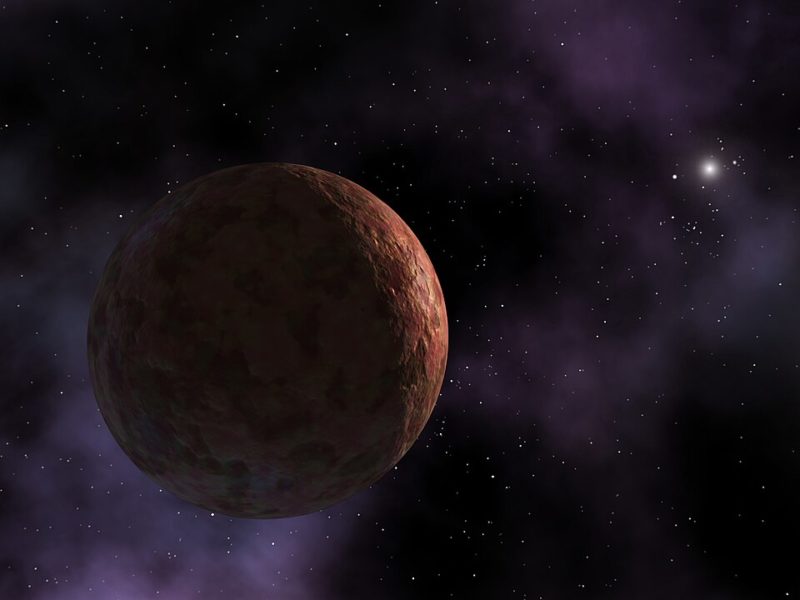
Sedna got its name from Sedna, the Inuit goddess associated with the sea and marine animals. The name was proposed by astronomer Mike Brown shortly after his team discovered the distant solar system object in 2003, then formally accepted by the International Astronomical Union in 2004. It suited the object’s strange identity: extremely remote, intensely cold, and moving through an orbit that still leaves astronomers scratching their heads.
Sedna is often called a dwarf planet, although the International Astronomical Union has not formally placed it on an official dwarf-planet list. It is more precisely a trans-Neptunian object and a likely dwarf planet. Its official designation is (90377) Sedna.
Who Named Sedna and When?
Discovery Team
Sedna was discovered by a team led by Mike Brown of the California Institute of Technology, working with Chad Trujillo and David Rabinowitz. Their search focused on faint, distant objects beyond Neptune, where sunlight is weak and motion across the sky can be painfully slow.
The object first received the provisional designation 2003 VB12. Its discovery was announced in March 2004, after follow-up observations confirmed that the faint point of light was traveling in an unusually distant orbit. Brown’s official Sedna account explains how the Inuit sea-goddess name entered the story.
2004 Announcement
The discovery announcement described Sedna as the most distant known object in the solar system at that time. NASA’s original 2004 release noted its extraordinary distance and surface temperature, details that made the name feel almost uncannily appropriate.
The news clearly reached well beyond astronomy circles: I still remember it rippling through my high-school classrooms in 2004, teachers setting aside the day’s lesson to talk about this strange new world at the solar system’s edge. For a remote outer-system discovery, that kind of cultural footprint was rare—it was genuinely a big deal.
The discovery team publicly used “Sedna” before the standard naming procedure had fully concluded. That created a small but genuine protocol dispute, because the Minor Planet Center and the IAU normally handle official names after an object’s orbit has been established.
IAU Naming Process
The IAU later accepted Sedna as the official name in 2004. The process generally involves confirming the object’s orbit, assigning a permanent numerical designation, and submitting a culturally appropriate name under the rules of small-body nomenclature.
In Sedna’s case, the sequence looked roughly like this:
- The object was observed and given the provisional label 2003 VB12.
- Additional observations refined its orbit.
- The discovery team proposed the name Sedna.
- The IAU approved the name alongside the permanent number 90377.
The early announcement was unusual, but it did not prevent formal recognition.
What Does the Name Sedna Mean?
Inuit Sea Goddess
Sedna is a powerful figure in Inuit traditions, often described as a sea goddess or sea mother who governs marine animals. Stories vary among Inuit communities, and no single version should be treated as the only authoritative account.
In many tellings, Sedna lives beneath the Arctic Ocean and controls the availability of seals, whales, walruses, and other animals important to human survival. That relationship gives the name considerable weight. It points toward an ancient Arctic understanding of nature as something governed by forces that demand respect.
Arctic Creation Story
A widely known version of the story says Sedna becomes associated with the sea after a violent transformation involving her father and the Arctic Ocean. In some accounts, her fingers are cut off as she clings to a boat, and those fingers become sea animals.
The details differ across retellings, which matters. Inuit mythology is not a single frozen text, and the cultural meaning of Sedna reaches beyond a simple “creation myth.” The goddess represents the ocean’s abundance, danger, and moral dimension.
Cultural Significance
Astronomers chose a name connected to Inuit tradition because the object’s discovery location and physical character evoked the Arctic: remote, dark, and bitterly cold. Sedna is not merely a decorative label borrowed from folklore. She remains an important figure in Inuit cultural traditions.
Why Did Astronomers Choose Sedna’s Name?
Extreme Distance
At discovery, Sedna was roughly 8 billion miles from the Sun, far beyond Pluto. Its orbit carries it much farther still, into the realm of the inner Oort Cloud, or perhaps the population of objects that forms a bridge toward it.
The JPL Small-Body Database tracks Sedna’s orbital data and permanent designation. Its orbit is so elongated that Sedna takes approximately 11,400 years to circle the Sun.
Frigid Surface
Sedna receives very little solar energy. Its surface likely contains methane and nitrogen ices, along with darker materials such as amorphous carbon. During much of its orbit, temperatures fall to levels where familiar planetary geology becomes almost alien.
Observations from the Hubble Space Telescope helped scientists investigate its size, color, and possible atmosphere. Sedna’s surface is reddish, reflective, and remarkably isolated from the better-known planets.
Mysterious Orbit
Sedna’s orbit is the real oddity. Neptune’s gravitational influence does not fully explain its path, and no confirmed moon or nearby planet has been found to account for it. Possible explanations include an ancient stellar encounter, formation within a stellar cluster, or the influence of a long-gone planetary body.
That mystery strengthens the name. Sedna lives, metaphorically, in a cold cosmic ocean whose rules are only partly understood.
How Was Sedna Discovered?
Palomar Observatory
The discovery images came from the Samuel Oschin Telescope at Palomar Observatory in California. The telescope captured a dim object moving against the background stars during a sky survey.
Mike Brown’s Team
Brown, Trujillo, and Rabinowitz compared images taken at different times. The object’s movement revealed that it belonged to the solar system rather than being a distant star.
Distant Solar System
Sedna became one of the first recognized sednoids, a class of exceptionally distant objects with large, eccentric orbits. Its discovery pushed astronomers to reconsider where the outer solar system truly ends.
What Was Sedna Called Before Its Official Name?
Before approval, Sedna was known as 2003 VB12, its provisional designation. The nickname “Sedna” circulated publicly during the discovery announcement, even though the formal IAU process was still underway.
How Does Sedna’s Name Fit Its Classification?
Sedna is a trans-Neptunian object, meaning it orbits beyond Neptune. It is also classified as a minor planet and is widely regarded as a likely dwarf planet because its size suggests it may be massive enough to reach hydrostatic equilibrium.
Unlike a major planet, Sedna has not cleared its orbital neighborhood. That distinction separates it from Earth, Jupiter, and Neptune, while its isolation makes it far more unusual than most objects beyond Pluto.
FAQ
Who discovered Sedna?
Mike Brown, Chad Trujillo, and David Rabinowitz discovered Sedna in 2003 using observations from Palomar Observatory.
Why is Sedna important?
Sedna offers clues about the solar system’s early architecture, including possible stellar encounters and the formation of the inner Oort Cloud.
When was Sedna officially named?
The IAU approved the name Sedna in 2004, following its discovery announcement and orbital confirmation.
Is Sedna a planet?
Sedna is not officially classified as a major planet. It is generally described as a likely dwarf planet and a trans-Neptunian object.
Is Sedna colder than Pluto?
Sedna can become colder than Pluto because its orbit carries it much farther from the Sun. Its surface temperature changes substantially over its enormous orbital path.
Conclusion
Sedna was named for an Inuit sea goddess because its distant, frozen, and mysterious nature reminded astronomers of a hidden world beneath the Arctic Ocean. The name began as a discovery-team proposal, survived a minor naming-protocol controversy, and became official through the IAU in 2004. Its formal label is now (90377) Sedna, a fitting name for one of the solar system’s most enigmatic worlds.
For some of us, the name also carries a personal echo—I remember the 2004 announcement landing as a genuine event in my high-school classrooms, a reminder that even the coldest corners of the solar system can capture the public imagination.
Would you like to receive similar articles by email?

Paul Tomaszewski
Paul Tomaszewski is a science & tech writer as well as a programmer and entrepreneur. He is the founder and editor-in-chief of CosmoBC. He has a degree in computer science from John Abbott College, a bachelor's degree in technology from the Memorial University of Newfoundland, and completed some business and economics classes at Concordia University in Montreal. While in college he was the vice-president of the Astronomy Club. In his spare time he is an amateur astronomer and enjoys reading or watching science-fiction. You can follow him on LinkedIn and Twitter.


You May Also Like
List of Meteor Showers in 2026

How LIDAR Mapping the World in 3D Is Changing Exploration