How Did Dwarf Planet Quaoar Get Its Name
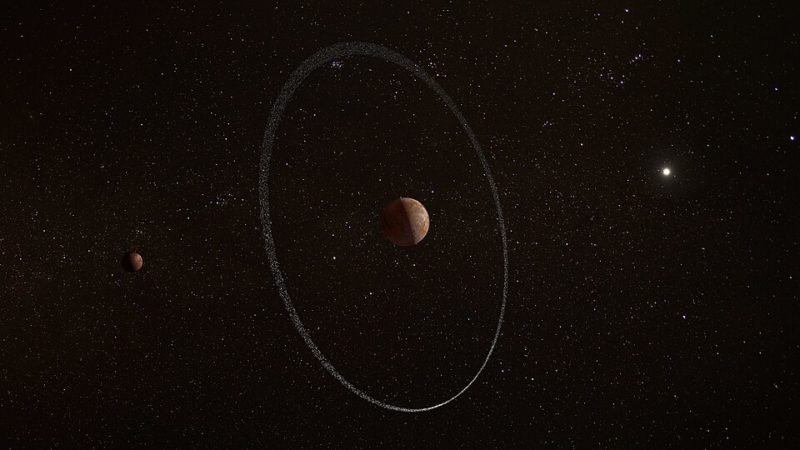
Quaoar takes its name from the creator god of the Tongva, the Indigenous people of the Los Angeles Basin, whose homeland sits within sight of the mountain where the object was found. Chad Trujillo and Michael Brown spotted it at Palomar Observatory in June 2002, and rather than reaching for Greek or Roman mythology again, they looked at the ground beneath the telescope. That single decision explains almost everything about the name, including its unusual spelling and the argument people still have over how to say it.
Where Does the Name Quaoar Come From?
Tongva creation figure
In Tongva mythology, Quaoar arrives into a formless void and brings order out of chaos. NASA’s own announcement of the Hubble measurements quoted tribal legends describing this creator figure, and the parallel is hard to miss: a body assembling itself out of the leftover planetesimals of the early solar system, named for a god who did the same thing to nothing.
Song and dance origin
The story goes that Quaoar sang and danced the other deities into existence, who in turn shaped the sky, the sea, and the land. Then came the seven giants, on whose shoulders the world was laid out. Space.com’s overview of the legend describes that sequence in more detail, and honestly, it’s a better creation myth than most.
Pronunciation and spelling
Brown himself settled on three syllables, roughly KWAH-oh-war. The original Tongva form is often rendered Kwawar, which is why you’ll see the name Kwawar floating around older references. English spelling did what English spelling does.
Who Discovered Quaoar and When?
Palomar sighting, 2002
The find came on June 4, 2002, using the 1.2 m Samuel Oschin Telescope at Palomar Observatory as part of a Caltech wide-area sky survey. The provisional designation was 2002 LM60. It was announced at an American Astronomical Society planetary science meeting on October 7, 2002.
Chad Trujillo and Michael Brown
The two American astronomers weren’t hunting this specific object so much as sweeping for anything large and slow-moving beyond Neptune. Minor planet number 50000 was picked deliberately, a round number reserved to flag a genuinely big discovery in the outer solar system.
Archival images from 1954
Once the orbit was roughly known, astronomers went digging. Precovery plates pulled the object back decades, including a May 25, 1954 Palomar plate catalogued in a long-running scientific directory of Quaoar data, which tightened the orbital solution enormously.
How the Naming Process Worked
Three things had to line up:
- Discoverers propose. Trujillo and Brown submitted the Quaoar name themselves, with the Tongva connection as their justification.
- The Minor Planet Center assigns the permanent number, in this case 50000.
- The IAU’s minor planet naming committee reviews and approves, checking the name against convention and against everything already in the catalogue.
Trans-Neptunian naming convention
The rule for non-resonant Kuiper belt objects, the cubewanos, is that they get creator deities drawn from world mythologies, a convention laid out clearly in an astronomical index of cubewano naming rules. Resonant Kuiper belt objects follow a different tradition. It’s bureaucratic, sure, but the effect is a sky map studded with names from cultures that never had observatories.
Physical and Orbital Profile
| Property | Value |
|---|---|
| Mean diameter | roughly 1,086 to 1,121 km |
| Orbital distance | about 43.5 astronomical units, nearly circular |
| Orbital period | roughly 288 years |
| Moon | Weywot |
| Rings | Q1R and Q2R |
Early Hubble Space Telescope work put the diameter near 1,287 km, later revised downward. The surface shows crystalline water ice and traces of ammonia hydrate, which shouldn’t survive billions of years of radiation without resurfacing. Its low albedo and modest apparent magnitude mean you’re not seeing it in a backyard telescope.
Classification Status as a Dwarf Planet
The IAU has never formally added it to the dwarf planet list, so Quaoar sits as a probable dwarf planet, sometimes written as likely dwarf planet in the literature. The hydrostatic equilibrium question is the sticking point. Density estimates and shape data from stellar occultations suggest something slightly flattened, not cleanly relaxed.
Compared with the dwarf planet Pluto, it’s roughly half the diameter and far less massive, with no substantial atmosphere. Makemake is the closer analogue, though Makemake holds a formal designation Quaoar lacks. The distinction matters less than people think. Categories are tools we sharpen as our instruments improve, not fences nature agreed to.
Weywot and the Ring System
Moon named by tradition
The small moon turned up in Hubble images taken February 14, 2006, and carries the formal designation (50000) Quaoar I. The Planetary Society’s account of the 2009 naming describes how Weywot, the sky god and son of Quaoar in Tongva tradition, was chosen in consultation with Tongva representatives rather than imposed from outside.
Rings outside the Roche limit
Then 2023 broke a rule. Observations of stellar occultations between 2018 and 2021 revealed the Q1R ring orbiting at about 7.4 planetary radii, roughly twice the Roche limit, where icy particles should have coalesced into a moon long ago. A second dense ring arc, Q2R, followed. Coverage of the occultation campaign that found the ring underlined how strange the geometry is.
What the rings reveal
Possibly a 1:3 orbit resonance with Quaoar’s spin holds the particles apart. Possibly the collisions out there are too gentle, at those temperatures, for accretion to work at all. Either way, textbook Roche limit math for Saturn and Uranian systems just got a caveat.
FAQ
Is Quaoar officially a dwarf planet?
Not formally. The IAU treats it as a possible dwarf planet.
Can I see it?
Only with large telescopes.
Why naming choices matter beyond astronomy?
Every name we hang on a tiny object ~6.5 billion km out (43.5 AU) writes a little more of humanity into the map. Science is a human enterprise built on stories as much as spectra.
What Quaoar still tells scientists about the Kuiper Belt?
Each measurement is a patch to the model: density constrains the core boundary, ammonia hints at cryovolcanism, rings rewrite accretion theory.
Conclusion
A creator god, a moon, a ring that shouldn’t exist. Not bad for a magnitude 19 object nobody knew until 2002.
Would you like to receive similar articles by email?

Paul Tomaszewski
Paul Tomaszewski is a science & tech writer as well as a programmer and entrepreneur. He is the founder and editor-in-chief of CosmoBC. He has a degree in computer science from John Abbott College, a bachelor's degree in technology from the Memorial University of Newfoundland, and completed some business and economics classes at Concordia University in Montreal. While in college he was the vice-president of the Astronomy Club. In his spare time he is an amateur astronomer and enjoys reading or watching science-fiction. You can follow him on LinkedIn and Twitter.


You May Also Like
Did you know? The Moon has an Atmosphere
Stargazing Calendar for February 2026