How Did Neptune’s Moon Proteus Get Its Name
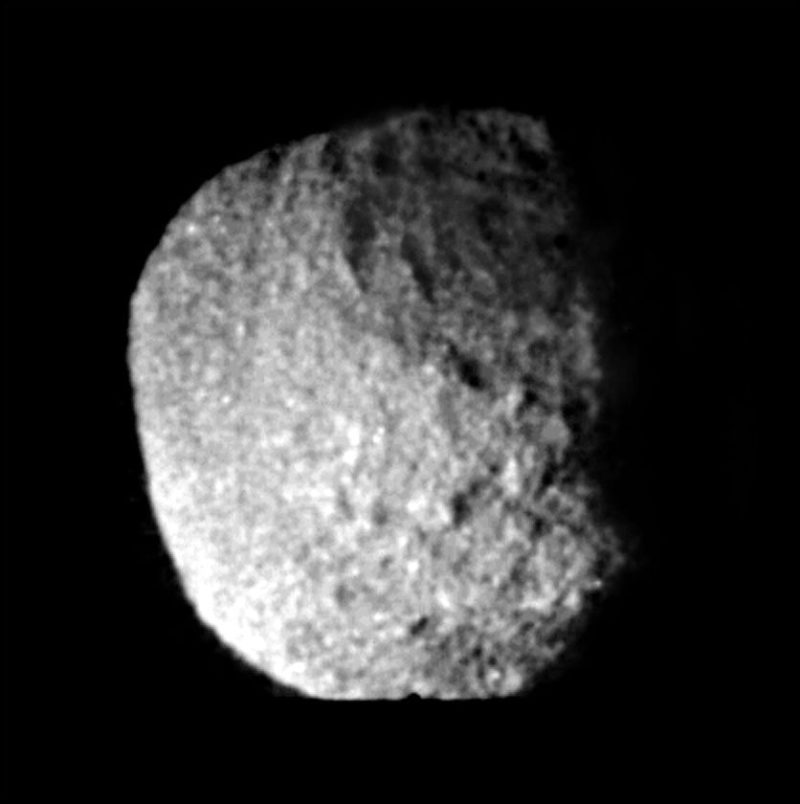
Neptune’s second-largest moon and the planet’s largest inner satellite carries the name Proteus because of a shape-shifting sea god from Greek mythology, and the label was made official by the International Astronomical Union on September 16, 1991. Before that it went by the clunky provisional designation S/1989 N 1, a placeholder stamped on it after the Voyager 2 imaging team spotted the object in June 1989.
The name fits almost too neatly. A lumpy, irregular moon orbiting the planet named for the god of the sea, named in turn after the one sea deity famous for never holding a single form.
Where Does the Name Proteus Come From?
Shape-Shifting Sea God
Proteus appears in Homer’s Odyssey as the old man of the sea who twists into a lion, a serpent, a leopard, running water, even a tree, all to avoid answering questions. Pin him down and he tells the truth. That stubborn slipperiness gave English the word “protean,” and the classical literature record of his attributes and offspring lineage keeps that reputation intact across centuries of retelling.
Herdsman of Poseidon’s Seals
He was no minor figure. In most versions he tends Poseidon’s seals along the Egyptian coast, a herdsman for the sea god’s flock, which places him squarely inside the household of the Olympian who rules the ocean.
Link to Neptune’s Family
Neptune is Poseidon’s Roman equivalent, so any satellite orbiting that planet needs a name drawn from that same watery mythology. Proteus qualified twice over: undersea deity, and a servant of Poseidon himself.
How the Name Became Official
Provisional Label S/1989 N 1
New moons get temporary designations first. The “S” means satellite, 1989 the year of detection, N for Neptune, 1 for the first found that year. Ugly, functional, and temporary.
IAU Approval in 1991
Two years of orbital confirmation later, the name cleared the IAU’s Working Group for Planetary System Nomenclature. The rules governing how planetary bodies and satellites get named are published openly by the USGS, and they are stricter than most people assume:
- Names must not duplicate existing ones anywhere in the solar system.
- They must fit the established theme for that planet’s system.
- Commercial and overtly political names are rejected outright.
- Approval requires a vote, not a discoverer’s whim.
Greek Water Deity Convention
Every Neptunian moon follows the same thread, something the Planetary Society has walked through in its commentary on marine mythological naming: Triton, Nereid, Larissa, Galatea, Despina, Thalassa, and the more recent Hippocamp all pull from sea nymphs, river gods, and Poseidon’s tangled family tree.
Who Discovered Proteus and When?
Voyager 2 Flyby
Voyager 2 reached Neptune in August 1989, and the moon turned up in images taken weeks before closest approach. NASA’s retrospective on that flyby captures how much the probe found in a matter of days after twelve years in transit. The discovery was announced July 7, 1989, based on images from June 16.
Stephen Synnott’s Detection
Stephen P. Synnott, working with imaging team lead Bradford Smith, made the identification from the spacecraft’s returned frames. The announcement in 1989 credited the pair, though the actual discovery date depends on which image you count as the first unambiguous one.
Why Telescopes Missed It
At roughly 416 km across, Proteus is bigger than Nereid. So why did nobody see it from Earth for 143 years after Neptune’s discovery?
- Its surface reflects about 6 percent of visible wavelengths of sunlight, ranking it among the darkest objects in the solar system.
- It orbits close in, barely 117,600 km out, drowned in Neptune’s glare.
- Ground-based resolution simply could not separate the two.
Physical Traits Measured by Voyager 2
Size and Irregular Shape
Proteus sits right at the boundary where gravity should start pulling a body into a sphere, yet it stayed an odd box, faceted and lopsided. NASA’s factsheet on the moon puts it as one of the largest known non-spherical objects in the solar system.
Dark, Low-Reflectivity Surface
Charcoal dark, spectrally flat, no sign of geological resurfacing. Whatever ice sits under that crust hasn’t reached the surface in a very long time.
Pharos Crater
A single basin roughly 255 km wide dominates one hemisphere. Pharos crater geometry shows a scar so large that the impact nearly shattered the moon.
Orbit and Motion Around Neptune
Prograde, near-circular, and hugging the equatorial plane. One trip takes about 1.12 days (sidereal period 1.1223 days), which makes it the slowest of the inner moons compared to Galatea and Despina. Tidal drag from Neptune is slowly nudging it outward.
What Proteus Reveals About Its Violent Past
My honest read: this is not a primordial, fully formed body. It looks like a second-generation moon, reassembled from a debris disk after Triton’s capture wrecked the original satellite system. The Pluto-Charon system shows how small differences in formation history produce wildly different geology, and Proteus reads the same way. Hippocamp, discovered in 2013 by Mark Showalter using Hubble archival images, is believed to be a fragment chipped from Proteus by a comet impact billions of years ago.
What Future Missions Could Confirm
An orbiter with modern spectrometers could test whether the surface composition matches Triton’s, which would settle the capture-debris hypothesis. Density measurements would help too. Right now the mass estimate is soft.
FAQ
Is Proteus visible from Earth?
Not through amateur equipment. Hubble struggles with it. At roughly magnitude 19.7, it is far below the threshold of even large backyard telescopes.
Does the name have a Roman version?
No. The IAU kept the Greek form.
Conclusion
The name Proteus—after a shape-shifter who only reveals truth when pinned down—feels almost deliberate for a moon that defied easy observation for over a century and still refuses to settle into a sphere. Sometimes the nomenclature committees get lucky.
Would you like to receive similar articles by email?

Paul Tomaszewski
Paul Tomaszewski is a science & tech writer as well as a programmer and entrepreneur. He is the founder and editor-in-chief of CosmoBC. He has a degree in computer science from John Abbott College, a bachelor's degree in technology from the Memorial University of Newfoundland, and completed some business and economics classes at Concordia University in Montreal. While in college he was the vice-president of the Astronomy Club. In his spare time he is an amateur astronomer and enjoys reading or watching science-fiction. You can follow him on LinkedIn and Twitter.


You May Also Like
Orion Constellation Guide
How To Start An Astronomy Club