How Did Neptune’s Moon Nereid Get Its Name
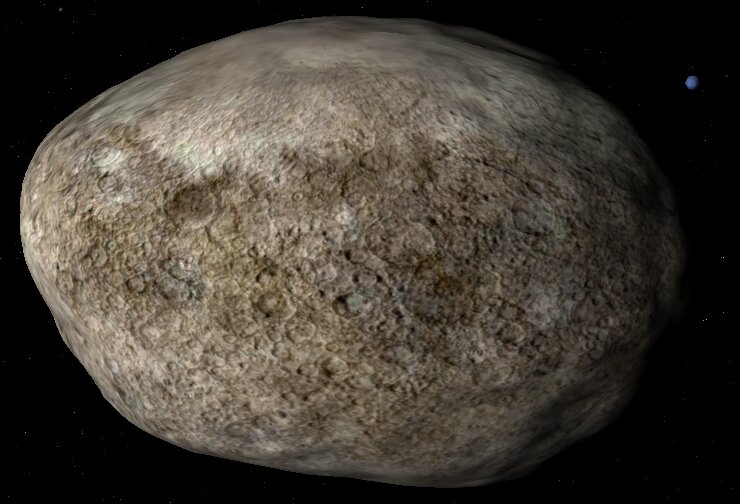
Neptune’s moon Nereid takes its name from the Nereids, the fifty sea nymphs of Greek mythology who served as attendants to Poseidon, the sea god whose Roman counterpart is Neptune. Gerard P. Kuiper spotted the moon on photographic plates on May 1, 1949, and proposed the name himself, keeping faith with a convention that ties every Neptunian satellite to the mythology of water. The name stuck. The International Astronomical Union later formalized it, and Nereid has carried it for more than seventy-five years.
Where Does the Name Nereid Come From?
Sea nymphs of Greek myth
The Nereids were daughters of Nereus, the old man of the sea, and the Oceanid Doris. They lived in the depths of the Mediterranean, rode dolphins, calmed storms, and generally attended to the moods of the ocean. Thetis, mother of Achilles, was one of them. Amphitrite, wife of Poseidon, was another. So this is not a minor bit of mythological trivia dredged up to fill a naming slot.
Link to Neptune
Neptune, the Roman sea god, inherited Poseidon’s court when the Romans absorbed Greek myth wholesale. A planet named for the ocean deserved oceanic company. NASA’s own profile of the moon notes the sea-nymph lineage plainly, and the logic is almost embarrassingly tidy: a distant blue world, attended by nymphs.
Plural to singular shift
Here’s the quirk. The Nereids were a group, always plural, never one. Kuiper had to singularize a collective noun to name a single body. English handled it fine. Latin scholars might wince.
Who Discovered and Named It?
Gerard Kuiper, 1949
Kuiper was working at McDonald Observatory in West Texas when he found it, and the story of that May 1 discovery has been retold by Astronomy Magazine’s account of Kuiper spotting Nereid, which credits him with proposing the name after the water nymphs who attended Neptune. He was the same astronomer whose name now hangs on the Kuiper Belt, a region that keeps circling back into this moon’s story.
Photographic plate evidence
No CCDs. No adaptive optics. Just glass plates, long exposures, and a patient eye comparing star fields for something that moved. Nereid is faint, roughly magnitude 19, and it sat unnoticed for a century after Triton because nobody had the sensitivity to catch it. The archival record of the McDonald Observatory plates shows how thin the margin was.
Official IAU adoption
Names proposed by discoverers still pass through committee. The USGS gazetteer of planetary nomenclature documents how the IAU vets and approves satellite names, and outer-planet task groups have been managing this since the 1970s. Kuiper’s suggestion was accepted because it fit the theme already in place.
Naming Convention for Neptune’s Satellites
Every moon of Neptune answers to some water deity, nymph, or sea-associated figure from Greek myth. That is the rule, and the IAU’s published nomenclature guidelines spell out how satellite themes extend from the parent planet’s mythology.
- Triton, found by William Lassell in 1846, weeks after Neptune itself, named for Poseidon’s merman son.
- Proteus, the shape-shifting sea prophet, discovered by Voyager 2 in 1989.
- Halimede, Sao, Laomedeia, Psamathe, Neso, all discovered between 2002 and 2003, all drawn from the same watery roster.
The later additions, mostly small irregular satellites on distant and often retrograde orbits, followed the pattern without fuss. Consistency across decades is rarer in astronomy than you might think.
What Makes Its Orbit So Unusual?
Nereid’s eccentricity is about 0.75, which is extreme for a moon and closer to what you’d expect from a comet. At closest approach it sits roughly 1,400,000 km from Neptune. At its farthest, nearly 9.7 million. One lap takes about 360 days, so a Nereidian month is almost an Earth year, which is a coincidence I find delightful and useless.
The capture hypothesis explains most of it. When Triton was seized by Neptune’s gravity, that violent event scrambled the original moon system, and Caltech researchers examining Nereid’s eccentric orbit have modeled how a surviving body would end up flung onto exactly this kind of path. Recent JWST observations have deepened the argument that Nereid may be the intact leftover of Neptune’s earlier satellite family. A 2026 Science Advances study using JWST NIRSpec spectroscopy and dynamical simulations concluded Nereid’s composition is inconsistent with a captured Kuiper Belt origin, favoring in-situ formation as a regular satellite.
Physical Traits Behind the Name
About 340 km across, irregular in shape, and reflecting roughly 24 percent of the light hitting it. Water ice shows up in its spectrum. Voyager 2 flew past in 1989 but never got close, imaging Nereid from around 4.7 million km away, so the best pictures remain a handful of blurry pixels. Coverage of Nereid’s physical traits and orbit fills in what ground-based work has added since.
FAQ
Was Nereid the second moon of Neptune found?
Yes, 103 years after Triton.
Is Nereid a captured Kuiper Belt object?
Possibly, though current work leans toward it being an original Neptunian moon whose orbit was wrecked by Triton’s arrival.
Conclusion
A Dutch-American astronomer squinting at photographic plates in Texas gave a lonely, wildly eccentric rock the name of Greek sea nymphs. Seventy-five years on, the science has caught up with the poetry.
Would you like to receive similar articles by email?

Paul Tomaszewski
Paul Tomaszewski is a science & tech writer as well as a programmer and entrepreneur. He is the founder and editor-in-chief of CosmoBC. He has a degree in computer science from John Abbott College, a bachelor's degree in technology from the Memorial University of Newfoundland, and completed some business and economics classes at Concordia University in Montreal. While in college he was the vice-president of the Astronomy Club. In his spare time he is an amateur astronomer and enjoys reading or watching science-fiction. You can follow him on LinkedIn and Twitter.


You May Also Like
Delta Aurigid Meteor Shower Guide

Building a Greener Future: Steps to Becoming an Eco-Friendly Business