How Did Uranus’ Moon Miranda Get Its Name
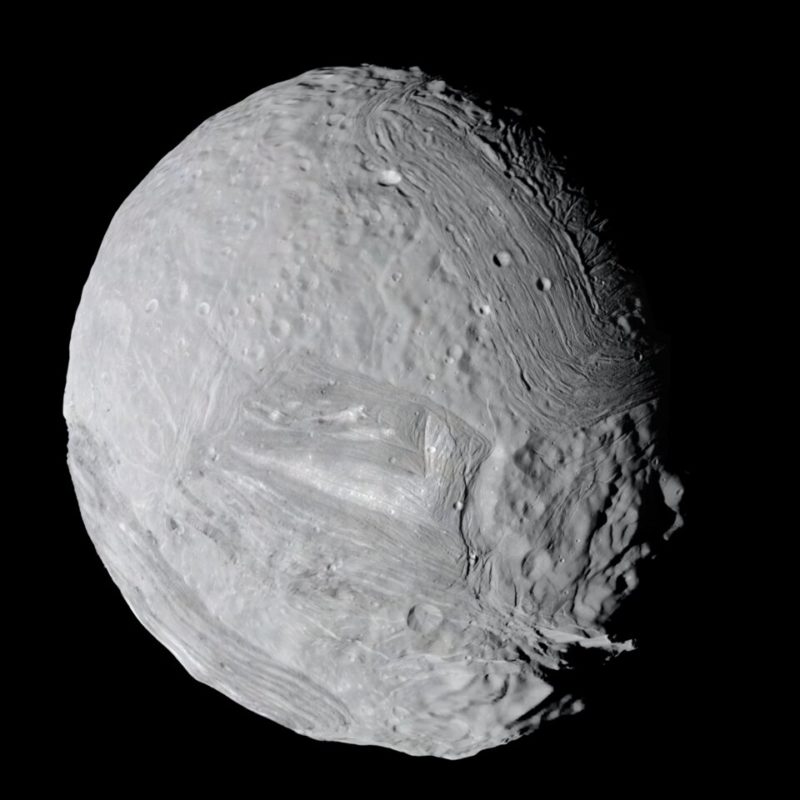
Miranda got its name from the daughter of Prospero in William Shakespeare’s The Tempest, and the man who picked it was Gerard Kuiper, the Dutch-American astronomer who spotted the moon on photographic plates in February 1948. That’s the short answer.
The longer answer is far more interesting, because it involves a stubborn family tradition, a poet named Alexander Pope, and a naming scheme at Uranus that deliberately snubs Greek and Roman mythology.
Most planetary satellites in the solar system carry mythological baggage. Jupiter’s moons are Zeus’s conquests. Neptune’s are sea deities. Uranus went a completely different direction, and the reason for that oddity is worth digging into.
Who Named Miranda and Why?
Gerard Kuiper’s choice
Kuiper wasn’t just cataloging a faint dot. He was extending a lineage. When he published his findings in the Publications of the Astronomical Society of the Pacific in 1949, he explained his reasoning plainly, and the account in this retrospective on the seventieth anniversary of the discovery preserves his own words about why he stuck with the Shakespearean pattern rather than reaching for a Greek name.
Shakespeare’s “The Tempest”
Miranda is Prospero’s daughter, raised on an island, sheltered from the world. Her famous line, “O brave new world, that has such people in’t,” is probably the most quoted thing in the play. She is also, notably, human. Ariel is a spirit. Puck is a fairy. Titania and Oberon are fairy royalty. As EBSCO’s overview of the moon points out, Miranda sits in a slightly different category among the Uranian moons for exactly that reason.
Miranda’s character link
Kuiper picked a name for a small, unremarkable-looking speck of light. Thirty-eight years later, Voyager 2 revealed a world that looked like it had been smashed and glued back together. The irony is delicious. A character defined by innocence, attached to the most violently scarred surface in the whole Uranus satellite system.
The Shakespeare and Pope Naming Convention at Uranus
William Herschel’s Break From Myth
William Herschel found Uranus in 1781 and then found two moons in 1787. He didn’t name them Shakespeareanly. His son did.
John Herschel’s Ariel and Umbriel
In 1852, John Herschel proposed Ariel, Umbriel, Titania, and Oberon. Two come from The Tempest, two from Shakespeare’s A Midsummer Night’s Dream, and Umbriel comes from Alexander Pope’s The Rape of the Lock. The choice deliberately sidestepped the classical pantheon, and the folks at the Folger Shakespeare Library have unpacked why an astronomer reached for English literature instead of the usual suspects. A broader look at how the tradition took hold and stuck traces the same thread.
Modern IAU Approvals
The International Astronomical Union now formalizes everything. Every subsequent Uranian moon, including the tiny outer moons found by Voyager and by ground-based surveys, follows the literary rule. NASA’s roster of the Uranus moons lists them all, and you’ll notice not one Greek deity in the bunch.
Here’s how the convention differs from the rest of the neighborhood:
- Jupiter: lovers and descendants of Zeus/Jupiter
- Saturn: Titans, Gallic, Inuit, and Norse giants
- Uranus: characters from Shakespeare and Alexander Pope
- Neptune: Greek and Roman water deities
- Pluto: underworld figures
How Was Miranda Discovered in 1948?
McDonald Observatory Observations
Kuiper used the 82-inch Otto Struve Telescope at McDonald Observatory in West Texas on the night of February 16, 1948. He was photographing the Uranian satellites when an unknown bright spot turned up on his plates. Astronomy magazine’s account of that night tells the story well, and the specifics of the instrument itself explain why an 82-inch reflector was needed to catch something that faint.
Confirmation and Designation
Follow-up plates confirmed it was orbiting. Miranda became Uranus V, the fifth confirmed satellite, and the first new major moon found at the planet in nearly a century. It’s the smallest and innermost of the five major moons, roughly 472 km across.
| Major moon | Discovery year | Discoverer | Literary source |
|---|---|---|---|
| Titania | 1787 | William Herschel | A Midsummer Night’s Dream |
| Oberon | 1787 | William Herschel | A Midsummer Night’s Dream |
| Ariel | 1851 | William Lassell | The Tempest |
| Umbriel | 1851 | William Lassell | The Rape of the Lock |
| Miranda | 1948 | Gerard Kuiper | The Tempest |
Voyager 2’s 1986 Flyby
Voyager 2 passed within about 29,000 km of Miranda. The images came back showing coronae, enormous fault scarps, terraced layers, and cratered terrain slammed up against smooth young surfaces with no gradual transition. Phys.org’s description of it as a “Frankenstein moon” is not hyperbole.
How Are Miranda’s Surface Features Named?
Coronae and Rupes
Surface features on Miranda draw from Shakespearean geography and characters. The coronae, those vast oval structures with concentric ridges, carry names like Arden, Elsinore, and Inverness. Forest, castle, castle. All lifted from the plays.
Craters and Regiones
Impact craters take character names. Alonso, Ferdinand, Gonzalo, Prospero, Stephano, Trinculo. Regiones follow the same rule.
Verona Rupes
The tallest known cliff in the solar system. Estimates put it somewhere between 5 and 20 km high, dwarfing the Grand Canyon by an absurd margin. Named after Verona, the setting of Romeo and Juliet.
Naming Rules the IAU Applies to Moons
The IAU Working Group for Planetary System Nomenclature approves both moon names and surface feature names. Discoverers propose, the committee vets. Names must avoid duplication, political or religious controversy, and living persons. Once a name is ratified, it’s permanent.
Why Miranda’s Name Fits Its Fractured Surface
Prospero conjures a storm that wrecks a ship. Miranda watches. The moon named for her looks like it survived something comparable, whether that was a colossal collision that shattered and reassembled it, or partial differentiation driven by tidal heating and compressional tectonics. Numerous ridges, salient angles, valleys cutting through cratered regions. The debate over which mechanism produced that geologic history is still live.
Miranda and Ariel as Future Mission Targets
Frankly, I think mission planners undersell these two. Miranda’s rugged topography and Ariel’s likely icy subsurface make them a natural pair for testing landing stability, mobility across jagged terrain, and power management in shadow-heavy environments. Send one spacecraft, get two radically different engineering problems. That’s not a poster shot. That’s a blueprint for how deep-space missions to distant worlds should be designed.
FAQ
Was Miranda named after a mythological figure?
No. It’s the Shakespeare-and-Pope convention, not mythology.
Who first suggested the literary theme?
John Herschel, in 1852.
Why did Kuiper get to name it?
Discoverers traditionally propose names, subject to IAU approval.
Conclusion
A Dutch-American astronomer at a Texas telescope reached across three centuries and pulled a name out of an English play, because a British astronomer’s son had set the pattern a hundred years earlier. Then a spacecraft showed up in 1986 and made the name look prophetic. The rest of the moon’s story is still being written.
Would you like to receive similar articles by email?

Paul Tomaszewski
Paul Tomaszewski is a science & tech writer as well as a programmer and entrepreneur. He is the founder and editor-in-chief of CosmoBC. He has a degree in computer science from John Abbott College, a bachelor's degree in technology from the Memorial University of Newfoundland, and completed some business and economics classes at Concordia University in Montreal. While in college he was the vice-president of the Astronomy Club. In his spare time he is an amateur astronomer and enjoys reading or watching science-fiction. You can follow him on LinkedIn and Twitter.


You May Also Like
NASA Astronaut Victor Glover: From Naval Aviator to Artemis II Pilot
How Did Uranus’ Moon Oberon Get Its Name