How Did Saturn’s Moon Mimas Get Its Name
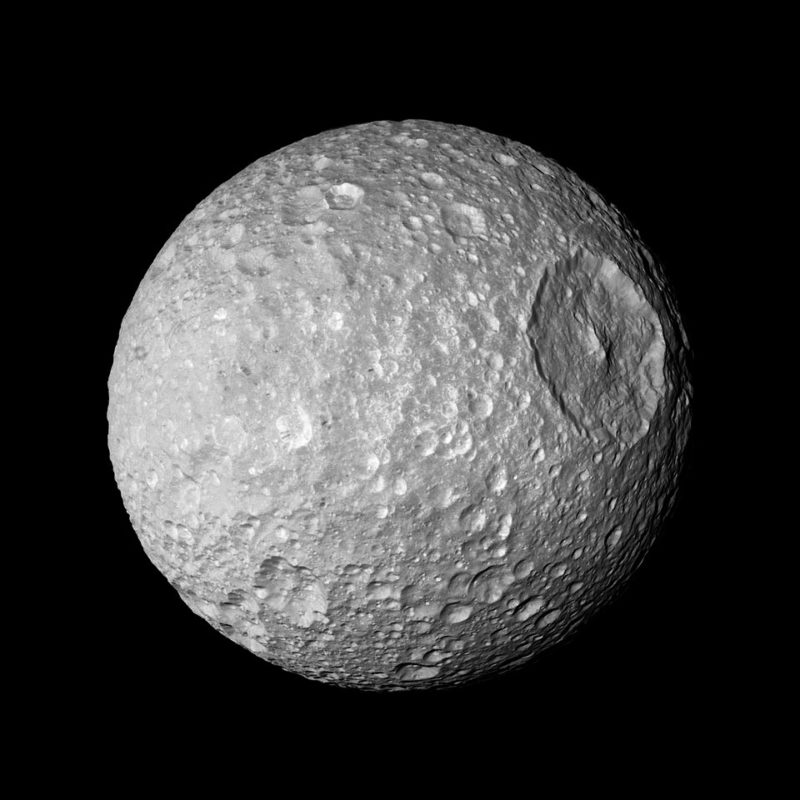
Ever squinted at a photo of Mimas and thought, “wait, that’s the Death Star”? You’re not alone. But long before George Lucas gave us a planet-killing space station, this little moon of Saturn carried a name pulled straight from the bloody battlefields of Greek mythology. The moon Mimas got its name from a Giant of Greek legend, a member of the Gigantes who was slain in the war between the gods and the giants. The name was proposed by the English astronomer John Herschel in 1847, long after his father, William Herschel, had actually spotted the moon through a telescope in 1789.
That’s the short version. The longer story, though, is where it gets good.
How Did the Moon Mimas Get Its Name?
Greek Mythological Root
The name comes from Greek mythology, specifically from the Gigantes, that unruly race of giants born from Gaia, the Earth herself. Mimas was one of them. When John Herschel sat down to sort out the messy naming situation for Saturn’s moons, he leaned into a theme. Saturn, after all, is the Roman version of Cronus, ruler of the Titans. So it made poetic sense to surround him with Titans and Giants from the old stories.
Giant Slain by Hercules
In the Titanomachy, the great clash between the Olympians and the older powers, Mimas the Giant met a grisly end. Depending on which version of the myth you read, he was struck down by Ares, or Hercules, or Zeus himself with a thunderbolt. Not a great career, honestly. But immortality came anyway, just not the way he probably imagined it, orbiting a gas giant hundreds of millions of kilometers from Earth.
Symbolism Behind the Choice
Why a Giant, though? Here’s what I find kind of clever. Herschel picked mythological figures with direct family ties to Saturn/Cronus, creating a coherent set rather than a random grab-bag of names. The seven original moons, according to the International Astronomical Union planetary names database, formed a mythological household of sorts. Mimas, Enceladus, Tethys, Dione, Rhea, Titan, and Iapetus. Each one earned its place because it belonged to the same cosmic family tree.
Who Discovered This Saturnian Moon?
William Herschel
The English astronomer William Herschel found Mimas. Same guy who discovered Uranus, which already made him a legend in astronomy circles. He was obsessive about building bigger, better instruments, and that obsession paid off when it came to spotting faint objects buried in Saturn’s glare.
Year of Discovery
The date was September 17, 1789. To put that in perspective, the French Revolution was in full swing and the United States had just ratified its Constitution. Herschel logged Mimas and its sister moon Enceladus within days of each other, a remarkable double find for the era.
Telescope and Method
He pulled it off using his monstrous 40-foot telescope, the largest in the world at the time. Spotting Mimas was no small feat because the moon hugs close to Saturn’s rings, drowning in reflected light. Herschel had to wait for the right geometry, when the rings appeared edge-on, dimming their brilliance enough to reveal the tiny moon lurking nearby.
Who Proposed the Naming Convention?
John Herschel’s Suggestion
For decades, Saturn’s moons just went by Roman numerals. Boring. Then John Herschel, William’s son and a formidable astronomer in his own right, published his 1847 work laying out a proper naming scheme. He suggested giving them mythological identities, and the idea stuck.
The Titans and Giants Theme
The logic was elegant. Since the planet honored Cronus, the moons should honor his kin. Here’s roughly how the original seven mapped out:
| Moon | Mythological Role |
|---|---|
| Mimas | Giant of the Gigantes |
| Enceladus | Giant, brother of Mimas |
| Tethys | Titaness of fresh water |
| Titan | Collective name for the Titans |
| Iapetus | Titan, father of Prometheus |
Official Adoption
The names weren’t law overnight. But astronomers gradually embraced Herschel’s system, and the IAU eventually cemented these designations. Mimas also carries the formal label Saturn I, a nod to the old numbering days that never fully disappeared.
Why Astronomers Name Moons After Mythology
There’s a practical reason mythology wins over, say, naming a moon after your uncle. Names drawn from ancient stories are shared cultural property, recognizable across borders, and unlikely to spark petty disputes about whose name goes where. A few things drive this convention:
- Mythological names create thematic families, linking a planet to its satellites.
- They avoid the ego problem of naming celestial bodies after living people.
- They connect modern science to humanity’s oldest attempts to explain the sky.
The one exception tends to be surface features. That’s why the massive Herschel crater on Mimas honors the discoverer directly, a rule the IAU permits for craters and landmarks even when the moon itself stays mythological.
The “Death Star” Nickname and Public Fascination
Let’s be real about that nickname, because it’s doing more work than people give it credit for. When Voyager and later the Cassini orbiter beamed back images of that enormous crater staring out from the moon’s surface, the resemblance to the Death Star was uncanny. And honestly? That pop-culture shortcut got more regular folks curious about a frozen rock than any textbook ever could.
The crater responsible, Herschel, stretches about 139 km across, a scar so deep it’s a wonder the whole moon didn’t shatter on impact. Calling Mimas the Death Star isn’t disrespecting the science. It’s an on-ramp to it, the same way a catchy team name pulls in fans who later learn the deeper strategy.
What Makes Mimas Notable Beyond Its Name?
Beyond the branding, Mimas turns out to be genuinely weird. Data from the Cassini probe, a joint effort between NASA’s Jet Propulsion Laboratory, the European Space Agency, and the Italian Space Agency, revealed a strange wobble in its orbit. Scientists poring over that new data began to suspect something sloshing beneath its cratered surface.
The leading theory now points to a hidden interior ocean of liquid water, kept warm by tidal stresses as Saturn’s gravity kneads the little moon. If confirmed, this internal ocean would make Mimas one of the most surprising ocean worlds in the solar system, hiding beneath a shell of water ice. Not bad for a body barely 396 km in mean diameter, a mass so small you could arguably call it a rounding error next to Titan.
FAQ
Is Mimas named after a person?
No. It honors Mimas the Giant from Greek mythology, not any historical astronomer. The Herschel crater on its surface, however, does honor its discoverer.
Who officially named Mimas?
John Herschel proposed the name in 1847, and the astronomical community, later formalized through the IAU, adopted it.
Why is Mimas called the Death Star?
Its giant Herschel crater gives the moon a striking resemblance to the fictional space station, a comparison popularized after spacecraft imagery revealed the feature.
Conclusion
So the name Mimas travels a strange arc, from a giant felled in a mythological war to a moon spotted in 1789 to a viral Death Star meme that’s still pulling curious minds toward Saturn. The story rewards anyone willing to look past the surface, which, fittingly, is exactly what scientists are doing with that suspected ocean underneath. Explore a little further and you’ll find the sky has always been full of these small, wonderful collisions between old stories and new discovery.
Would you like to receive similar articles by email?

Paul Tomaszewski
Paul Tomaszewski is a science & tech writer as well as a programmer and entrepreneur. He is the founder and editor-in-chief of CosmoBC. He has a degree in computer science from John Abbott College, a bachelor's degree in technology from the Memorial University of Newfoundland, and completed some business and economics classes at Concordia University in Montreal. While in college he was the vice-president of the Astronomy Club. In his spare time he is an amateur astronomer and enjoys reading or watching science-fiction. You can follow him on LinkedIn and Twitter.


You May Also Like
Stargazing Calendar for October 2026
How Spaceflight Inc.’s Sherpa Vehicles Improve Satellite Launch