How Did the Milky Way Galaxy Get Its Name
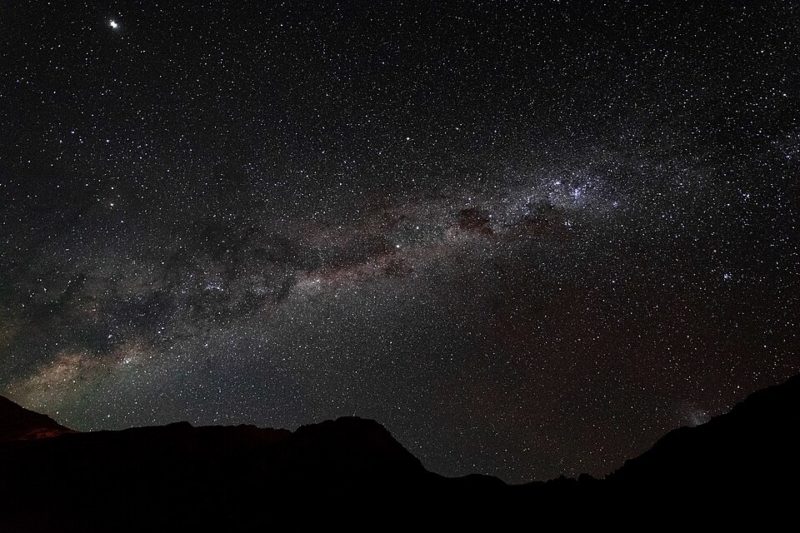
The Milky Way got its name from its pale, milk-like appearance and from ancient Greek mythology. Greek observers called the luminous band Galaxias Kyklos, meaning “milky circle,” while Roman writers translated the idea into Via Lactea, or “milky road.” The name describes what people saw in the sky long before anyone understood that the glowing path was the visible disk of our home galaxy.
That distinction matters. “Milky Way” is an ancient cultural label, not a description of how the galaxy formed. Modern astronomy identifies it as a barred spiral galaxy containing hundreds of billions of stars, including the Sun.
How Did Ancient Cultures Name the Milky Band?
Greek Mythology
On a clear night far from city lights, the Milky Way appears as a faint, uneven arc stretching across the sky. Ancient people had no telescope to resolve its individual stars, so the band looked like a substance, a road, or a celestial river.
Greek thinkers connected it with milk. The earliest Greek references appear between roughly 800 B.C. and 500 B.C., according to historical accounts discussed by science historian Matthew Stanley. The phrase Galaxias Kyklos became associated with the pale circle crossing the heavens.
The word “galaxy” itself comes from the Greek root gala, meaning milk. That linguistic clue survived even after astronomers discovered that the Milky Way is a vast stellar system rather than a smear of liquid light.
Latin Translation
Roman writers adopted and translated the Greek expression as Via Lactea, meaning “milky road.” NASA explains how this phrase helped shape the English name Milky Way.
The road image is surprisingly practical. The band seems to lead from one horizon to another, cutting through constellations like a dim highway. In different cultures, the same arc became a river, path, backbone, or trail left by birds.
Ancient Alternatives
There was never one universal name. Chinese tradition called it the Silver River, while some Kalahari communities described it as the Backbone of Night. The American Museum of Natural History’s cross-cultural overview shows how communities gave the same celestial feature meanings rooted in local landscapes and stories.
That variety is important. The Milky Way name became dominant in English because of Greek and Latin influence, not because it was scientifically more accurate than every other description.
Why Does It Look Like a Milk-Colored Path?
Dense Star Fields
The Milky Way appears bright because Earth sits inside its flattened stellar disk. When we look along the disk, our line of sight passes through enormous numbers of stars packed across a narrow direction. Individual stars blur together with the unaided eye, creating a soft band of light.
A telescope changes the picture completely. Galileo’s early observations revealed that the Milky Way could be resolved into countless faint stars, a turning point described in historical accounts of ancient and early astronomical observation.
Interstellar Dust
Dark lanes interrupt the glow. These are clouds of interstellar dust and gas blocking visible light from more distant stars. The result is a mottled pattern of bright fields and dark areas, rather like smoke drifting across a distant lamp.
Britannica describes the Milky Way as an irregular luminous band made visible across the night sky. “Irregular” refers to its appearance from Earth, not to the galaxy’s overall shape.
Viewing Conditions
City lighting can erase the Milky Way almost entirely. Under genuinely dark skies, the band may look broad and textured, with a brighter region toward Sagittarius, where the galactic center lies. Moisture, haze, moonlight, and atmospheric pollution also weaken the view.
The best observations usually come from a rural site on a moonless night. Give your eyes time to adjust. A few minutes can reveal stars that seemed absent at first.
How Did Greek Mythology Shape Its Name?
Hera’s Breast Milk
One popular Greek story says that the infant Heracles, later known by his Roman name Hercules, nursed from the sleeping goddess Hera. When Hera awoke and pulled away, her milk spilled across the heavens, forming the Milky Way. NASA’s Ames Research Center recounts this Hera and Heracles legend.
Heracles’ Origin
Heracles was the son of Zeus and the mortal Alcmene. Zeus wanted the child to gain divine strength, which made Hera’s milk symbolically powerful. The myth also explains why the sky’s pale arc was associated with nourishment, divinity, and an accidental spill rather than with a physical road.
Mythological Variations
The story was not always told in precisely the same way. Ancient myths shifted across writers and centuries, and some accounts connect the band more generally with divine milk or a heavenly pathway. Ovid’s Metamorphoses, written around A.D. 8, helped preserve the image for later European readers.
What Does “Galaxy” Mean Scientifically?
Greek Gala
Scientifically, a galaxy is a gravitationally bound system of stars, gas, dust, stellar remnants, planets, and dark matter. The term’s milk-related root is historical vocabulary, not evidence that galaxies contain milk or share a particular physical substance.
Latin Via Lactea
“Via Lactea” means Milky Way or milky road. English inherited the translated image, while astronomers often use “the Galaxy” when referring specifically to our own system.
Modern Usage
The discovery that the Milky Way was only one galaxy came much later. Edwin Hubble’s observations in the 1920s established that Andromeda was a separate galaxy beyond our own, helping transform the universe from a single cosmic place into a vast population of galaxies.
How Is the Milky Way Actually Structured?
The Milky Way is a barred spiral galaxy. Its central bulge contains older stars, while a bar-shaped structure crosses the center and feeds into winding spiral arms. The Sun sits in the Orion Arm, also called the Local Spur, about 26,000 light years from the center.
At that center is Sagittarius A*, a supermassive black hole with a mass of roughly four million Suns. It does not pull in the entire galaxy like a cosmic vacuum cleaner; the galaxy’s stars orbit within the combined gravitational field of its matter, including its dark matter halo. Modern observations continue to refine this picture of galactic structure.
How Does Its Name Differ From Its Formation?
The name came from human interpretation of light in the sky. The galaxy formed through gravity, gas accumulation, mergers, star formation, and the gradual assembly of a rotating disk over cosmic time. Those are separate stories.
The Milky Way did not form from spilled milk, and its spiral shape was not created by the mythological road. Ancient language captured an appearance. Astrophysics explains the machinery behind it.
Why Has This Ancient Name Survived?
Frankly, the name works. It is ancient, lyrical, easy to remember, and culturally embedded. Scientists sometimes call it “our Galaxy,” but everyday astronomy, news coverage, and educational media still default to “Milky Way.”
That is less a problem of precision than a triumph of familiarity. “Milky Way” gives people an immediate visual clue, even though its true nature is far grander than the phrase suggests.
FAQ
Who named the Milky Way?
No single person named it. Greek cultures used terms meaning “milky circle,” and Roman writers translated that idea into Via Lactea, or “milky road.”
Is the Milky Way a galaxy or part of one?
The Milky Way is a galaxy, specifically a barred spiral galaxy. Earth and the Solar System are located inside it.
When did people realize it contained stars?
Galileo’s telescope observations in the early 17th century showed that the Milky Way could be resolved into many individual stars, replacing part of its mythic mystery with observation.
Conclusion
The Milky Way’s name began with a visual impression and gained force through Greek myth, Latin translation, and centuries of cultural repetition. Its physical reality is more dramatic: a rotating barred spiral galaxy filled with stars, dust, gas, dark matter, and a central black hole. The old name remains because it turns a difficult astronomical idea into an image anyone can recognize.
Would you like to receive similar articles by email?

Paul Tomaszewski
Paul Tomaszewski is a science & tech writer as well as a programmer and entrepreneur. He is the founder and editor-in-chief of CosmoBC. He has a degree in computer science from John Abbott College, a bachelor's degree in technology from the Memorial University of Newfoundland, and completed some business and economics classes at Concordia University in Montreal. While in college he was the vice-president of the Astronomy Club. In his spare time he is an amateur astronomer and enjoys reading or watching science-fiction. You can follow him on LinkedIn and Twitter.


You May Also Like
Draco Constellation Guide
Piscis Austrinus Constellation Guide