
How Did Dwarf Planet Makemake Get Its Name
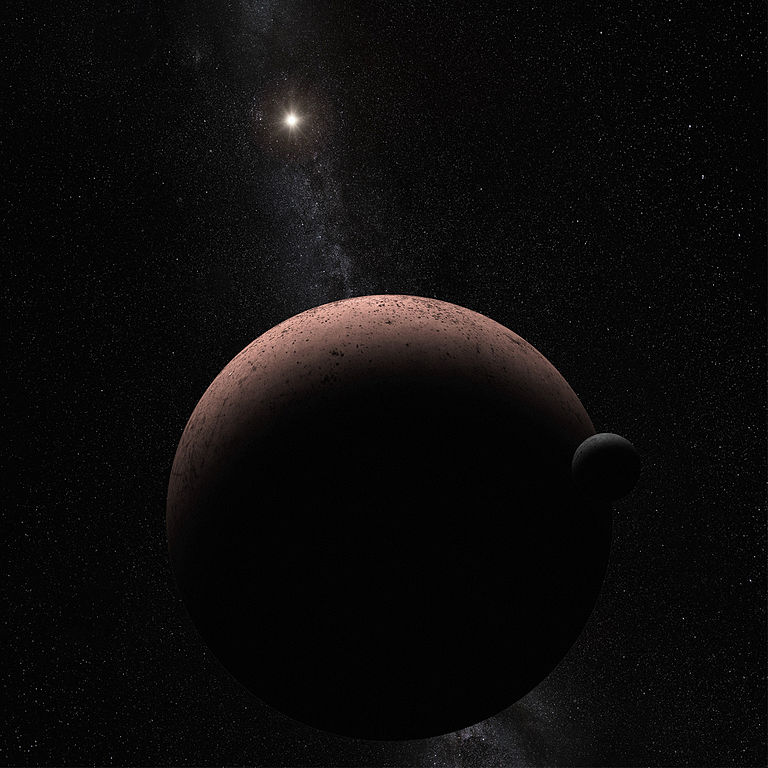
The dwarf planet Makemake takes its name from the creator god and fertility deity of the Rapa Nui, the Polynesian inhabitants of Easter Island. Michael E. Brown, Chad Trujillo, and David Rabinowitz spotted it on March 31, 2005, from Palomar Observatory in California, just days after Easter Sunday, and the discovery team nicknamed the unnamed object “Easterbunny” while they waited for something more dignified. The International Astronomical Union made the name official in July 2008.
What follows is the longer version, along with why the naming story is probably the least interesting thing about this world.
Where Does the Name Come From?
Rapa Nui creation god
Makemake (say it “MAH-kay MAH-kay”) sits at the center of the birdman cult of Easter Island, credited with creating humanity and presiding over fertility. Not a minor figure in some dusty index of terrestrial mythology. A central one.
Easter Island context
Brown wanted a name that carried the Easter connection forward without being cute about it. Rapa Nui mythos gave him that, and it kept the naming inside Polynesian tradition rather than raiding Greek oracles again.
Naming timing choice
There’s also the small matter of convention. Classical Kuiper Belt objects, the so-called classical KBOs on well-behaved orbits, get creator deities by IAU rule. Makemake fit the category and the calendar at once. Convenient, and Brown has admitted as much in his own reflections on the process.
Who Found It and When?
Palomar discovery team
The California Institute of Technology group ran the same survey that turned up Eris and Haumea. Same telescopes, same wide-field sweep of the outer sky, a remarkable run of discovery in about eighteen months.
2005 FY9 designation
Before any mythology got involved, the object carried the provisional designation 2005 FY9, later the minor planet number 136472. Astronomy Now traced that numbering history in its coverage of the naming.
“Easterbunny” nickname
The internal codename stuck around for three years. Brown’s team also juggled 2003 EL 61, which became Haumea, and the two announcements landed close enough together that the naming committees were fielding both at once. Universe Today noted the competitive pressure that came with it.
How Did the Official Name Become Formal?
The approval ran through two IAU committees, the Working Group for Planetary System Nomenclature and the Committee on Small Body Nomenclature, largely over email. Not a grand ceremony. Science News covered the email-based deliberations that finalized the moniker.
- Plutoid rules: any transneptunian object beyond Neptune’s orbit, massive enough for its own gravity to pull it into a sphere, qualifies. Makemake became the third plutoid after Pluto and Eris.
- Ceres stays out: it orbits in the asteroid belt, so it’s a dwarf planet but never a plutoid.
- Sibling naming: Haumea drew from Hawaiian mythology, Eris from Greek discord, Sedna from Inuit tradition, Orcus from Etruscan. The IAU’s official 2008 press release set the precedent for that spread.
Physical Profile
NASA lists a radius of roughly 715 kilometers, which makes Makemake the fourth dwarf planet by size ranking and comfortably smaller than Pluto. It circles the Sun once every 305 Earth years at an average distance near 45.8 astronomical units, and the rotation period runs a bit under 23 hours.
| Property | Makemake | Pluto |
|---|---|---|
| Radius | ~715 km | ~1,188 km |
| Orbital period | 305 Earth years | 248 Earth years |
| Known moons | 1 (MK 2) | 5 |
| Surface | frozen methane, ethane | nitrogen, methane ice |
The surface is coated in pure methane ice with pellets a centimeter or more across, giving it a high albedo. A stellar occultation in 2011 found no global atmosphere, though NASA’s profile allows for a thin seasonal one near perihelion, when nitrogen and methane might briefly sublimate.
Moon MK 2
In April 2016, astronomers announced a satellite found in Hubble Space Telescope images from 2015. MK 2 is faint, dark, roughly 100 kilometers across, and about 1,300 times dimmer than its parent. It hid inside the glare for years until someone wrangled the data properly.
Why the Moon Matters More Than the Name
Frankly, the naming discourse is a sideshow. A moon lets you measure mass. Mass plus size gives density, and density tells you what the thing is actually made of and how it assembled out in the Kuiper Belt. Whether MK 2 formed in place or was captured shifts the whole formation story for these worlds.
How Makemake Compares to Other Dwarf Planets
Eris is denser and more massive. Pluto has a real atmosphere and five moons. Haumea spins so fast it’s stretched into an egg. Makemake is the bright, cold, mostly quiet one, and Britannica’s entry frames it as the second-brightest KBO after Pluto.
FAQ
Is Makemake a planet?
No. It’s a dwarf planet and a plutoid.
Has any spacecraft visited?
None. No flyby is scheduled.
Who named it?
Brown proposed it; the IAU approved it.
Conclusion
A creator god, an Easter weekend, and three years of committee email. That’s the name of Makemake. The science is elsewhere.
Would you like to receive similar articles by email?

Paul Tomaszewski
Paul Tomaszewski is a science & tech writer as well as a programmer and entrepreneur. He is the founder and editor-in-chief of CosmoBC. He has a degree in computer science from John Abbott College, a bachelor's degree in technology from the Memorial University of Newfoundland, and completed some business and economics classes at Concordia University in Montreal. While in college he was the vice-president of the Astronomy Club. In his spare time he is an amateur astronomer and enjoys reading or watching science-fiction. You can follow him on LinkedIn and Twitter.


You May Also Like

Canadian Astronaut Jeremy Hansen: Artemis II Mission Specialist
Alpha Capricornid Meteor Shower Guide
