How Did Saturn’s Moon Iapetus Get Its Name
Saturn’s third-largest moon carries the name of a Titan from Greek mythology, and honestly, the backstory of how that name stuck is messier than most people expect. Iapetus was spotted in 1671, but it wouldn’t get its permanent name until nearly two centuries later. This guide walks through the mythological roots, the discovery credited to Giovanni Cassini, and the naming conventions that eventually pulled the whole Saturnian system into one coherent theme. If you’ve ever wondered why a frozen, giant satellite ended up honoring the father of Prometheus, you’re in the right place.
How Did Iapetus Get Its Name?
Iapetus got its name from the Titan Iapetus in Greek mythology, a naming choice formally proposed by astronomer John Herschel in 1847. For roughly 176 years after its discovery, the moon carried no proper name at all. Astronomers just referred to it by numerical designation, calling it Saturn V or later Saturn VIII depending on how many satellites had been catalogued around the planet at the time.
The name fits a pattern. Herschel wanted the moons orbiting Saturn to reflect Saturn’s own mythological identity, since the Roman god Saturn maps onto the Greek Cronus, ruler of the Titans. So it made poetic sense to name Cronus’s satellites after his siblings. Iapetus, one of those Titans, slotted right in.
Who Was Iapetus in Greek Mythology?
In Greek mythology, Iapetus was one of the twelve Titans, the son of Uranus and Gaia, and he’s often remembered as the father of Prometheus. That lineage matters. Prometheus gave fire to humankind, which is partly why some ancient traditions treated Iapetus as an ancestor of the human race itself.
He wasn’t a flashy god. No dramatic love affairs, no thunderbolts. Iapetus was more of a foundational figure, one of those old-world Titans who existed before the Olympians took over. That quiet, structural role in the pantheon almost mirrors the moon named after him. Both sit at the edges, both carry heavier histories than their reputation suggests.
Who Discovered Iapetus and When?
Giovanni Cassini
The Italian-French astronomer Giovanni Domenico Cassini discovered the moon while working with the telescopes of his era. He’d already found other Saturnian satellites, so Iapetus joined a growing list of his discoveries around the planet. Cassini had a knack for spotting these faint outer moons that most observers of his day couldn’t catch.
1671 Sighting
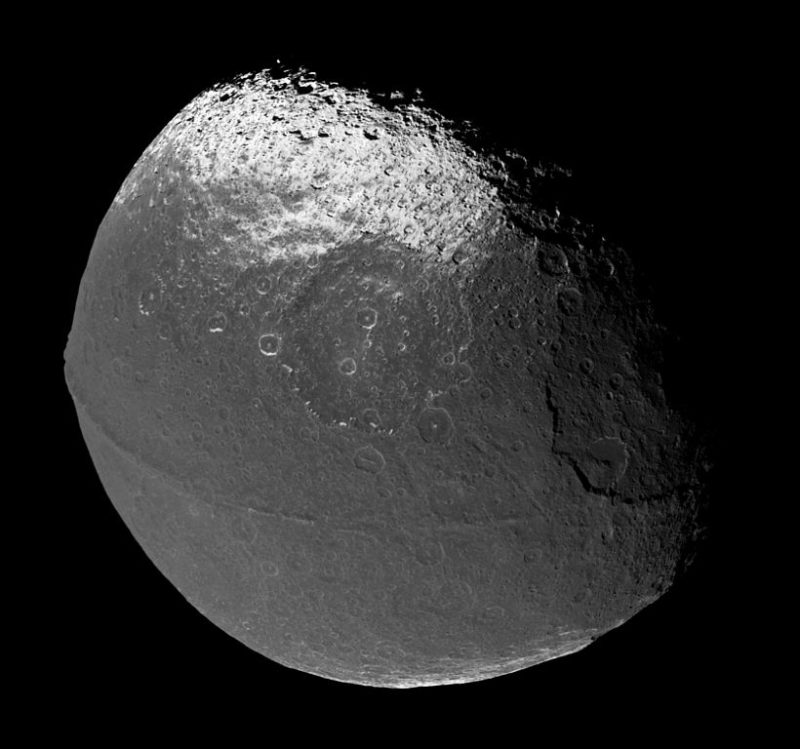
Cassini first observed Iapetus in October 1671. And here’s the odd part. He could only see it on the western side of Saturn, never the eastern side. That baffled him for years. What he’d actually stumbled onto was the moon’s tidally locked rotation combined with its bizarre albedo, one hemisphere bright and the other dark as coal.
That dark region was later named Cassini Regio, honoring the man who first puzzled over why the satellite kept vanishing. When Iapetus swings to Saturn’s east, the dark trailing face turns toward Earth, dimming it beyond what his telescope could resolve.
The Naming Delay
For decades, nobody bothered to formally name it. The moon just floated in astronomical records as a numerical designation, a habit that lasted well into the 1800s. Discovery and naming were treated as two entirely separate events back then, and the gap between them stretched on far longer than you’d think reasonable.
Who Officially Named the Moon?
John Herschel
John Herschel, son of the famous William Herschel who discovered Uranus, took on the task of tidying up Saturn’s chaotic satellite catalogue. In his 1847 work Results of Astronomical Observations, he laid out a proposal that gave the moons proper mythological names instead of a jumble of numbers.
1847 Proposal
Herschel’s suggestion covered several of the known moons at once. He assigned Titans and their kin to the satellites, and Iapetus landed on this particular icy body. The proposal caught on quickly, and by the following year the naming was widely accepted across the astronomy community.
Titan Theme
The genius of Herschel’s scheme was its internal logic. Rather than scatter random names, he tied every moon back to the mythology of Saturn himself. That thematic consistency is why the naming survived. It wasn’t arbitrary. It told a story.
How Are Saturn’s Other Moons Named?
Titans and Giants
The largest moons of Saturn, the ones Cassini and others found early, drew from the Titans and giants of Greek and Roman lore. Rhea, Dione, and Iapetus all fit this original grouping. These were the first-tier names for the big, obvious satellites visible through modest telescopes.
Modern Categories
As spacecraft like the Voyager probes and later the Cassini orbiter revealed many dozens more moons, the naming pool had to expand. Today the categories break down roughly like this:
- Titans for the classical large moons discovered by early astronomers
- Gallic, Norse, and Inuit giants for the smaller irregular moons found in recent decades
- Descriptive surface features on Iapetus itself, drawn from the French epic The Song of Roland
IAU Oversight
The International Astronomical Union now governs all of this. Every new satellite discovered in the Saturnian system gets vetted and slotted into the appropriate mythological bucket, keeping the whole naming architecture from collapsing into confusion.
Why the Titan Naming Fits Iapetus
There’s something fitting about naming this stubborn moon after a Titan. Iapetus refuses to behave like a tidy textbook object. Its two-tone surface, its odd equatorial ridge, its slow orbit that takes about 79 days to circle Saturn, all of it resists simple explanation.
The Titans were the old, elemental powers, weighty and ancient. And Iapetus, geologically speaking, reads like a fossil record. The equatorial bulge and the sharp albedo split aren’t cosmetic quirks. They’re evidence of processes that played out over eons, encoded into a surface that looks deceptively plain from a distance.
What Makes Iapetus Stand Out Beyond Its Name
| Feature | Detail |
|---|---|
| Discovery | 1671, by Giovanni Cassini |
| Orbital period | Roughly 79 Earth days |
| Surface | Two-tone, bright leading and dark trailing hemispheres |
| Equatorial ridge | A towering mountain belt along the equator |
| Named after | The Titan Iapetus, father of Prometheus |
The equatorial ridge is the real showstopper. According to imaging from the Cassini mission, this belt of mountains runs almost perfectly along the equator, and scientists still debate whether it formed from early tectonics, a collapsed ring, or an ancient faster spin. That ridge is your anchor point if you want to understand what makes this satellite so distinct from every other icy body in the solar system.
FAQ
Is Iapetus named after a god or a Titan?
A Titan. Iapetus was one of the twelve Titans, not an Olympian god, and he’s best known as the father of Prometheus.
Why did it take so long to name Iapetus?
Discovery and naming were separate concerns in the 17th century. The moon existed as a numerical designation for over 170 years until Herschel proposed formal names in 1847.
What does the name Iapetus mean?
The name comes from the Greek Titan, pronounced roughly eye-AP-i-tus, tied to themes of ancestry and the origins of humankind through his son Prometheus.
Conclusion
The name Iapetus is a small monument to how astronomy actually works, slow, collaborative, and stitched together across centuries. Cassini found it in 1671, Herschel gave it a proper name in 1847, and the International Astronomical Union keeps the whole Titan-themed system in order today. What I love about this moon is that its name feels earned. It’s a Titan through and through, a patient, layered puzzle that keeps handing scientists new questions with every close look. And frankly, that’s the kind of wonder worth chasing.
Would you like to receive similar articles by email?

Paul Tomaszewski
Paul Tomaszewski is a science & tech writer as well as a programmer and entrepreneur. He is the founder and editor-in-chief of CosmoBC. He has a degree in computer science from John Abbott College, a bachelor's degree in technology from the Memorial University of Newfoundland, and completed some business and economics classes at Concordia University in Montreal. While in college he was the vice-president of the Astronomy Club. In his spare time he is an amateur astronomer and enjoys reading or watching science-fiction. You can follow him on LinkedIn and Twitter.


You May Also Like

How To Choose the Right Lab Equipment for Your Next Experiment
NGC 7469: Home to a Supermassive Black Hole and Starburst Activity