How Did Dwarf Planet Haumea Get Its Name
Haumea took its name from the Hawaiian goddess of fertility and childbirth, approved by the International Astronomical Union on September 17, 2008, with its two moons named for her daughters. The choice was not arbitrary. The team that spotted the object worked from the summit of Mauna Kea on Hawaii’s Big Island, and the goddess in that mythology gave birth to children from parts of her own body, which is a rather elegant match for a dwarf planet that appears to have shed moons in an ancient smash-up.
Below, the naming story, the messy discovery dispute behind it, and the physics that makes this little world so strange.
Where Does the Name Haumea Come From?
Hawaiian goddess of fertility
In Hawaiian tradition, Haumea is a patron goddess of the island of Hawaiʻi, tied to fertility, childbirth, and stone. That stone association matters more than it sounds. This dwarf planet is unusually dense for a Kuiper belt body, roughly 1.8 to 2.0 grams per cubic centimeter, meaning a rocky core of silicate minerals hidden under a thin ice shell rather than the fluffy ice-ball you might expect. The encyclopedic profile of its structure notes how neatly that symbolism landed.
Link to the two moons
The goddess bore offspring from her own body. The official IAU announcement of the fifth dwarf planet leaned on exactly that image, since the two satellites are thought to be fragments knocked loose from the parent object.
Fit with the object’s origin story
There is a whole Haumean collisional family out there. Icy shards sharing similar orbits and spectra, scattered across the Kuiper belt like debris from a hit-and-run. That family, as laid out in a planetary science teaching module, is why the fertility angle stuck with the naming committee.
Who Discovered It and When?
Palomar team announcement
Mike Brown’s Caltech group first picked the object out of images taken on December 28, 2004, at Palomar. They nicknamed it “Santa” internally, since the find came just after Christmas.
Sierra Nevada team claim
On July 27, 2005, José Luis Ortiz and colleagues at the Sierra Nevada Observatory in Spain announced it to the Minor Planet Center. Brown’s team had posted an abstract online with observing logs. The resulting accusations, covered in detail by journalists tracking the international tension, were ugly.
Unresolved discovery credit
The IAU split the difference in an odd way. The discovery location is credited to Sierra Nevada Observatory, no individual discoverer is listed, and the name that survived was the one from Caltech. Sky & Telescope’s autopsy of the naming fight called it a compromise nobody loved.
How Did the IAU Approve the Name?
Santa and Ataecina proposals
- “Santa,” the placeholder nickname that was never going to survive a formal vote
- Ataecina, an Iberian chthonic goddess put forward by the Spanish team
- Haumea, the Caltech submission honoring the discovery instruments’ Pacific home
Kuiper belt naming convention
Ataecina had a problem. Underworld deities are reserved for objects in orbital resonance with Neptune, per the protocols for naming astronomical objects. Classical belt bodies get creation figures. That convention alone doomed the alternative.
September 2008 decision
The Working Group for Planetary System Nomenclature and the Committee on Small Body Nomenclature signed off jointly, retiring the provisional label 2003 EL61 and logging 136108 Haumea in the official planetary names gazetteer. Makemake got its badge around the same stretch, per the Planetary Society’s dispatch from that year.
Names of the Two Moons
Hiʻiaka
The outer moon, brighter and larger, roughly 370 km across. Hiʻiaka was born from the goddess’s mouth and became patron of hula dancers.
Namaka
Smaller, closer in, a water spirit born from the goddess’s body. Both satellites were tracked with the Keck telescope on Mauna Kea.
Mythological logic behind both
Children of the parent, orbiting the parent. NASA’s StarChild resource spells out that parallel plainly for younger readers.
Shape, Spin, and Collisional Past
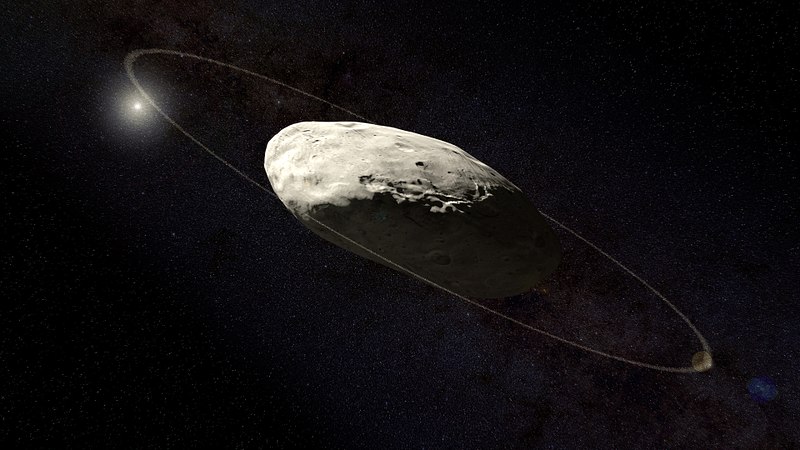
A day here lasts about 3.9 hours. That is violently fast for something this size, and it stretches the body into an elongated ellipsoid roughly 2,122 km along its long axis and half that through the poles. Think of a sesame seed, scaled up. My take: the egg shape is not a curiosity, it is evidence. Rapid rotation plus a stripped ice mantle points straight back to an ancient impact.
Surface, Rings, and Composition
Crystalline water ice covers the surface, giving a high albedo comparable to fresh snow. A stellar occultation in 2017 revealed a ring about 70 km wide, the first found around a trans-Neptunian object.
| Feature | Value |
|---|---|
| Rotation period | 3.9 hours |
| Geometric mean diameter | ~1,544 km |
| Orbital period | ~284 Earth years |
| Average distance from Sun | 43 astronomical units |
Orbit and Position in the Kuiper Belt
It swings between roughly 35 and 51 AU, tilted 28 degrees off the ecliptic. Space.com’s profile traces that path from the 2004 sightings forward.
FAQ
Who named it?
Brown’s Caltech team proposed it; the IAU approved it.
Why not Ataecina?
Wrong mythological category for its orbit.
What was 2003 EL61?
The provisional designation, still logged in orbital tracking records.
What Else in Space Carries Hawaiian Names?
Leleakūhonua, a distant scattered object, borrows from a creation chant. ʻOumuamua, the interstellar visitor, means scout.
What Qualifies Haumea as a Dwarf Planet?
Sufficient mass for hydrostatic equilibrium, orbits the Sun, has not cleared its zone. NASA’s planetary overview classes it among the plutoids alongside Pluto and Eris.
Conclusion
The name works because it earns its keep. A goddess of stone and birth, attached to a dense rocky body that spawned its own family of fragments, chronicled from nickname to ratification by Universe Today’s discovery history. Diverse family, that dwarf planet label. Size is the least interesting thing about it.
Would you like to receive similar articles by email?

Paul Tomaszewski
Paul Tomaszewski is a science & tech writer as well as a programmer and entrepreneur. He is the founder and editor-in-chief of CosmoBC. He has a degree in computer science from John Abbott College, a bachelor's degree in technology from the Memorial University of Newfoundland, and completed some business and economics classes at Concordia University in Montreal. While in college he was the vice-president of the Astronomy Club. In his spare time he is an amateur astronomer and enjoys reading or watching science-fiction. You can follow him on LinkedIn and Twitter.


You May Also Like

The Link Between Mental Health and Skin Health
Stargazing Calendar for June 2025