How Did Saturn’s Moon Enceladus Get Its Name
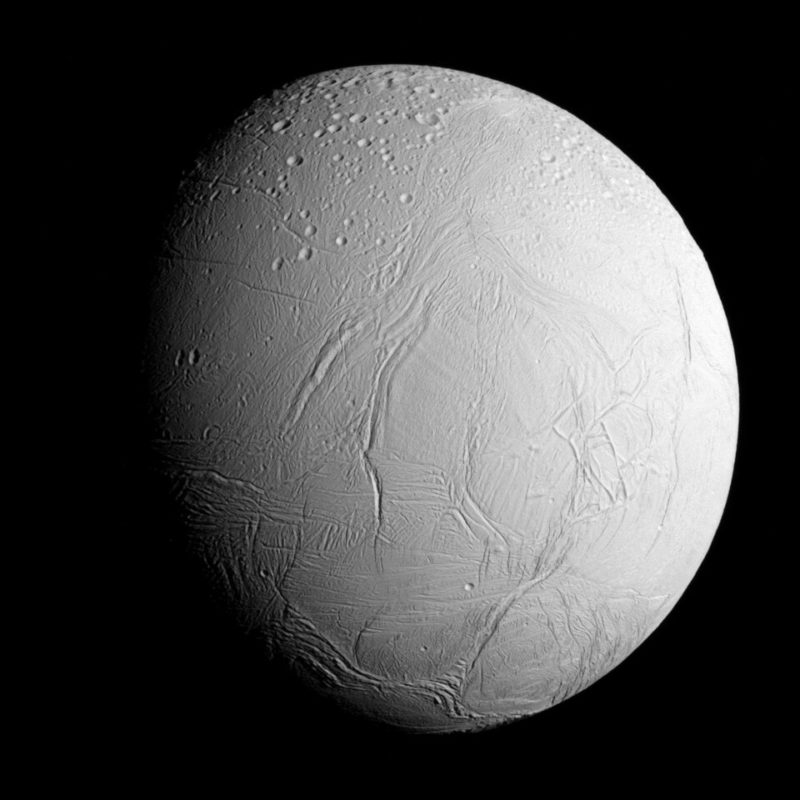
Enceladus got its name from a Giant in Greek mythology, one of the Gigantes born from the goddess Gaia. The naming came courtesy of the astronomer John Herschel in 1847. That’s the short version. The longer story involves a family of astronomers and a battle between gods and giants. Moreover, it includes a naming tradition that ties nearly every one of Saturn’s moons back to ancient myth. If you’ve ever wondered why this tiny, shining icy moon carries the name of an earth-shaking Titan, you’re in the right place. Let’s dig into it.
How Did the Moon Enceladus Get Its Name?
The name traces back to John Herschel, son of the man who spotted the moon in the first place. He proposed it while working on a set of astronomical observations published from the Cape of Good Hope. He didn’t pull the name out of thin air, though. There was a logic to it, rooted in family and mythology alike.
Greek Mythology Origin
Enceladus was one of the Gigantes in Greek mythology, the enormous offspring of Gaia (Earth) and the spilled blood of Uranus. These weren’t gentle beings. The Gigantes waged war against the Olympian gods. Enceladus, according to the detailed accounts of ancient sources, played a central role in that conflict.
Naming Tradition
Here’s where the naming got clever. Since Saturn is the Roman counterpart of the Greek Cronus, ruler of the Titans, Herschel figured the moons circling Saturn should carry the names of the Titans and Giants associated with that mythological family. It was a tidy thematic choice. Nearly all the Saturnian moons known at the time got names pulled from the same mythic lineage.
John Herschel’s Suggestion
When John Herschel published his 1847 work, he laid out the naming scheme for the seven inner moons of Saturn known back then. Enceladus, the Giant, fit right in. The suggestion stuck. The International Astronomical Union later formalized this kind of thematic naming for celestial bodies across the solar system.
Who Discovered Enceladus and When?
Long before it earned its name, someone had to actually find the little moon. That job fell to one of history’s sharpest observers.
William Herschel
William Herschel, the German-born British astronomer famous for discovering Uranus, was also the one who first laid eyes on Enceladus. He had a gift for spotting faint objects that others missed. Saturn’s dim, high-albedo satellite was exactly the kind of target that rewarded patience and a good telescope.
1789 Observation
The discovery happened on August 28, 1789. This is a date that European space agencies like the ESA still mark in their historical archives. Herschel caught the faint glimmer near Saturn’s rings during one of his systematic sweeps of the planet’s neighborhood.
Telescope Used
He wasn’t using ordinary equipment. Herschel had just completed his massive 12-meter reflecting telescope, the largest of its era. Enceladus was among the first objects it revealed. The moon’s brightness (it has one of the highest reflectivities of any body in the solar system) helped. However, you still needed serious optics to catch it against Saturn’s glare.
What Does Enceladus Represent in Greek Mythology?
The mythological Enceladus deserves his own moment, because the story behind the name adds a strange poetry to a moon that turned out to be far more interesting than anyone in 1789 could have guessed.
Giant of the Gigantomachy
Enceladus fought in the Gigantomachy, the epic war between the Gigantes and the Olympian gods. As one of the most formidable Giants, he charged into battle against the divine order. He was part of Gaia’s rebellion against Zeus and his kin.
Battle Against Athena
In the thick of the fighting, Enceladus faced the goddess Athena, whose account of the confrontation appears across many classical retellings. Athena, warrior-goddess of wisdom and strategy, proved too much for him.
Burial Under Mount Etna
Athena crushed Enceladus beneath the island of Sicily. Myth holds that his restless body still lies buried under Mount Etna. His breath, the ancients said, was the source of the volcano’s fire. His tossing and turning explained the earthquakes that shook the region. Oddly enough, that connection to geological unrest feels prophetic given what we later learned about the moon.
Key Physical Characteristics of Enceladus
Let’s get to the numbers. Enceladus is small. However, nearly every measurement about it turns out to be scientifically loaded.
- Diameter: Roughly 504 km across, making it small enough to fit within the borders of a single U.S. state like Arizona.
- Surface: An icy shell so reflective it bounces back nearly all sunlight that hits it, giving the entire moon its brilliant white appearance.
- Distance from Saturn: It orbits at about 238,000 km from its host planet, roughly four Saturn radii out.
Size and Diameter
At only about 504 km wide, Enceladus is one of Saturn’s mid-sized icy satellites, dwarfed by moons like Titan. Yet for its size, this small moon punches far above its weight in the world of planetary science.
Icy Surface
The icy surface is what first drew attention. With one of the highest geometric albedos of any object we know, the crust reflects sunlight so efficiently that its temperatures stay brutally cold. They hover far below anything comfortable.
Distance From Saturn
Its orbit places it right where the tidal stresses from Saturn’s gravity flex and heat the moon’s interior. This tidal heating is driven by the gravitational tug-of-war within the Saturn system. It quietly powers everything that makes Enceladus remarkable.
Why Enceladus Matters to Scientists
Frankly, this is where the story turns thrilling. A moon named after a buried Giant turned out to be one of the most promising places to search for life beyond Earth.
Source of Saturn’s E Ring
Enceladus feeds Saturn’s faint E ring. Geysers near its south pole blast ice grains and water vapor into space. Additionally, those particles spread out to form and sustain the planetary ring. The small moon literally sculpts a portion of Saturn’s ring system.
Subsurface Ocean
Beneath that frozen icy crust hides a global ocean of liquid water. This subsurface ocean, kept warm by tidal shear heating, sits between the moon’s rocky core and its ice shell, and it’s the reason scientists talk about Enceladus in the same breath as Jupiter’s moon Europa.
Potential for Life
The habitable ocean world checklist is long. Enceladus keeps ticking boxes. Liquid water, an energy source, and the right chemistry. That combination makes it, as some astrophysicists have argued, our closest great hope for finding life elsewhere in the solar system.
Cassini Mission Discoveries
None of this would be known without Cassini. The NASA spacecraft, which orbited the Saturn system for years, flew directly through the plumes erupting from Enceladus and tasted what was inside. Cassini observations revealed water vapor, silica grains, and organic molecules. There were hints of hydrothermal vents on the ocean floor much like those that sustain life in Earth’s deep seas. The Cassini mission transformed a faint smudge Herschel spotted in 1789 into one of astrobiology’s brightest targets.
FAQ
Who named Enceladus?
John Herschel named it in 1847, choosing a Giant from Greek mythology to fit Saturn’s Titan-and-Giant naming theme.
Who discovered Enceladus?
William Herschel, John’s father, discovered it on August 28, 1789, using his 12-meter reflecting telescope.
Why is Enceladus named after a Giant?
Because Saturn corresponds to Cronus, ruler of the Titans, so its moons carry the names of Titans and Giants from the same mythological family.
Does Enceladus have an ocean?
Yes. A global subsurface ocean of liquid water lies beneath its icy shell. This is one of the main reasons it excites planetary scientists.
Conclusion
There’s something fitting about a moon named for a Giant tied to earthquakes and volcanic fire, only to be revealed centuries later as a geologically active ocean world spewing water into space. William Herschel found it, John Herschel named it, and Cassini gave it meaning. Next time you read about the search for life beyond Earth, remember this shining little moon and the ancient Greek myth still echoing in its name.
Would you like to receive similar articles by email?

Paul Tomaszewski
Paul Tomaszewski is a science & tech writer as well as a programmer and entrepreneur. He is the founder and editor-in-chief of CosmoBC. He has a degree in computer science from John Abbott College, a bachelor's degree in technology from the Memorial University of Newfoundland, and completed some business and economics classes at Concordia University in Montreal. While in college he was the vice-president of the Astronomy Club. In his spare time he is an amateur astronomer and enjoys reading or watching science-fiction. You can follow him on LinkedIn and Twitter.


You May Also Like

A Glance at the Different Types of Farm Soil
Auriga Constellation Guide