How Did Saturn’s Moon Dione Get Its Name
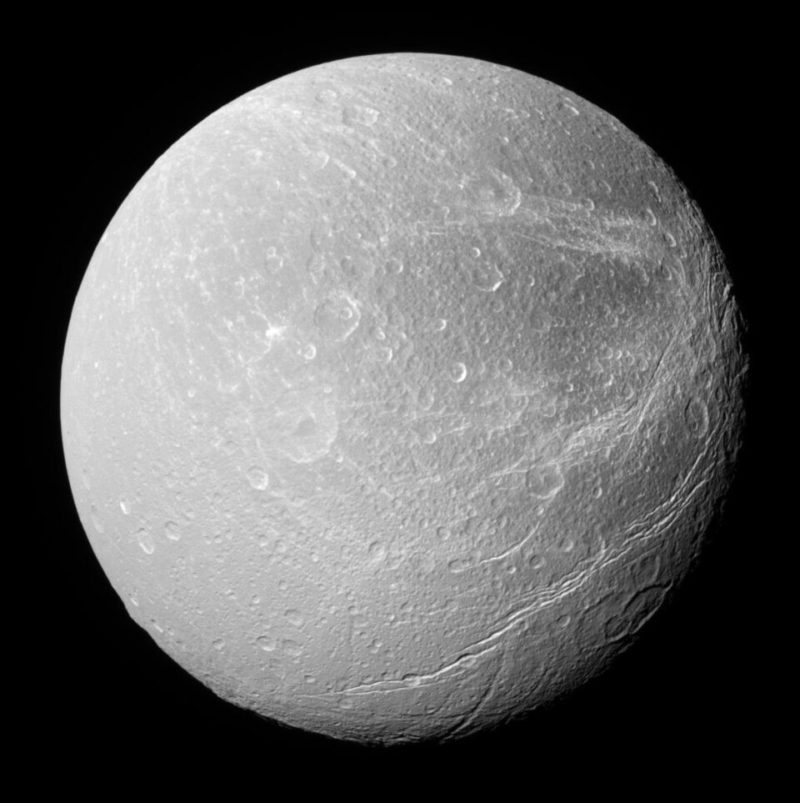
Names in the sky rarely arrive in a straight line. They wander, get rewritten, argued over, and sometimes forgotten for a century before somebody dusts them off. Dione, one of Saturn’s icy moons, is a perfect little case study in this messy tradition. Its name carries a Greek goddess, a French king’s ego, and a British astronomer’s tidy sense of order all bundled together.
This article walks through where that name came from, who first spotted the moon, and how it slotted into the sprawling family of satellites orbiting Saturn.
How Did the Moon Dione Get Its Name?
Dione got its name from a Titaness in Greek mythology, but the moon didn’t officially carry that name until 1847, more than 150 years after its discovery. The Italian astronomer Giovanni Cassini spotted it in 1684 and initially called it something else entirely.
It was John Herschel who later proposed the mythological naming scheme, and the name Dione, tied to the divine and to the goddess Aphrodite, stuck. So the moon’s identity is really two stories stitched together: an ancient goddess and a nineteenth-century decision to bring some consistency to Saturn’s growing collection of orbiting moons.
Who Is Dione in Greek Mythology?
The mythological Dione is one of those figures who feels slightly out of focus, which is oddly fitting for a name that later drifted across the astronomy record for over a century. Ancient sources disagree about her. Some call her a Titaness, others fold her into the Oceanids. Her name itself seems to mean something close to “goddess” or “divine,” a feminine echo of Zeus.
Divine Lineage
Depending on which poet you trust, Dione was a daughter of the sky and earth, sitting among the elder gods that predate the Olympians. That lineage matters here. When Herschel went looking for names, he wanted figures connected to Cronus, the Titan the Romans called Saturn, and Dione fit that older generation neatly.
Mother of Aphrodite
In Homer’s telling, Dione is the mother of Aphrodite, the goddess the Romans knew as Venus. That maternal role is probably her most cited claim to fame, and it links her to a chain of divine feminine figures that stretch across Greek and Phoenician traditions, where scholars have connected her to figures like Baaltis.
Oracle at Dodona
At Dodona, one of the oldest oracle sites in Greece, Dione was worshipped as a patron goddess alongside Zeus. This gave her a real cultic presence rather than just a mention in genealogies. She wasn’t a major Olympian, sure. But she held a quiet, steady kind of importance.
Who Discovered This Moon of Saturn?
Giovanni Cassini
The discovery belongs to Giovanni Domenico Cassini, the astronomer whose name now stretches across everything from a division in Saturn’s rings to the NASA orbiter that mapped the planet for over a decade. He was hunting Saturn’s moons with the best optics of his era.
1684 Observation
In 1684, Cassini logged Dione for the first time, the same year he also caught Tethys. Both moons joined his earlier finds of Rhea and Iapetus. Four satellites, spotted by one man, using telescopes that would look almost comically fragile to a modern observer.
Paris Observatory
Working from the Paris Observatory, Cassini used enormously long-focus aerial telescopes, the kind with lenses mounted high on poles and no tube at all. Crude by today’s standards. Yet good enough to resolve a small moon roughly 1123 km across, orbiting a planet well over a billion km away.
How Did the Naming Process Unfold Historically?
Cassini’s “Sidera Lodoicea”
Here’s where the ego comes in. Cassini bundled his four discoveries under the collective name Sidera Lodoicea, or “Stars of Louis,” a flattering nod to his patron King Louis XIV. Politically shrewd. Astronomically useless. The name barely traveled beyond France, and astronomers elsewhere mostly ignored it, referring to the moon by its numerical slot instead, Saturn IV.
John Herschel’s Proposal
More than 150 years later, John Herschel stepped in with a cleaner idea. In his 1847 publication Results of Astronomical Observations made at the Cape of Good Hope, he suggested naming Saturn’s moons after the Titan siblings of Cronus. Dione, being one of those older deities, earned a permanent spot.
Formal Adoption
Herschel’s scheme caught on because it made sense, and the astronomical community adopted it without much fuss. What Cassini’s flattery couldn’t accomplish, Herschel’s logic did.
How Does the Name Fit Saturn’s Moon Conventions?
The naming logic ties directly to Saturn’s own identity. Saturn is the Roman version of Cronus, ruler of the Titans, so surrounding the planet with his mythological relatives creates a kind of family portrait in the sky. Dione belongs to that older cosmic generation, which is exactly why she was chosen over, say, a random Olympian.
The Titan Theme Behind Saturn’s Satellites
The Titan theme isn’t just decorative. It reflects a broader habit in planetary science of grouping moons around a coherent mythological frame. For Saturn, that frame is Cronus and his kin. The International Astronomical Union now oversees these conventions, and even the surface features of Dione follow a subtheme, with chasmata and craters drawn from Virgil’s Aeneid, giving us names like Padua Chasma and Tantalus Chasma.
FAQ
Is Dione named after a male or female figure?
Female. Dione was a Titaness, associated with the divine feminine and worshipped at Dodona as a consort of Zeus.
Did Cassini name the moon Dione himself?
No. Cassini called his four discoveries the “Stars of Louis.” The name Dione came from John Herschel in 1847.
What does the word Dione mean?
It roughly translates to “goddess” or “divine,” a feminine counterpart to the name Zeus.
Are Dione’s surface features named after Greek myths too?
Not exactly. While the moon honors a Greek goddess, its geologic surface features draw from Virgil’s Aeneid, a Roman work.
Conclusion
Dione’s name is really a relay race run across centuries. A goddess from ancient Dodona, a moon caught in Cassini’s telescope in 1684, a flattering title that fizzled, and finally Herschel’s clean mythological scheme that gave the moon the identity it holds today. That layered history is part of what makes exploring the Saturn system so rewarding, and with active missions and past flybys revealing hidden ridges and possible oceans beneath its icy crust, this small moon still has plenty left to discover.
Would you like to receive similar articles by email?

Paul Tomaszewski
Paul Tomaszewski is a science & tech writer as well as a programmer and entrepreneur. He is the founder and editor-in-chief of CosmoBC. He has a degree in computer science from John Abbott College, a bachelor's degree in technology from the Memorial University of Newfoundland, and completed some business and economics classes at Concordia University in Montreal. While in college he was the vice-president of the Astronomy Club. In his spare time he is an amateur astronomer and enjoys reading or watching science-fiction. You can follow him on LinkedIn and Twitter.


You May Also Like
What’s the Difference Between LEO, MEO and GEO Satellites?

The Sustainable Science of Longevity: How Medicine Aligns with a Greener Future