How Did The Centaurs Get Their Names
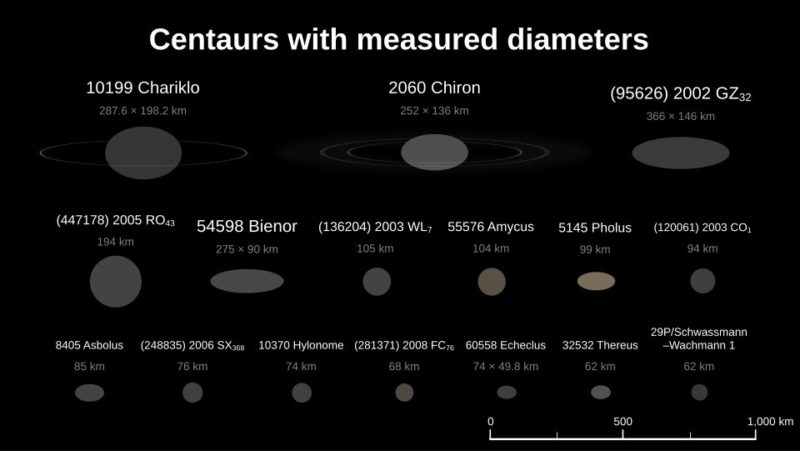
Centaurs are small Solar System bodies that orbit between Jupiter and Neptune while carrying a curious dual identity: their paths resemble asteroids, yet some develop the icy activity associated with comets. The name comes from the mythological centaur, a creature combining human and horse traits. Astronomers saw a similar mixture in these objects, which occupy an unstable frontier between the inner solar system and the distant Kuiper belt.
The label describes a population, not a single composition or perfectly rigid class. Some centaurs are dark and inactive. Others grow a coma, shed dust, or behave like active comets when sunlight warms their volatile-rich surfaces.
Why Did Astronomers Choose the Name Centaur?
Chiron’s Discovery
The naming story begins with 2060 Chiron, discovered in 1977 by American astronomer Charles Kowal. Chiron was unusual from the start. Its orbit carried it between Saturn and Uranus, far beyond the asteroid belt, but later observations revealed comet-like activity around its nucleus.
Kowal named the object after Chiron, the wise teacher in Greek mythology. That choice established a useful precedent. Similar objects discovered afterward became known as centaurs, a term that captured both their astronomical behavior and their mythological connection.
Chiron remains one of the best-studied examples. Its changing brightness, faint coma, and unstable orbit helped astronomers realize that the outer solar system contains bodies capable of shifting between asteroid-like and comet-like states.
Mythological Symbolism
The mythology is more than decorative naming. Chiron was a centaur associated with knowledge, medicine, and astronomy, which made the name especially fitting for an object that forced scientists to rethink the boundary between asteroids and comets.
The IAU naming guidelines maintain this thematic tradition for relevant outer Solar System objects. Naming themes also help astronomers organize the growing population of minor planets, dwarf planets, and other celestial bodies.
Asteroid–Comet Similarities
Asteroids generally appear rocky and inactive, while comets contain volatile ices that can produce a coma and tail near the Sun. Centaurs blur that tidy division.
Their surfaces may display low albedo, reddish or neutral spectra, and little visible activity. Yet some contain carbon compounds and frozen gases capable of escaping when the object moves closer to the Sun. In that sense, the name reflects physical behavior as much as orbital geography.
Who Assigns Names to These Objects?
Discovery observations first receive a provisional designation, usually based on the year and sequence of observation. After an orbit becomes secure, the International Astronomical Union’s Minor Planet Center records the object and the discoverer can eventually propose a permanent name.
The Minor Planet Center naming process makes clear that discovery alone does not instantly produce a mythological name. The orbit must be established, the object must receive a permanent number, and the naming proposal must pass through the appropriate review process.
Names are not the same thing as classifications. “Centaur” describes dynamical behavior and location; “Chiron” is the proper name of one particular object.
How Does the IAU Classify Centaurs?
Orbital Location
Most centaurs occupy the region between Jupiter’s orbit, roughly 5.2 astronomical units from the Sun, and Neptune’s orbit, about 30.1 astronomical units away. Their semimajor axes fall in that broad zone, although orbital eccentricity can carry them across one or more giant-planet paths.
The MPC orbit documentation helps distinguish these orbital groups. Centaurs are usually identified by unstable orbits that cross the paths of giant planets without being protected by a long-term mean-motion resonance.
That instability matters. A gravitational encounter with Jupiter, Saturn, Uranus, or Neptune can alter an object’s eccentricity and inclination, eject it from the solar system, or send it toward the Sun.
Physical Properties
There is no universal diameter, density, or albedo cutoff that defines every centaur. Most are small compared with planets, often measuring a few miles to several hundred miles across. Their densities may be lower than those of many main-belt asteroids, suggesting porous interiors containing ice, rock, and organic-rich material.
Reflectivity varies sharply. Some surfaces are exceptionally dark, while others are brighter or distinctly red. Spectra provide clues about water ice, carbon compounds, silicates, and irradiated surface material, though observations from Earth can struggle to separate surface chemistry from dust and coma effects.
Comet-Like Activity
A centaur becomes especially interesting when it displays a coma or dust emission far from the Sun, where ordinary water-ice sublimation is weak. Carbon monoxide and carbon dioxide may drive activity at those distances.
29P/Schwassmann-Wachmann 1, often discussed as an active centaur, produces recurring outbursts. Echeclus has also shown episodes of activity. The MPC unusual minor planets database records many of the orbital and observational oddities that make this population so scientifically valuable.
How Do Their Orbits Resemble Both Asteroids and Comets?
Centaurs resemble asteroids because they are generally observed as point-like bodies with no persistent coma, and their orbital periods can be comparatively long. Their paths are also governed by gravitational dynamics rather than continuous outgassing.
They resemble comets because many occupy eccentric, planet-crossing trajectories and may become active as they approach the Sun. Their unstable orbit is the giveaway. A main-belt asteroid typically remains in a comparatively orderly region between Mars and Jupiter; a centaur wanders through the gravitational traffic of the outer planets.
One object can change category over time. Classification follows the current orbit and observed behavior, while the object itself continues along its evolutionary path.
Where Did Centaurs Come From?
The leading hypothesis is that many centaurs originated as Kuiper belt objects or scattered disc objects beyond Neptune. Long ago, gravitational interactions with Neptune displaced some icy bodies inward. Once they entered the region of the giant planets, repeated encounters made their orbits chaotic.
This history explains their mixed appearance. A centaur may preserve ancient material from the cold outer solar system while its surface has been altered by cosmic radiation, impacts, and occasional heating. Orbital simulation and infrared data support the view that centaurs are transitional bodies rather than a completely separate primordial family.
How Do Centaurs Become Comets?
Planetary gravity provides the route. A close encounter with Jupiter can reduce a centaur’s orbital period and place it on a trajectory through the inner solar system. If its perihelion moves close enough to the Sun, volatile ices begin to sublimate, producing a coma and sometimes a tail.
Many are thought to become Jupiter-family comets, whose orbital periods are usually less than about 20 years and whose motion is strongly controlled by Jupiter. The transition is not guaranteed. Some centaurs are ejected into interstellar space, collide with a planet, or break apart first.
Which Centaurs Are Best Known?
2060 Chiron remains the essential example because it was the first recognized centaur and later displayed cometary activity. 10199 Chariklo gained attention after astronomers discovered a remarkable ring system around it, proving that small bodies can possess complex structures once associated mainly with giant planets.
5145 Pholus is notable for its very red surface and elongated orbit. 29P is famous for repeated outbursts. Together, these objects show that centaurs are not one uniform kind of asteroid or comet.
FAQ
Are centaurs asteroids or comets?
They can resemble both, but “centaur” primarily refers to an object’s unstable orbit between Jupiter and Neptune. Comet-like activity may strengthen the comparison, but it is not required in every case.
Are centaurs named after horses?
They are named after mythological centaurs, who were half-human and half-horse. The theme reflects their mixed asteroid-comet character.
Are centaurs dangerous to Earth?
Most pose no immediate threat. Their orbits can evolve, though, so astronomers track them carefully through long-term observations and dynamical models.
Conclusion
Centaurs received their name because they occupy a genuine middle ground. Their unstable orbits connect them to the giant planets, while their icy surfaces and occasional outbursts link them to comets. Studying them lets astronomers explore how ancient outer-system debris migrates inward, changes under sunlight, and sometimes becomes an active comet.
Would you like to receive similar articles by email?

Paul Tomaszewski
Paul Tomaszewski is a science & tech writer as well as a programmer and entrepreneur. He is the founder and editor-in-chief of CosmoBC. He has a degree in computer science from John Abbott College, a bachelor's degree in technology from the Memorial University of Newfoundland, and completed some business and economics classes at Concordia University in Montreal. While in college he was the vice-president of the Astronomy Club. In his spare time he is an amateur astronomer and enjoys reading or watching science-fiction. You can follow him on LinkedIn and Twitter.


You May Also Like

NASA Astronaut Victor Glover: From Naval Aviator to Artemis II Pilot
Stargazing Calendar for January 2026