How Did Jupiter’s Moon Callisto Get Its Name
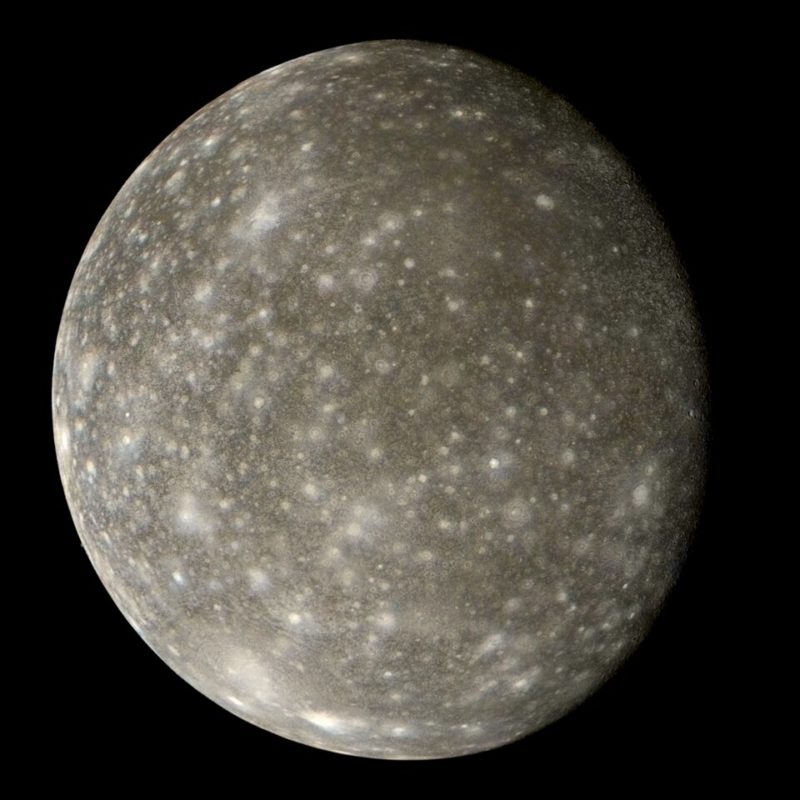
Look up at Jupiter through a decent backyard telescope and you’ll spot four tiny pinpricks of light strung out beside it. One of those, the outermost of the bunch, is Callisto. And the story behind how this heavily cratered ice-world got its name is far messier than most people assume, tangled up in a Greek tragedy, a bitter rivalry between two seventeenth-century astronomers, and a naming convention that took roughly three hundred years to actually stick.
How Did the Moon Callisto Get Its Name?
Callisto takes its name from a nymph in Greek mythology, one of the many mortal and semi-divine companions who caught the wandering eye of Zeus. The moon was discovered in 1610, but the name we use today wasn’t assigned by the man who first saw it. That credit goes to a rival astronomer whose contribution was ignored for centuries.
Named after a nymph
The naming follows a simple logic once you know it. Every one of the four large Galilean moons carries the name of a figure from mythology romantically linked to Zeus, the king of the gods (Jupiter, in his Roman guise). Callisto fits that pattern neatly, and her story, as chronicled in various retellings of the myth, is one of the more heartbreaking ones.
Galileo’s discovery
Galileo Galilei turned his newly improved telescope toward Jupiter in January 1610 and noticed what he thought were fixed stars near the planet. Over several nights he watched them shift position, and the penny dropped. These weren’t stars at all. They were moons orbiting Jupiter, the first satellites ever found circling another planet. Galileo didn’t bother with mythological names. He called them by number. Callisto, being farthest out, became Jupiter IV.
Simon Marius’s suggestion
Here’s where it gets contentious. A German astronomer named Simon Marius claimed he’d observed the same moons around the same time, and it was Marius, in his 1614 work Mundus Jovialis, who proposed the names we use now. The suggestion actually came from Johannes Kepler, who reasoned that Jupiter’s lovers would make fitting companions for the giant planet. Galileo dismissed Marius as a plagiarist, and the two feuded over priority. Modern historians have largely rehabilitated Marius, granting that he likely made independent observations.
Who Was Callisto in Greek Mythology?
The nymph Callisto, whose name roughly translates to “the most beautiful,” was a follower of Artemis, the virgin goddess of the hunt. Her tale is one of divine cruelty, and it explains why she ended up immortalized twice over, first in the stars and later on a moon.
Companion of Artemis
Callisto had sworn a vow of chastity as part of Artemis’s hunting band. These companions roamed the wilderness, pledged to remain unmarried and devoted to the goddess. It was a sacred commitment, and breaking it carried consequences that were never fair to the woman involved.
Zeus and betrayal
Zeus, being Zeus, set his sights on her. In many versions he disguised himself as Artemis to get close, then forced himself upon Callisto. She became pregnant, and when Artemis discovered the pregnancy during a bathing scene, the nymph was cast out in disgrace despite having done nothing willingly wrong.
The bear transformation
The ending varies by source, but the common thread is transformation. Either Hera, Zeus’s jealous wife, or Artemis turned Callisto into a bear. Years later her own son nearly killed her while hunting, not recognizing his mother. To prevent the tragedy, Zeus placed them both in the sky as the constellations Ursa Major and Ursa Minor, the Great and Little Bears.
Who Discovered Callisto and When?
Callisto was discovered on January 7, 1610, by Galileo Galilei, though he continued observing over the following nights to confirm the moons were genuinely orbiting Jupiter rather than being background stars. It ranks among the most consequential observations in the history of astronomy.
The 1610 observation
That first sighting changed everything. Before 1610, the prevailing view held that all celestial bodies revolved around Earth. Watching four moons circle a distant planet delivered a direct challenge to that idea, offering fresh evidence for the Copernican model of the solar system.
The Galilean moons
The four moons Galileo spotted are collectively known as the Galilean moons, or Galilean satellites, in his honor. In order from Jupiter, they run:
- Io – the innermost, riddled with active volcanoes
- Europa – an icy moon hiding a subsurface ocean
- Ganymede – the largest moon in the entire solar system
- Callisto – the outermost of the four, and the most heavily cratered
Naming dispute
The quarrel over who deserved credit dragged on for centuries. Academic analyses of the roughly 300-year-old dispute suggest both men observed the moons within days of each other. Galileo published first and won the discovery, while Marius supplied the names. History, oddly enough, settled on a split decision.
When Was the Name Officially Adopted?
Though Marius floated the names in 1614, astronomers stubbornly clung to Galileo’s numbering system for generations. Callisto was still routinely called Jupiter IV well into the nineteenth century. The mythological names only gained real traction in the mid-1800s and became standard once the volume of newly discovered satellites made a simple numbering scheme hopelessly confusing. The International Astronomical Union later formalized these as the accepted names.
How Are Jupiter’s Moons Named?
The International Astronomical Union governs the naming of every solar body and its surface features. For Jupiter’s growing family of moons, now numbering in the nineties, the convention draws on the lovers, descendants, and conquests of Zeus and his Roman counterpart Jupiter. Surface features on Callisto follow their own rules too, with craters named after heroes and heroines from northern mythologies, which is how you end up with names like the Tindr crater dotting the cratered plains.
What Do the Other Galilean Moons’ Names Mean?
Each of the four names reaches back into the same mythological well, and the connections are worth spelling out plainly.
| Moon | Mythological Figure | Relationship to Zeus |
|---|---|---|
| Io | A priestess of Hera | A lover pursued by Zeus |
| Europa | A Phoenician princess | Abducted by Zeus as a bull |
| Ganymede | A Trojan prince | A youth carried off to serve the gods |
| Callisto | A nymph of Artemis | A lover transformed into a bear |
Ganymede is the odd one out here, a young man rather than a woman, which tells you the naming logic was always looser than “Zeus’s female lovers.” It really came down to figures entangled with the king of the gods, one way or another.
FAQ
Is Callisto named after a person?
Not a historical person, no. The name comes from a mythological nymph, though the moon itself was named by Simon Marius on Kepler’s advice.
Why didn’t Galileo’s names stick?
Galileo used numbers, not myths. His numbering system worked fine when there were only four moons, but it fell apart as astronomers kept finding more.
How big is Callisto?
It’s roughly 4,821 km in diameter, making it the third-largest moon in the solar system and nearly the size of Mercury.
Conclusion
So the next time you catch Callisto glinting beside Jupiter, remember you’re looking at a heavily cratered ice-ball named after a woman wronged by a god, catalogued by a man who called it a number, and christened by his bitter rival on the advice of a third astronomer. It took three centuries for that name to win out. Space, it turns out, keeps some wonderfully human stories tucked inside its cold arithmetic.
Would you like to receive similar articles by email?

Paul Tomaszewski
Paul Tomaszewski is a science & tech writer as well as a programmer and entrepreneur. He is the founder and editor-in-chief of CosmoBC. He has a degree in computer science from John Abbott College, a bachelor's degree in technology from the Memorial University of Newfoundland, and completed some business and economics classes at Concordia University in Montreal. While in college he was the vice-president of the Astronomy Club. In his spare time he is an amateur astronomer and enjoys reading or watching science-fiction. You can follow him on LinkedIn and Twitter.


You May Also Like
Does Space Tourism Have Health Risks?

4 Surprising Uses of Metal in Our Everyday Lives