How Did Uranus’ Moon Ariel Get Its Name
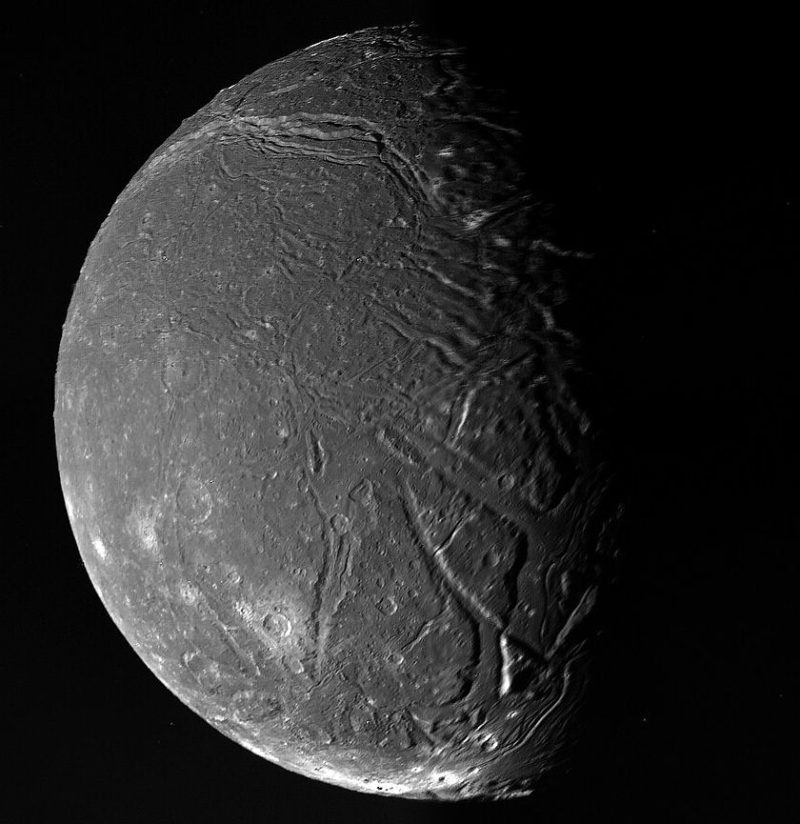
Ariel, the fourth-largest moon of Uranus, takes its name from a literary spirit of the air, a figure who appears both in Alexander Pope’s 1712 mock-epic The Rape of the Lock and in William Shakespeare’s 1611 play The Tempest. William Lassell discovered the moon on October 24, 1851, and the name was published by Sir John Herschel in 1852 at Lassell’s request. That’s the short version. The longer version involves lost letters, a quiet rebellion against Greek mythology, and a naming rule that still governs the Uranian system today.
Who Is Ariel in Literature?
Pope’s protective sylph
In Pope’s poem, Ariel is a sylph, an air spirit of some rank, assigned to guard the hair of Belinda from harm. The poem is satire, gorgeously overwrought, and Ariel functions as a kind of celestial bodyguard who ultimately fails. Which is funny, given that the moon named after him is the brightest of the five large moons of Uranus. Guard duty done properly, at last.
Shakespeare’s captive sprite
Shakespeare’s Ariel is a different animal. Bound to serve the magician Prospero, he conjures the storm that opens the play and spends five acts negotiating for freedom. How neatly that airy, storm-summoning character maps onto a planet named for the sky god. There’s even an etymological wink here, since some writers on Shakespeare’s moons have pointed out how close “Ariel” sits to “aerial.”
Dual-source distinction
Here is the detail most people miss. Ariel and Umbriel are the only Uranian moons whose names sit in both literary pools at once, and the Forsyth Astronomical Society’s rundown on Uranian naming treats Pope as the genuine outlier in a system otherwise dominated by Shakespeare. Titania, Oberon, Miranda: pure Shakespeare. Ariel: both.
Who Discovered the Moon and When?
Lassell’s 1851 observation
Lassell was a Liverpool brewer before he was an astronomer, and he funded his own reflecting telescopes with the fortune. On a single October night in 1851 he pulled two new Uranian satellites out of the glare of the giant planet, a feat the European Space Agency’s own calendar of astronomical history still marks. Not bad for a merchant with a grinding lathe.
Early placeholder labels
For years the moons carried Roman numerals rather than names, and the numbering shuffled as new discoveries came in. Ariel eventually settled as Uranus I, the designation still listed alongside its physical statistics in NOAA’s dataset for the moon. Numbering by distance from the planet, not by discovery order, which caused no end of confusion in nineteenth-century papers.
Path to official use
The literary names circulated informally for decades before the International Astronomical Union formalized planetary nomenclature. Today the registry lives in the USGS Gazetteer of Planetary Nomenclature, which governs not just moon names but every named crater and chasma on their surfaces.
Who Actually Chose the Name?
The Herschel attribution
The moon was named by Sir John Herschel, son of Uranus discoverer Sir William Herschel, at the request of the discoverer, William Lassell.
Lassell’s request
Lassell, by every account, deferred. He had found the objects; he wanted someone with the family pedigree to christen them. Understandable. The Herschel name carried weight in a way a brewer’s did not.
The lost correspondence
In 1899, Lassell’s daughter Jane told a reporter the names came from Herschel, “to whom my father applied.” The letters themselves are gone. So the honest answer is that we don’t know whether Herschel invented the names outright or simply blessed a shortlist Lassell had already drafted.
Why Air Spirits Suited Uranus
Sky god connection
Uranus is the Greek personification of the sky. Attending it with spirits of air rather than sea nymphs or war gods was elegant reasoning, the sort of thing that makes you nod before you notice how radical it was.
Break from classical myth
Before 1852, planets and satellites drew exclusively from Greek and Roman mythology. Jupiter had its Galilean four, Saturn its Titans. Herschel and Lassell reached into English literature instead, and Wikipedia’s survey of the Uranian moons traces how thoroughly that broke the mold.
Precedent for the IAU
| Naming pool | Example moons | Source |
|---|---|---|
| Shakespeare, The Tempest | Miranda, Titania (partly), Caliban, Sycorax | Elizabethan drama |
| Pope, The Rape of the Lock | Ariel, Umbriel, Belinda | 18th-century satire |
| Classical mythology | none in the Uranus system | Greek/Roman |
How the Uranian Naming System Works Today
Shakespeare and Pope pools
The rule is now codified: characters from Shakespeare or Pope, no mythology admitted. Surface features follow their own logic, and the Gazetteer’s target page for Ariel restricts crater and chasma names to bright or light spirits, which fits a moon whose icy crust reflects more sunlight than any of its siblings, something ESA and Hubble imaging of the Uranus system has documented across the giant planet’s long orbit.
Miranda and the rule shift
When Gerard Kuiper found Miranda in 1949, he named it for a mortal human, not a spirit. That quietly widened the rule. Any character qualifies now, supernatural or otherwise.
What Ariel’s Name Reveals About Science Communication
Frankly, the Shakespeare convention does more outreach work than most press releases. It gives the public a hook into a system that otherwise sounds like inventory. And it matters right now, because Ariel is a live scientific target: hints of a subsurface ocean, carbon dioxide ice concentrated on one hemisphere, cratered terrain cut by fresh chasmata. Johns Hopkins University Applied Physics Laboratory researchers have argued the case for geological activity, and Universe Today’s overview of the sprightly moon covers why the surface looks younger than Umbriel’s. Whether it qualifies as an ocean world is unsettled. I’d want multi-wavelength data and a dedicated Uranus orbiter before anyone declares it.
FAQ
Was Ariel named after the mermaid?
No. The moon predates the Disney film by 138 years.
Who found it?
William Lassell on October 24, 1851, alongside Umbriel.
Is Ariel the biggest Uranian moon?
No, that’s Titania. Ariel is fourth by size and first by brightness.
Conclusion
A brewer with a telescope, an astronomer’s son with a bookshelf, and a play about a shipwreck. That’s how a moon of Uranus got its name, and the convention it started still holds.
Would you like to receive similar articles by email?

Paul Tomaszewski
Paul Tomaszewski is a science & tech writer as well as a programmer and entrepreneur. He is the founder and editor-in-chief of CosmoBC. He has a degree in computer science from John Abbott College, a bachelor's degree in technology from the Memorial University of Newfoundland, and completed some business and economics classes at Concordia University in Montreal. While in college he was the vice-president of the Astronomy Club. In his spare time he is an amateur astronomer and enjoys reading or watching science-fiction. You can follow him on LinkedIn and Twitter.


You May Also Like
How Did the Planets Get Their Names
Comae Berenicid Meteor Shower Guide