How Circumbinary Planets Stay Stable: Key Mechanics
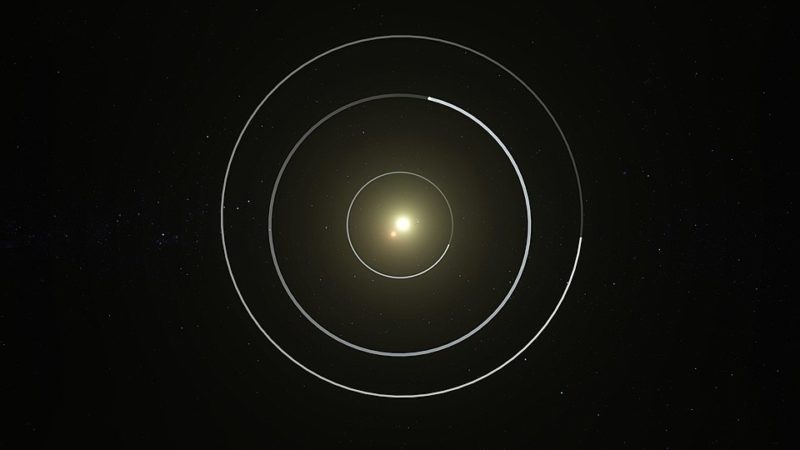
Circumbinary planets stay stable when they orbit far enough from both stars that the binary’s messy, fast-changing gravity begins to average out into something much smoother. That is the whole game. Get too close, and the planet’s orbit is kicked around by competing tugs, resonance overlap, and growing eccentricity until the path turns chaotic. Stay beyond the critical radius, and a long-lived circumbinary orbit becomes entirely plausible.
That sounds almost too tidy, I know. Two suns ought to mean disorder. Yet astronomy keeps discovering that disorder often has edges. In this case, we are talking about P-type systems, where a circumbinary planet goes around both stars together, not a single planet circling just one member of a binary. Kepler showed that such worlds exist, that their orbital stability is real, and that most of them seem to live in very particular neighborhoods rather than wandering wherever they like.
What keeps these worlds bound?
A stable planet orbit around a binary usually depends on three linked conditions:
- the planet stays beyond the binary’s inner chaotic zone
- its orbital period avoids the worst resonant kicks
- its eccentricity and tilt remain bounded over long time spans
Combined gravity
Far from the stars, the binary can act almost like one object centered near the barycenter. Not perfectly. Never perfectly. Still, if the planet year is much longer than the binary orbit, the rapid back-and-forth of the stars gets blurred into an averaged gravitational field. The figures from long-term stability studies of binary systems keep landing on the same conclusion: distance softens complexity.
That is why a circumbinary planet is not balancing between two equal pulls every moment. It is orbiting the combined mass, with extra perturbations layered on top. Small distinction, big consequence.
Chaotic inner zone
Move inward and the smoothing fails. The planet then feels periodic kicks from the binary at nearly the same orbital phases, and those kicks do not cancel neatly. They stack. Semimajor axis changes, orbit eccentricity grows, and unstable regions open up.
This is where systems get ugly. A planet can be scattered outward, driven into one star, or simply pushed into an unstable orbit that does not survive on any meaningful time scale. Work on the fate of unstable circumbinary planets shows that once a body slips inside that instability radius, survival odds drop hard.
Long-term balance
Long-term stability is less about a perfectly circular path than about bounded behavior. A planet may precess. Its inclination may breathe a little. Its planet eccentricity may oscillate. That can still be fine, provided the motion never wanders into resonance overlap or close encounters.
So the right mental picture is not a frozen clockwork model. It is a constrained dance.
Where does the safe orbit begin?
Critical radius
Astronomers usually describe the inner edge of safety with a critical radius, often expressed as a critical semimajor axis. The classic Holman and Wiegert criterion gives an empirical stability boundary based on the binary’s mass ratio and orbital eccentricity. It is not magic. It is a fitted result from numerical simulation, but it works remarkably well.
Most known circumbinary planets sit only a little beyond that line. That pile-up is not an accident.
Binary separation
A rough rule of thumb is that the stable orbit begins at about two to four times the distance between the two stars. Tight binary star systems can still host planets, but the planet has to live comfortably outside the stellar pair. If the stars are farther apart, the safe region moves outward with them. Same physics, larger map.
Eccentricity effect
Binary eccentricity matters a lot, more than many people expect. As the stars move on more elongated binary orbits, the perturbations become sharper and the unstable region grows wider. A high-eccentricity system such as Kepler-34 can still host planets, but the planet configuration has less room for error.
Which binary traits matter most?
| Binary trait | Why it matters | Typical effect on stability |
|---|---|---|
| Mass ratio | Sets the symmetry of the central potential | Shifts the exact critical radius |
| Orbit shape | Controls how violent the perturbations become | Higher eccentricity usually widens the instability hole |
| Stellar spacing | Sets the scale of the whole system | Larger spacing pushes stable orbits farther out |
Mass ratio
The stars do not need to be twins, but unequal masses change the detailed forcing felt by the planet. The mass ratio tweaks where stable planet orbits can exist. Oddly enough, this factor is usually secondary to eccentricity.
Orbit shape
Nearly circular binaries are kinder. Eccentric binaries stir the disk more aggressively during planet formation and can pump stronger eccentricity changes into later planet orbits. That makes both birth and survival harder.
Stellar spacing
Spacing is simple in principle. The wider the binary, the wider the circumbinary orbit must be in absolute terms. Relative spacing still matters because migration and resonance operate near the inner cavity of the circumbinary disk.
How do resonance and tilt affect survival?
Mean motion resonance
Resonance can protect or destroy. If the orbital harmonics line up badly, repeated kicks can destabilize the planet. If they land inside a safe resonant cell, a resonant planet may survive for ages. The classic Kepler-16 case is famous partly because resonance analysis suggests it sits in a protected part of phase space, bracketed by unstable resonances.
Precession
Precession changes the orientation of the orbit over time. That matters dynamically, and it matters observationally. Some planets stop transiting for years because the line of sight drifts. Transit probability studies make this point beautifully, and Kepler 413 is the poster child for that wobble. The orbit survives, but the geometry refuses to sit still.
Polar paths
Most circumbinary orbits lie close to the binary plane. Some do not. In eccentric systems, misaligned and even polar configurations can remain stable, which still feels a little offbeat even to people who work on exoplanets all day. The catch is that these are special orbital configurations, not the standard template.
What do surveys and models show?
Kepler systems
Kepler changed the conversation. Kepler-16, Kepler-47, Kepler-413, Kepler-1647 b, and the Kepler-47 system more broadly showed that circumbinary planets are real and stay stable across several architectures, including multi-planet systems. Kepler-47 in particular proved this was not a one-off novelty.
Edge populations
Observed planets cluster near the inner stable edge. That likely reflects migration. In hydrodynamic models of circumbinary disks and planet migration, planets often form farther out, drift inward through the gas disk, then stall near the cavity carved by the binary. So the edge population is not just where planets survive. It may also be where they get parked.
N-body results
N-body simulations, often run with tools like REBOUND, keep showing a familiar pattern:
- inner planet orbits are stripped away first
- outer planets survive more easily
- mutual tilts or extra companions can trigger secular trouble later
Why are these worlds relatively rare?
They are rare partly because nature makes them work for it. Planet formation in a circumbinary disk is rougher than around a single star. The binary excites the gas, raises collision speeds among planetesimals, and hollows out the inner disk. A young planet then has to migrate without falling into the unstable region. Plenty do not make it.
Observation bias is the other half. Transits in circumbinary systems are irregular, precession can hide them, and detection pipelines were built first for tidier single-star timing. So the dearth is real, but it is probably not absolute. We are still discovering the map.
What follow-up questions matter most?
The sharpest open questions are not whether orbital stability is possible. That part is settled. The live questions concern formation efficiency, the true occurrence rate around low-mass binaries, and how often multiple-planet systems remain stable after disk dispersal. Climate is another interesting wrinkle. A world with changing insolation is not automatically doomed, and climate models with ocean buffering suggest some of these planets could handle surprisingly uneven heating.
FAQ
Do circumbinary planets always have circular orbits?
No. Many have measurable eccentricities, and modest eccentricity can still be part of a stable orbit.
Can more than one planet survive around two stars?
Yes. Kepler-47 shows that multi-planet circumbinary systems are possible.
Are all tilted orbits unstable?
No. Some misaligned, even polar, orbital configurations can be stable for long periods.
Conclusion
Circumbinary planets remain stable for a plain reason wrapped in complicated math: distance tames the binary. Beyond the critical radius, the two-star system starts to behave like a manageable gravitational center rather than a dynamical ambush. Kepler’s discoveries, resonance studies, and numerical simulations all point the same way. These worlds are not impossible, just picky. And in science, picky systems are often the ones that teach the best lessons.
Would you like to receive similar articles by email?

Paul Tomaszewski
Paul Tomaszewski is a science & tech writer as well as a programmer and entrepreneur. He is the founder and editor-in-chief of CosmoBC. He has a degree in computer science from John Abbott College, a bachelor's degree in technology from the Memorial University of Newfoundland, and completed some business and economics classes at Concordia University in Montreal. While in college he was the vice-president of the Astronomy Club. In his spare time he is an amateur astronomer and enjoys reading or watching science-fiction. You can follow him on LinkedIn and Twitter.


You May Also Like

The Necklace Nebula: A Heavenly Jewel in Our Universe
What Is a Bok Globule?