How Are Astronomers Able to Explore the Layers of the Sun Below the Photosphere?
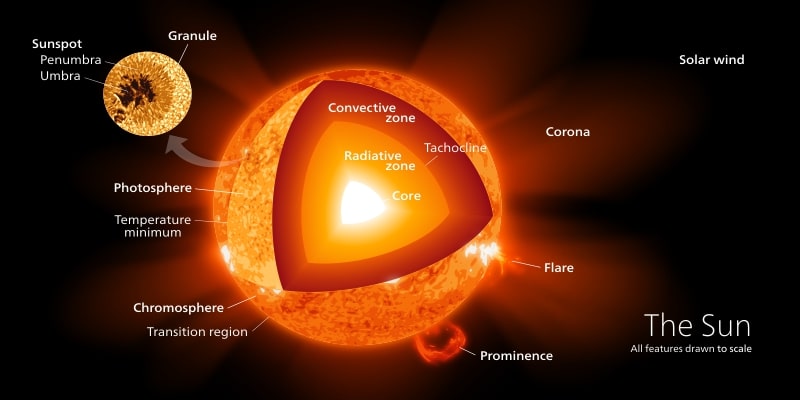
The Sun, our nearest star, has always captivated the curiosity of humans. While the bright photosphere is what we most commonly associate with the Sun’s appearance, astronomers have made significant strides in exploring the layers beneath the photosphere. Understanding these deeper layers is crucial for our comprehension of solar processes and phenomena.
So, how exactly do astronomers explore the layers of the Sun below the photosphere? Because the Sun’s interior cannot be observed directly, scientists rely on a combination of indirect techniques and models to study it. The main methods are outlined below:
Helioseismology
Helioseismology is the study of the Sun’s internal structure and dynamics using observations of its surface oscillations (often called solar oscillations, sometimes informally referred to as “sunquakes”). Similar to how seismologists study earthquakes on Earth, helioseismologists analyze the waves that travel through the Sun. As a result, they gain insights into its interior.
By observing the changes in the Sun’s surface caused by these internal waves, astronomers can infer information about the density, temperature, and composition of the layers below the photosphere. In particular, this technique has provided scientists with valuable data on the Sun’s core, radiative zone, and convective zone.
These oscillations are primarily pressure waves (p-modes), which travel through much of the Sun’s interior. Scientists also search for gravity waves (g-modes), which would provide even deeper insights into the core, though they are difficult to detect.
Helioseismology has also revealed that the Sun rotates differentially beneath its surface, with different layers rotating at different speeds. In addition, it has uncovered large-scale internal flow patterns.
Recent advances in global and local helioseismology, especially using data from instruments like the Helioseismic and Magnetic Imager (HMI) aboard the Solar Dynamics Observatory, have further enhanced our understanding of the Sun’s interior dynamics.
Solar Spectroscopy
Another powerful tool for exploring the Sun’s outer layers is solar spectroscopy. Astronomers use spectrographs to study the Sun’s spectrum of light, which reveals an abundance of information about its chemical composition and physical properties.
By analyzing the absorption and emission lines in the Sun‘s spectrum, scientists can determine the elements present and their quantities within different layers of the Sun.
This technique is especially effective for investigating the temperature, density, and magnetic fields in the Sun’s outer layers—such as the photosphere, chromosphere, and transition region. However, it does not probe the deeper layers beneath the photosphere. Instead, it provides essential surface data that supports models of the Sun’s interior.
Solar Magnetic Field Measurements
The Sun’s magnetic field plays a pivotal role in shaping its behavior and driving various solar phenomena. Astronomers have developed sophisticated instruments to measure the Sun’s magnetic field. They also investigate its structure at and above the photosphere.
By studying the Sun’s magnetic field lines using methods like magnetographs and polarimeters, astronomers can measure magnetic fields at the surface and infer what may be happening below it. Consequently, these measurements provide insights into how the Sun’s magnetic activity drives solar flares, coronal mass ejections, and other fascinating phenomena.
Subsurface magnetic structures, such as those that give rise to sunspots and emerging magnetic flux, are not directly observed but are inferred using surface measurements combined with helioseismology and theoretical models.
Solar Neutrino Detection
One of the only ways scientists can directly probe the Sun’s core is through the detection of solar neutrinos—tiny, nearly massless particles produced during nuclear fusion reactions.
Because neutrinos interact very weakly with matter, they escape from the Sun’s core and travel to Earth almost unimpeded. As a result, they carry direct information about the fusion processes occurring deep inside the Sun.
Experiments such as the Sudbury Neutrino Observatory and Super-Kamiokande have confirmed theoretical models of the Sun’s energy production and helped resolve the long-standing “solar neutrino problem.”
Solar Space Missions
To get a more detailed understanding of the Sun’s interior, astronomers have developed dedicated space missions to study our star up close. Missions like the Solar and Heliospheric Observatory (SOHO), the Solar Dynamics Observatory (SDO), and the Parker Solar Probe were designed to gather data about the layers beneath the Sun’s photosphere.
These missions employ a range of instruments, including telescopes, spectrometers, and magnetometers, to observe and measure different aspects of the Sun’s layers. Therefore, the data collected by these missions provides the high-resolution observations needed to support helioseismology and improve models of the Sun’s internal structure.
More recent missions, such as ESA and NASA’s Solar Orbiter (launched in 2020), complement these efforts by providing close-up views of the Sun’s polar regions and inner heliosphere. In addition, Parker Solar Probe has crossed into the Sun’s corona, passing the Alfvén critical boundary—a milestone in solar exploration.
The Role of Solar Models
In addition to observational techniques, astronomers rely heavily on theoretical models—such as the Standard Solar Model—to understand the Sun’s interior. These models combine physics with observational data from helioseismology, neutrino detection, and surface measurements. In turn, these are used to reconstruct the structure and behavior of the Sun’s inner layers.
Conclusion
Astronomers are able to explore the layers of the Sun below the photosphere using a variety of techniques such as helioseismology, solar neutrino detection, magnetic field measurements, and dedicated solar space missions.
Because most of these methods are indirect, scientists combine observational data with theoretical models to build a detailed picture of the Sun’s interior. Together, these approaches have helped unravel the mysteries of the Sun’s inner structure and improved our understanding of how stars function.
See also: How Is the Sunspot Cycle Directly Relevant to Us Here on Earth?
Would you like to receive similar articles by email?

Paul Tomaszewski
Paul Tomaszewski is a science & tech writer as well as a programmer and entrepreneur. He is the founder and editor-in-chief of CosmoBC. He has a degree in computer science from John Abbott College, a bachelor's degree in technology from the Memorial University of Newfoundland, and completed some business and economics classes at Concordia University in Montreal. While in college he was the vice-president of the Astronomy Club. In his spare time he is an amateur astronomer and enjoys reading or watching science-fiction. You can follow him on LinkedIn and Twitter.


You May Also Like
Libra Constellation Guide
Mensa Constellation Guide