Horologium Constellation Guide
Horologium is a faint southern constellation created in the 18th century to honor the pendulum clock. It has no ancient Greek myth, no dramatic hero, and no especially bright stars. What it does have is a fascinating connection to precision science, difficult observing conditions, and several worthwhile galaxies hidden in a relatively quiet region of the sky.
What Is Horologium?
Modern Southern Constellation
Horologium, abbreviated Hor and formally associated with the genitive Horologii, is one of the 88 modern constellations recognized by the International Astronomical Union. The IAU constellation data lists its official astronomical designation and boundaries.
The name comes from the Latin word for clock. In older references, it sometimes appears as Horologium Oscillatorium, meaning “the pendulum clock.” That longer name points directly toward its historical purpose.
Size And Boundaries
Covering roughly 249 square degrees, Horologium ranks among the smaller constellations. Its boundaries sit deep in the southern celestial hemisphere, where the stars appear low or remain entirely invisible to many observers north of the equator.
It is a faint constellation, too. Alpha Horologii, its brightest star, has an apparent magnitude near 3.9. That makes it visible without optical aid under a dark sky, but the rest of the pattern is far less cooperative. Horologium often looks like a dim patch rather than a crisp, memorable figure.
Scientific Significance
Its sparse stellar arrangement has a useful advantage. Horologium lies away from the densest visible band of the Milky Way, so the field contains less foreground dust and fewer bright nearby stars. That leaves distant galaxies easier to study and photograph.
The region includes galaxies such as NGC 1512, IC 1954, and NGC 1448. Far beyond them, astronomers also study large-scale galaxy structures in the direction of Horologium, including the Horologium Supercluster.
How Did Horologium Get Its Name?
Lacaille’s Southern Survey
French astronomer Nicolas-Louis de Lacaille introduced Horologium during his survey of the southern sky in the 1750s. Working from the Cape of Good Hope, Lacaille mapped stars that were difficult or impossible to observe from Europe.
His new constellations did not usually draw on ancient mythology. Instead, many celebrated instruments, tools, and scientific ideas. The southern sky became a kind of historical diagram of Enlightenment technology.
Huygens’ Pendulum Clock
Horologium honors Christiaan Huygens, the Dutch scientist who developed the first practical pendulum clock in 1656. The pendulum dramatically improved timekeeping, which mattered greatly in astronomy.
Accurate clocks allowed observers to record when a star crossed the local meridian. Those transit times helped astronomers determine celestial coordinates, improve star catalogs, and calculate longitude. A clock, in other words, was part of the observing equipment, not merely a household object.
Enlightenment Astronomy
Lacaille’s naming choice reflects an era when astronomy, navigation, engineering, and mathematics were tightly connected. Horologium represents that practical side of science. It celebrates the machinery behind celestial discovery.
The constellation’s official boundaries were standardized much later, when astronomers created the modern system of 88 constellations. The historical account of Horologium also explains how its original star figures and designations changed over time.
What Myth Explains Horologium?
No Ancient Mythology
There is no classical myth explaining Horologium. Ancient Greek and Roman astronomers never recognized a pendulum clock because the device did not yet exist.
That distinction matters. Horologium is a modern cultural constellation, not a surviving fragment of mythology. Its meaning comes from scientific history rather than gods, monsters, or legendary voyages.
A Tribute To Technology
The “story” of Horologium is the rise of accurate measurement. Huygens’ clock improved the measurement of time, while Lacaille’s observations expanded European knowledge of the southern celestial hemisphere.
Oddly enough, the constellation is more revealing as history than as a star picture. Its dim outline tells us little about a clock, but its name preserves the connection between mechanical innovation and astronomy.
Historical Star Catalogs
Early catalogs assigned Greek letters to some stars in Horologium, but several were extremely faint. Later catalogers altered or dropped some designations, which explains why historical charts do not always match modern ones.
Where Is Horologium Located?
Neighboring Constellations
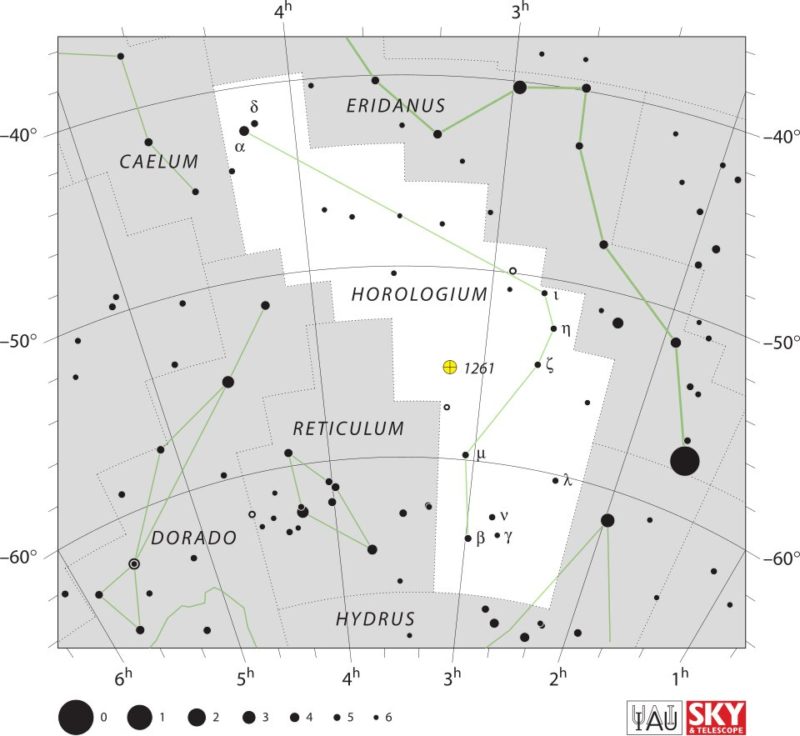
Horologium is bordered by Eridanus to the north, Caelum to the west, Reticulum to the south, and Dorado and Hydrus toward the east and southeast. The constellation boundary guide is useful when moving between these dim southern patterns.
Achernar, the bright star in Eridanus, is an especially helpful landmark. From Achernar, scan southward and slightly west for the subdued stars of Horologium.
Southern Celestial Hemisphere
The constellation lies at southern declinations, making it best suited to observers in Australia, New Zealand, southern Africa, southern South America, and Antarctica. Observers in the United States may glimpse it from southern locations, but much of the pattern stays low above the horizon.
From Alaska and most northern temperate regions, Horologium is not realistically observable.
Galactic Position
Because it sits away from the Milky Way’s crowded central plane, the constellation offers a cleaner window toward external galaxies. This does not make those galaxies bright. It simply reduces some of the visual clutter between Earth and distant targets.
When And How Can You See It?
Horologium is best viewed during late spring and summer evenings in the Southern Hemisphere, with December commonly regarded as its most favorable month. Look toward the southern sky after dusk and begin with Achernar in Eridanus.
The constellation is challenging under suburban lighting. Use binoculars first, then a telescope for its galaxies. A star chart or planetarium app will help because the main outline lacks a strong geometric shape. Give your eyes time to adjust, and observe when the constellation is highest above the horizon.
Which Stars Shine In Horologium?
Alpha Horologii is the dominant star, an orange giant of approximately magnitude 3.9. Its warm color is easier to notice through binoculars than with the naked eye.
Beta Horologii, Delta Horologii, and Eta Horologii are fainter stars that help define the pattern. R Horologii is more unusual: it is a Mira-type variable star whose brightness changes substantially over a cycle of roughly 400 days. The AAVSO variable-star resources can help observers follow such changes, although the star may require a telescope when near minimum brightness.
| Star | Characteristic |
|---|---|
| Alpha Horologii | Bright orange giant, about magnitude 3.9 |
| Beta Horologii | Faint boundary star |
| R Horologii | Mira-type variable star |
| Delta and Eta Horologii | Useful stars for tracing the constellation |
Which Deep-Sky Objects Lie Within It?
NGC 1512 is the standout target, a barred spiral galaxy roughly 30 million light-years from Earth. Its elongated central bar feeds material toward the nucleus and helps shape its spiral structure. Hubble observations reveal details that small amateur telescopes cannot resolve, as shown in this NGC 1512 observation.
Nearby NGC 1510 is a smaller companion galaxy interacting with NGC 1512. Their gravitational relationship has influenced star formation in both systems.
IC 1954 is another spiral galaxy, located about 45 million light-years away. Astronomers have combined optical observations with radio data to examine its star-forming gas, a process documented in this Hubble and ALMA study. NGC 1448, an edge-on spiral galaxy, is also found in the constellation and makes a demanding but rewarding imaging target.
FAQ
Is Horologium visible from the Northern Hemisphere?
Only from low northern latitudes, and then close to the southern horizon. It is much easier to observe south of the equator.
Does Horologium have a mythology?
No. It was created in the 18th century by Nicolas-Louis de Lacaille as a tribute to the pendulum clock.
What is the brightest star in Horologium?
Alpha Horologii is the brightest, with an apparent magnitude near 3.9.
What is Horologium known for?
It is known for its Enlightenment-era origin, faint stars, the variable star R Horologii, and deep-sky galaxies such as NGC 1512 and IC 1954.
Conclusion
The Horologium constellation is easy to overlook, which is precisely why it deserves a closer look. Its dim stars preserve the history of timekeeping, navigation, and southern-sky exploration, while its galaxies open a view toward structures far beyond the Milky Way. It is less a dramatic celestial portrait than a quiet record of human curiosity, drawn across the southern night.
Would you like to receive similar articles by email?

Paul Tomaszewski
Paul Tomaszewski is a science & tech writer as well as a programmer and entrepreneur. He is the founder and editor-in-chief of CosmoBC. He has a degree in computer science from John Abbott College, a bachelor's degree in technology from the Memorial University of Newfoundland, and completed some business and economics classes at Concordia University in Montreal. While in college he was the vice-president of the Astronomy Club. In his spare time he is an amateur astronomer and enjoys reading or watching science-fiction. You can follow him on LinkedIn and Twitter.


You May Also Like

Europa vs. Enceladus: Subsurface Ocean Evidence Comparison

What Is an Inflatable Planetarium Dome