Hercules Constellation Guide
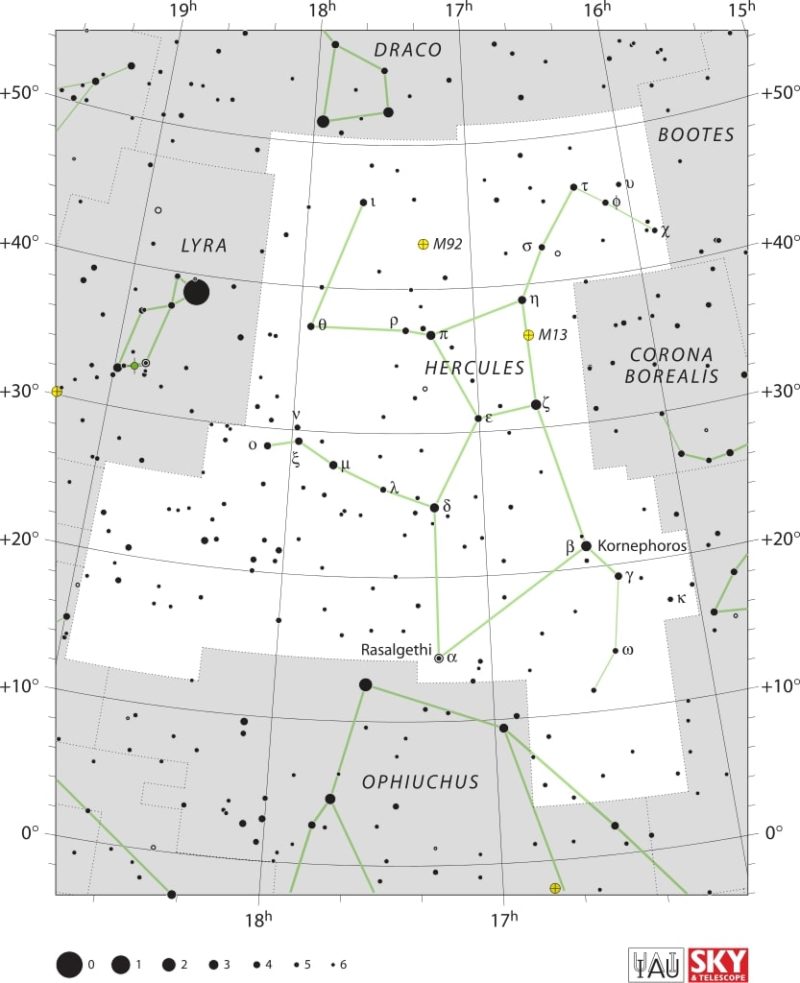
The Hercules constellation represents Heracles, the legendary Greek hero known for extraordinary strength and the Twelve Labors. It is one of the 88 modern constellations, occupying a broad patch of the northern sky between Boötes and Lyra. Its most famous treasures are the globular clusters Messier 13 and Messier 92, while its most recognizable feature is the four-star Keystone asterism.
Hercules can look unimpressive at first glance. The stars are fairly faint, and the figure requires imagination. Yet under a dark sky, this region becomes a rewarding destination, packed with ancient star clusters and a mythology that reaches back to Greek and Roman storytelling.
What Does Hercules Represent in Greek Mythology?
The Twelve Labors
Greek mythology identifies Hercules with Heracles, the son of Zeus and Alcmene. Hera, angered by Zeus’s infidelity, persecuted the hero throughout his life. In one tragic episode, Hercules was driven into a state of madness and killed his wife and children. His Twelve Labors were assigned as penance, although later traditions sometimes frame them as a test of his heroic status.
The labors included defeating the Nemean Lion, destroying the many-headed Lernaean Hydra, capturing the Erymanthian Boar, and retrieving the Golden Apples of the Hesperides. The mythological history of Hercules also includes his struggle with the giant Antaeus and his role in supporting the sky while Atlas retrieved the apples.
The constellation’s posture is unusual. Hercules is often shown kneeling, with one foot near the head of Draco, the dragon. Some ancient illustrations portray him holding a club or the skin of the Nemean Lion, though the stars themselves do not form an especially obvious human figure.
Roman Interpretations
Roman writers adopted Heracles as Hercules and folded his story into their own religious and literary traditions. The name Hercules became more familiar in Europe than Heracles, which is why modern star charts use the Roman form.
That distinction matters when exploring older sources. The hero is the same mythological entity, but Greek and Roman authors emphasized different details, names, and cultural meanings.
Celestial Placement
According to one tradition, Zeus placed Hercules among the stars after the hero’s death. Another interpretation connects the constellation with Hercules defeating the dragon Ladon during the quest for the Golden Apples. Mythology rarely behaves like a tidy database, and several versions can coexist without producing a single official answer.
How Did Ancient Astronomers Record Hercules?
Ptolemy’s Catalog
Hercules was included among the 48 constellations listed by the Greek astronomer Claudius Ptolemy in the second century. His work, the Almagest, helped preserve the constellation through centuries of astronomical study and later became a foundation for Western star mapping.
Modern astronomy keeps the name but uses precisely defined boundaries. The International Astronomical Union’s constellation system treats Hercules as a designated region of the sky, not merely a recognizable pattern of stars.
Earlier Traditions
The constellation’s story may draw from older Mesopotamian star figures, especially depictions of a kneeling hero or warrior. Ancient sky cultures did not divide the heavens in exactly the same way, so direct one-to-one identification is difficult. Hercules developed through a long chain of retelling, cataloging, and artistic reinterpretation.
Modern Boundaries
Hercules covers about 1,225 square degrees, making it the fifth-largest constellation. Its official abbreviation is Her. The region contains stars, globular clusters, double stars, and distant galaxies, although many of these objects require optical aid.
Which Stars Define the Figure?
Beta Herculis
Beta Herculis, also called Kornephoros, is the brightest star in the constellation. It is a yellow giant located roughly 140 light-years from Earth. The name means “club-bearer,” matching the traditional image of Hercules carrying his weapon.
Zeta Herculis
Zeta Herculis is a binary star system and one of the useful points in the constellation’s central pattern. It is less visually dominant than Kornephoros, but its position helps form the Keystone, the compact quadrilateral that makes Hercules easier to recognize.
Keystone Asterism
The Keystone consists of four stars: Epsilon, Zeta, Eta, and Pi Herculis. It resembles a slightly skewed rectangle and acts as the practical gateway to Messier 13.
For a first attempt, look between bright Vega in Lyra and Arcturus in Boötes. The Keystone’s location between these bright guide stars gives observers a useful starting point, especially during summer evenings in the Northern Hemisphere.
Which Deep-Sky Objects Stand Out?
Messier 13, also known as the Great Hercules Cluster, is the constellation’s headline attraction. It is a globular cluster containing more than 100,000 densely packed stars, according to NASA’s Hubble observations. The cluster lies around 22,000 light-years away and appears as a faint, hazy patch through binoculars.
A small telescope begins to resolve its outer stars. Larger instruments reveal the cluster’s grainy texture and concentrated core. Charles Messier cataloged it in the eighteenth century, while Edmond Halley had already recorded it earlier. Historical observing notes and discovery details are preserved in the Messier 13 records.
Messier 92 is another globular cluster in Hercules. It is slightly less celebrated than M13 but remarkably beautiful, containing hundreds of thousands of old stars. It sits about 26,000 light-years away and is a rewarding target for small telescopes. The Messier 92 database provides its coordinates and observing history.
Far beyond these star clusters lies Hercules A, a powerful radio galaxy roughly 2.2 billion light-years away. It is not a casual backyard target, but it reveals how a constellation can serve as a visual address for objects separated by immense distances.
When and Where Can You See It?
Hercules is best viewed from late spring through early autumn in the Northern Hemisphere, with the strongest evening visibility generally occurring in June and July. It is also visible from much of the Southern Hemisphere, although it appears lower above the horizon and may be harder to observe.
The constellation rises in the northeast, climbs high in the sky, and later moves toward the west. Light pollution washes out many of its fainter stars, so a rural location or designated dark-sky site makes a substantial difference.
How Do You Observe Its Main Features?
Start without equipment. Find Vega, one of the brightest stars in the northern sky, then shift your attention toward the area between Vega and Arcturus. Once the Keystone appears, aim binoculars at the northern side of the asterism to search for M13.
A telescope with a 4-inch aperture can show M13 as a mottled glow under decent conditions. M92 is somewhat more demanding because of its position and smaller apparent size. The NASA Night Sky Network’s observing guidance supports using binoculars to become familiar with the field before moving to a telescope.
Use a red flashlight, allow your eyes at least 20 minutes to adapt, and avoid judging the sky from a brightly lit driveway. Astronomy rewards patience more than frantic equipment upgrades.
FAQ
Is Hercules a zodiac constellation?
No. Hercules is a northern constellation and is not part of the zodiac. The zodiac constellations lie along the ecliptic, the Sun’s apparent annual path.
What is the brightest star in Hercules?
Beta Herculis, or Kornephoros, is generally recognized as the constellation’s brightest star.
Can you see Hercules with the naked eye?
Yes. Its brighter stars and Keystone asterism are visible without equipment, although its shape may be difficult to interpret from light-polluted locations.
Which object is most famous in Hercules?
Messier 13 is the best-known deep-sky object in Hercules. It is one of the finest globular clusters visible from the Northern Hemisphere.
Conclusion
Hercules is a constellation where mythology and observational science overlap neatly. The kneeling hero of Greek legend occupies a large northern sky region, while M13 and M92 expose dense stellar systems formed long before human history. Once the Keystone becomes familiar, Hercules stops looking like a random scattering of stars and starts becoming a reliable route into deeper astronomy.
Would you like to receive similar articles by email?

Paul Tomaszewski
Paul Tomaszewski is a science & tech writer as well as a programmer and entrepreneur. He is the founder and editor-in-chief of CosmoBC. He has a degree in computer science from John Abbott College, a bachelor's degree in technology from the Memorial University of Newfoundland, and completed some business and economics classes at Concordia University in Montreal. While in college he was the vice-president of the Astronomy Club. In his spare time he is an amateur astronomer and enjoys reading or watching science-fiction. You can follow him on LinkedIn and Twitter.


You May Also Like
Ara Constellation Guide
NGC 2359: A Closer Look at Thor’s Helmet Nebula