Grus Constellation Guide
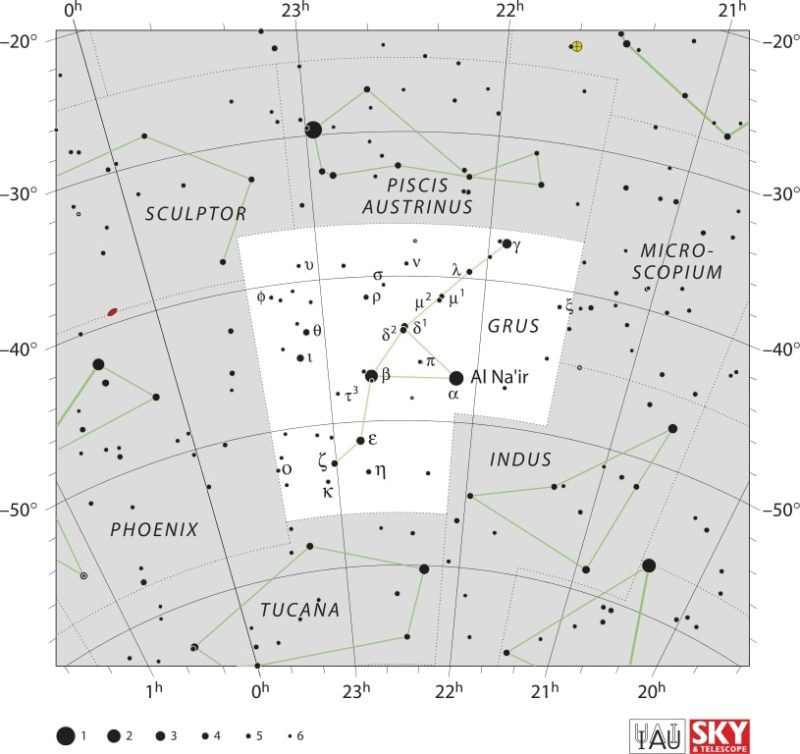
Grus is easy to overlook. Its brightest star, Alnair, is striking, but the rest of the pattern can look like a faint, slightly awkward bird sketched across the southern sky. That modest appearance hides a richer story: Grus is a modern constellation created during the great age of celestial mapping, a region containing unusual galaxies, a planetary nebula, and a wonderfully tangled mixture of Latin, Dutch, and Arabic astronomical traditions.
What Is the Celestial Crane?
Name and Symbol
The name Grus is Latin for “crane,” a long-legged bird often associated with vigilance and migration. Unlike Orion or Scorpius, it has no surviving classical myth attached to it. The crane’s meaning comes from its shape and symbolism rather than an ancient tale handed down through Greek poetry.
The International Astronomical Union’s constellation framework recognizes Grus as one of the 88 official constellations. It is a defined patch of sky, not a physical group of related stars. The stars may sit at very different distances from Earth, appearing together only because of our viewing angle.
Southern-Sky Identity
Grus belongs to the family of southern birds, along with Phoenix, Tucana, and Pavo. It occupies the fourth quadrant of the southern celestial hemisphere, where the Milky Way becomes less dominant and faint galaxies become more rewarding targets.
That position gives Grus a distinctive character. Observers in the southern hemisphere see it high above the horizon, while people in northern latitudes may find only Alnair and its neighboring stars before they sink into atmospheric haze.
Visual Impression
The whole constellation resembles a crane stretching its neck toward the west. Alnair marks the bird’s body or lower neck, while Beta Gruis and Gamma Gruis help form the wings and headward extension. Frankly, it is more suggestive than obvious. Under suburban light pollution, Grus may look like a crooked line or a dim cross.
Where Can You Find It?
Neighboring Constellations
Grus lies near Piscis Austrinus, Microscopium, Sculptor, Phoenix, Indus, and Tucana. Its brightest guide star, Alnair, is southeast of Fomalhaut, the prominent star in Piscis Austrinus. This relationship is useful because Fomalhaut is much easier to identify from northern locations.
Boundaries and Coordinates
Grus covers roughly 366 square degrees, placing it around 45th among the 88 official constellations. Its boundaries extend approximately from right ascension 21 hours 27 minutes to 23 hours 27 minutes, and from declination 37 degrees south to 57 degrees south. The IAU constellation boundaries were standardized in the twentieth century, long after the original bird was first placed on a celestial globe.
Seasonal Visibility
October is generally the best month to observe Grus, when it reaches a favorable position during evening hours. It is visible from latitudes as far north as about 34 degrees north, though only briefly and very low in the sky. From southern Australia, southern Africa, New Zealand, and South America, the constellation becomes a much easier target.
For northern observers, timing matters. Look south shortly after nightfall in autumn, choose a location with an unobstructed southern horizon, and expect the lower stars to shimmer because Earth’s atmosphere is doing its usual optical mischief.
Which Stars Define Its Shape?
Alnair
Alpha Gruis, better known as Alnair, is a blue-white main-sequence star with an apparent magnitude near 1.7. The name comes from Arabic and means “the bright one,” though its full historical meaning refers to a bright star in the fish’s tail. That older association connects it directly with Piscis Austrinus.
Alnair’s stellar position and brightness make it the practical starting point for finding Grus. It is bright enough to stand out even when the rest of the pattern is faint.
Beta and Gamma Gruis
Beta Gruis is a cool red giant and one of the constellation’s most prominent stars. Gamma Gruis, a blue-white star, helps extend the crane’s body toward the east. Together, Alpha, Beta, and Gamma create the broad framework that makes the bird recognizable.
The color contrast is subtle but pleasing: Alnair appears white or blue-white, while Beta Gruis has the warmer tone associated with a giant star.
Delta and Mu Gruis
Delta Gruis and Mu Gruis are rewarding tests under dark skies. Their apparent pairings can be separated with careful naked-eye observation by experienced observers, although binoculars make the relationship far easier to appreciate. A small telescope reveals additional companions and turns the region into a quiet double-star exercise rather than a parade of spectacular objects.
Which Deep-Sky Objects Reward Observation?
Grus Quartet
The Grus Quartet consists of four interacting galaxies: NGC 7552, NGC 7582, NGC 7590, and NGC 7599. These galaxies are bound together by perspective and gravitational environment, not by the same sort of stellar structure seen in an open cluster.
The Grus Quartet requires a dark sky and a telescope with enough aperture to separate the faint smudges. NGC 7582, a barred spiral galaxy with an angular size of roughly 7 by 3 arcminutes, is among the more substantial members.
Spare Tyre Nebula
IC 5148, nicknamed the Spare Tyre Nebula, is a planetary nebula with a near-circular form. Despite the name, it has nothing to do with planets. The term “planetary nebula” describes the round appearance early astronomers noticed through small telescopes, not a cloud surrounding a planet.
A moderate telescope under dark skies can show its ring-like structure, while an oxygen-III filter may improve contrast. It is one of those objects that looks plain in a photograph until the eye catches its geometry.
Notable Galaxies
Grus contains several other galaxies suitable for imaging and large-aperture observation. The field is especially interesting because it sits away from the densest Milky Way star clouds, allowing distant galaxies to emerge from the background. In this part of the sky, patience often matters more than spectacle.
What History and Myth Shape Its Meaning?
Dutch Cartography
Grus was introduced in the late sixteenth century through the work of Dutch navigators Pieter Dirkszoon Keyser and Frederick de Houtman, later incorporated into maps associated with the Flemish astronomer Petrus Plancius. It appeared during an era when European cartographers were adding unfamiliar southern stars to the celestial atlas.
Piscis Austrinus
Some stars now assigned to Grus were once treated as part of the tail of Piscis Austrinus, the southern fish. This explains why Alnair carries an Arabic name linked to a fish while sitting inside a Latin-named crane. Astronomy is full of these historical seams. They are messy, but revealing.
Arabic Star Names
Arabic star names often preserve older observational traditions that traveled across languages and empires. Alnair is a particularly neat example: a bird in modern European cartography carrying a name rooted in the fish beside it.
How Do You Locate It?
Use Alnair
Begin with Fomalhaut if it is visible, then move southeast toward the brighter Alnair. From a southern location, Alnair may be found directly by looking for the prominent blue-white star beneath the broader southern sky.
Trace the Crane
Once Alnair is located, follow the dimmer stars toward Beta Gruis and Gamma Gruis. Do not expect a crisp outline. The crane emerges gradually as your eyes adapt to the darkness.
Confirm Nearby Patterns
Check the surrounding patterns of Piscis Austrinus, Sculptor, Tucana, and Indus. A planisphere or astronomy app can help, but binoculars are often better than a telescope for the first sweep because they preserve the constellation’s larger shape.
Choose the Right Observing Conditions
Dark skies make the greatest difference. Give your eyes at least 20 minutes to adapt, avoid bright phone screens, and choose a night when the Moon is below the horizon. Binoculars reveal the star field, while a 6-inch telescope is a sensible starting point for IC 5148 and the brighter galaxies.
For northern observers, atmospheric extinction is the real enemy. Grus may technically rise, yet remain too low for satisfying detail. Southern locations have the advantage, especially when Alnair and the surrounding stars pass high overhead.
FAQ
Is Grus an ancient constellation?
No. Grus is a modern constellation created during late-sixteenth-century Dutch celestial mapping. It has no established classical Greek myth.
What is the brightest star in Grus?
Alnair, or Alpha Gruis, is the brightest star, with an apparent magnitude of about 1.7.
When is Grus easiest to see?
October is generally the best month for evening observation, particularly from the southern hemisphere.
Can northern observers see Grus?
Yes, from some northern latitudes, but only the northernmost portion rises. Alnair may be visible from around 34 degrees north under favorable conditions.
Conclusion
Grus rewards the observer who stays with it. It may begin as a faint stick figure, then open into a lesson in cartography, Arabic astronomy, southern navigation, stellar evolution, and interacting galaxies. The crane is not loud in the night sky. It is subtler than that, and perhaps more interesting for the restraint.
Would you like to receive similar articles by email?

Paul Tomaszewski
Paul Tomaszewski is a science & tech writer as well as a programmer and entrepreneur. He is the founder and editor-in-chief of CosmoBC. He has a degree in computer science from John Abbott College, a bachelor's degree in technology from the Memorial University of Newfoundland, and completed some business and economics classes at Concordia University in Montreal. While in college he was the vice-president of the Astronomy Club. In his spare time he is an amateur astronomer and enjoys reading or watching science-fiction. You can follow him on LinkedIn and Twitter.


You May Also Like

Stargazing Calendar for September 2026
How Did Dwarf Planet Salacia Get Its Name