Gemini Constellation Guide
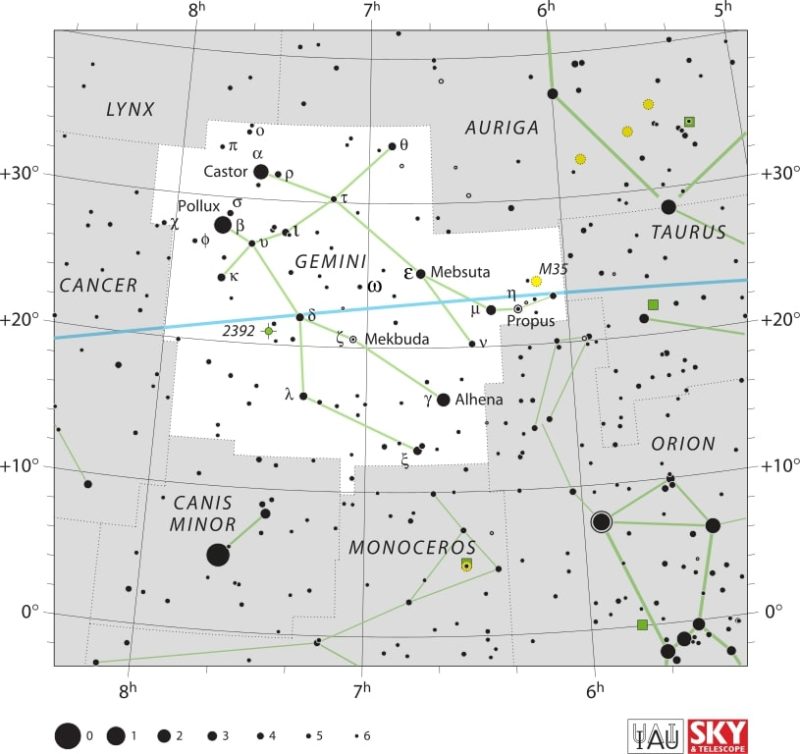
Gemini is a northern zodiacal constellation best recognized by its two bright stars, Castor and Pollux. It lies between Taurus and Cancer, above Orion during northern-hemisphere winter, and becomes easiest to observe from December through February. Its neat twin-star pattern is only the surface. Gemini also contains rich open clusters, a famous planetary nebula, and the radiant point of the Geminid meteor shower.
The constellation has earned a reputation as a busy crossroads in the sky. The Sun, Moon, and planets pass through its region because Gemini lies close to the ecliptic, the apparent path of the Sun across the heavens. That placement gives the Gemini star constellation unusual visibility and historical importance.
What Is Gemini, and Where Is It Located?
Northern Sky
Gemini occupies an area of roughly 514 square degrees in the northern sky. Its official boundaries are set by the International Astronomical Union, so the constellation is a defined region rather than merely the familiar stick-figure pattern drawn between its stars. Its position is centered near right ascension 7 hours and declination +20 degrees, although the visible figure extends well beyond that central point.
From much of the United States, Canada, and Europe, Gemini rises in the east during the evening in late autumn, reaches a comfortable height during winter, then shifts toward the west as spring approaches. Observers farther south can also see it, though the constellation sits lower above the horizon.
Zodiac Position
Gemini is one of the 12 zodiacal constellations, meaning the ecliptic crosses its boundaries. The constellation sits between Taurus to the west and Cancer to the east. Auriga lies northward, while Orion and Monoceros occupy much of the southern view. A scientific profile of Gemini gives a useful sense of its boundaries, visibility, and neighboring constellations.
Seasonal Visibility
Gemini is most rewarding from December through February, when it stands high in the evening sky. In December, look east after sunset. By January, it is prominent overhead, and in February it begins drifting westward during the first part of the night.
The best observing window depends on latitude, local horizon, and light pollution. A dark rural location reveals far more than a city park, particularly around M35 and the fainter stars that shape the twins.
How Do You Find It Among Nearby Constellations?
Orion’s Pointer
Orion is the easiest route into Gemini. Find Betelgeuse, the reddish star marking Orion’s shoulder. Draw an imaginary line from Rigel through Betelgeuse and continue northward. The line leads toward Gemini, although Castor and Pollux sit somewhat above and to the left of that path depending on your viewing direction.
A second route begins with Orion’s Belt. Follow the belt upward and westward toward Taurus, then sweep northeast toward Auriga and Gemini. The sky is three-dimensional, so these directions can feel slippery at first. Give your eyes a few minutes to adapt.
Auriga and Taurus
Capella, the bright star in Auriga, forms a useful northern landmark. Castor lies southeast of Capella, while Pollux appears below and slightly east of Castor. Taurus, recognizable through Aldebaran and the Pleiades, marks Gemini’s western neighborhood.
For a practical star-hopping route, use this sequence:
- Locate Orion and its three-star Belt.
- Identify bright orange Aldebaran in Taurus.
- Move northeast toward Capella in Auriga.
- Search between those landmarks for Castor and Pollux.
Which Stars Define the Twin Figures?
Castor’s Six Stars
Castor, designated Alpha Geminorum, appears as one white star to the unaided eye. Through a small telescope, it becomes a striking binary star. The deeper story is stranger: Castor is a complex sextuple star system made of three pairs of stars, with each pair orbiting closely.
That arrangement makes Castor a superb target for amateur astronomy, though separating every component requires more than a casual telescope. The Castor system analysis explains why its apparently simple point of light conceals such a complicated family.
Pollux’s Golden Hue
Pollux, or Beta Geminorum, is an orange giant and the brighter-looking member of the pair. It lies closer to Earth than Castor and has a noticeably warmer color. Pollux also hosts Pollux b, a confirmed giant planet orbiting the star. The physical profile of Pollux covers its spectral class, stellar properties, and historical designation.
The Twin Contrast
The twins are therefore a visual partnership rather than a physical one. They are not bound together as a binary star, and they are not identical. Castor is white and intricate; Pollux is golden and evolved. The contrast is easy to see once you stop treating the pair as matching dots.
What Does Gemini Represent in Mythology and History?
Greek mythology identifies Castor and Pollux as the Dioscuri, twin brothers associated with horsemanship, adventure, and the voyage of the Argonauts. Castor was mortal, while Pollux was the son of Zeus and therefore divine. After Castor died, Pollux asked Zeus to let the brothers remain together. Their final placement among the stars became Gemini.
Older sky traditions also connected the region with paired figures or youthful companions. Ptolemy included Gemini among the 48 constellations in the Almagest, helping preserve its identity in Western astronomy.
Which Deep-Sky Objects Can You Observe There?
Gemini rewards more than naked-eye viewing. M35, a large open star cluster near the feet of the twins, is visible under dark skies and becomes spectacular through binoculars or a telescope. Its dense field of young stars makes it one of the constellation’s finest targets.
The Eskimo Nebula, also called NGC 2392, is a planetary nebula formed when a dying Sun-like star expelled its outer layers. A telescope reveals its compact disk, though the familiar face-like appearance usually requires a larger instrument and steady conditions.
Gemini also contains remnants and energetic objects studied across radio, optical, and X-ray wavelengths. The constellation’s apparent calm is deceptive. Behind those pinprick stars, stellar winds, white dwarfs, and nebulae form and disperse over immense spans of time.
When Do Gemini’s Celestial Events Occur?
The Geminid meteor shower peaks each December, usually around December 13 or 14. Unlike most major meteor showers, the Geminids originate from asteroid 3200 Phaethon rather than a conventional comet. Their meteors can be bright, slow, and plentiful, with the best rates occurring after midnight when Gemini climbs higher.
The shower’s radiant point lies near Castor, although meteors may streak across much of the sky. Keep the Moon phase in mind: bright moonlight can erase the fainter streaks.
FAQ
Is Gemini visible from the Southern Hemisphere?
Yes. Gemini can be seen from much of the Southern Hemisphere, though it appears lower in the northern sky and may have a shorter viewing window.
Are Castor and Pollux physically close?
No. They only appear close from Earth. Castor is a distant sextuple system, while Pollux is a separate orange giant.
Is Gemini a constellation or a zodiac sign?
It is both a constellation in astronomy and a zodiac sign in astrology. The two systems describe different ideas and should not be confused.
Conclusion
Gemini is easy to find but difficult to exhaust. Start with Castor and Pollux, trace the surrounding star pattern, then return with binoculars for M35 or a telescope for the Eskimo Nebula. In December, watch for Geminid meteors. The twins may look simple from a city sidewalk, yet their region contains stellar evolution, planetary systems, mythology, and one of winter’s most dependable celestial displays.
Would you like to receive similar articles by email?

Paul Tomaszewski
Paul Tomaszewski is a science & tech writer as well as a programmer and entrepreneur. He is the founder and editor-in-chief of CosmoBC. He has a degree in computer science from John Abbott College, a bachelor's degree in technology from the Memorial University of Newfoundland, and completed some business and economics classes at Concordia University in Montreal. While in college he was the vice-president of the Astronomy Club. In his spare time he is an amateur astronomer and enjoys reading or watching science-fiction. You can follow him on LinkedIn and Twitter.


You May Also Like
Leo Minor Constellation Guide
704 Interamnia: A Giant Asteroid