Free Digital Infrastructure: Why It Matters for Startup Success
Free digital infrastructure sounds like a gift basket from a cloud provider. It isn’t. It’s a set of shared building blocks that let a new company ship software without first buying a small data center. Think protocols, open-source tools, public platforms, free tiers, and standards that make systems talk without drama. Startups thrive on speed. Speed comes from reuse. Reuse comes from infrastructure that doesn’t demand permission slips or large checks. “Free” never means “no strings.” The bill shows up somewhere else, often in limits, lock-in risk, or time spent fixing what the marketing page hid.
The Quiet Machinery Under Every App
Free digital infrastructure starts with the stuff nobody brags about. DNS. TLS certificates. Git hosting. Package registries. Monitoring that works until it doesn’t. A founder hunting for compute might run a free VPS service comparison and think the game centers on RAM and disk. Wrong obsession. The real question asks what breaks at scale, what gets rate-limited, what support vanishes, and what terms quietly forbid real commercial load. Free infrastructure buys runway. It also invites sloppy architecture. That bargain can turn toxic fast.
Runway, Not Charity
No serious operator offers free capacity out of the kindness of their heart. Free tiers exist because customer acquisition costs money, and vendors prefer giving away spare cycles to buying ads. Take the deal. The smart ones wake up and treat it like oxygen canisters, not a permanent atmosphere. Free infrastructure turns early chaos into testable chaos. A team can validate pricing and retention without negotiating enterprise contracts. The bill still arrives in constraints. Cold starts, quotas, missing regions, and weak SLAs. A startup that pretends those constraints don’t exist will learn the lesson during an outage, with customers watching.
Standards Beat Savings
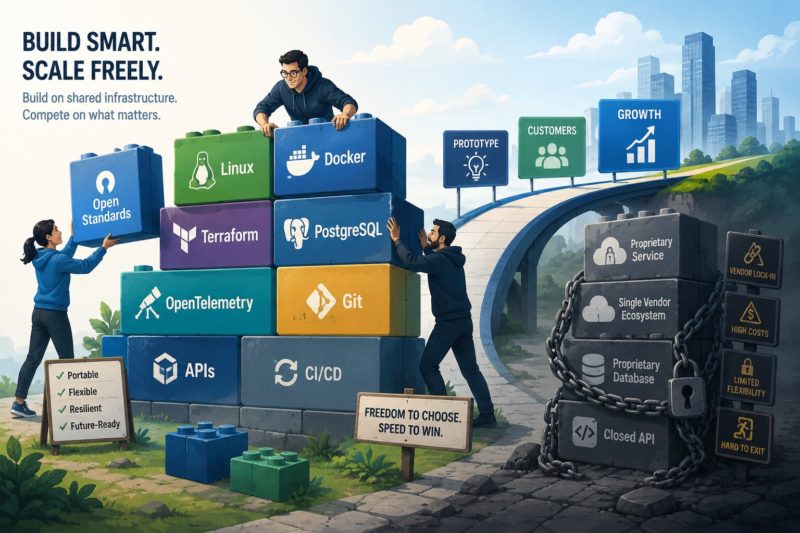
Free infrastructure matters most when it keeps a company portable. Portability sounds boring. Boring wins. Open standards and common interfaces keep a startup from being tied to a single vendor’s quirks. Money saved on day one means little if the codebase grows roots into proprietary services that can’t move without surgery. Linux, Terraform, Docker images, OpenTelemetry, and Postgres are all examples of open standards and common interfaces. These don’t ask for loyalty oaths. A startup that chooses standards can switch providers when pricing shifts, compliance requirements change, or a region goes dark.
The Costs That Eat Teams
Free infrastructure often involves labor. Labor costs more than servers. Debugging flaky CI runners, handling abuse reports, and patching around undocumented limits can drain a tiny team until the product stalls. Security adds another trap. Free services attract attackers. Guardrails must arrive early. Least privilege. Real backups that restore. Basic observability before panic. Many teams wait, then scramble. That scramble burns trust. The best teams treat free infrastructure as a scaffold, then plan the upgrade path before success forces it overnight.
Conclusion
Free digital infrastructure matters because startups don’t compete on owning hardware. They compete by learning faster than their rivals. Shared building blocks compress the time between an idea and proof, and between a prototype and revenue. The winning stance stays unsentimental. Free tiers and open tools offer a launchpad, not a home. A disciplined startup maps dependencies, watches for lock-in, and keeps an exit route ready. Standards, backups, and clean interfaces look like chores until the day they save the company. The advantage comes from building on what’s shared, then paying for stability only where it protects real customers.
Would you like to receive similar articles by email?

Paul Tomaszewski
Paul Tomaszewski is a science & tech writer as well as a programmer and entrepreneur. He is the founder and editor-in-chief of CosmoBC. He has a degree in computer science from John Abbott College, a bachelor's degree in technology from the Memorial University of Newfoundland, and completed some business and economics classes at Concordia University in Montreal. While in college he was the vice-president of the Astronomy Club. In his spare time he is an amateur astronomer and enjoys reading or watching science-fiction. You can follow him on LinkedIn and Twitter.


You May Also Like

Ranking The Best Mapping Software by Features

6 Features to Look For in the Best Police Department Scheduling Software