Fornax Constellation Guide
Fornax is a faint southern constellation best known for its galaxies, galaxy cluster, and role in modern deep-sky astronomy. Its brightest star, Alpha Fornacis, reaches only about magnitude 3.9, so the constellation rarely impresses at first glance. Its real appeal appears through binoculars, telescopes, and space observatories, where this quiet patch of sky opens onto a crowded universe.
The International Astronomical Union lists Fornax, abbreviated For, among the 88 official constellations and translates its name as “The Furnace” in its official constellation database. That name carries a distinctly scientific flavor. No dragon, hero, or ancient sea monster is involved.
What Does Fornax Represent?
Chemical Furnace
Fornax represents a chemical furnace, or Fornax Chemica, rather than a mythological character. The Latin word fornax means furnace. Nicolas-Louis de Lacaille chose the name during his 18th-century survey of the southern sky, when scientific instruments and disciplines were beginning to replace the mythic imagery favored by earlier European astronomers.
The ESA Hubble historical overview explains how Lacaille’s naming choices reflected this Enlightenment interest in science, technology, and measurement. Fornax belongs to that family of practical constellations, alongside Antlia, Telescopium, and Microscopium.
Lacaille’s Design
Lacaille introduced Fornax after observing from the Cape of Good Hope between 1751 and 1752. He mapped a region of the southern celestial hemisphere that contained relatively dim stars and few older constellation traditions. The constellation was later standardized through modern constellation boundaries, preserving Lacaille’s general design.
Missing Classical Myth
Fornax has no established Greek or Roman myth. Its name may sound as though it refers to the Roman goddess Fornax, sometimes associated with baking ovens, but that connection is largely a linguistic coincidence rather than the constellation’s intended story. Fornax is an artifact of scientific history, and that makes it unusual. Its symbolism points toward laboratories, instruments, and human curiosity.
Where Is Fornax Located?
Southern Sky
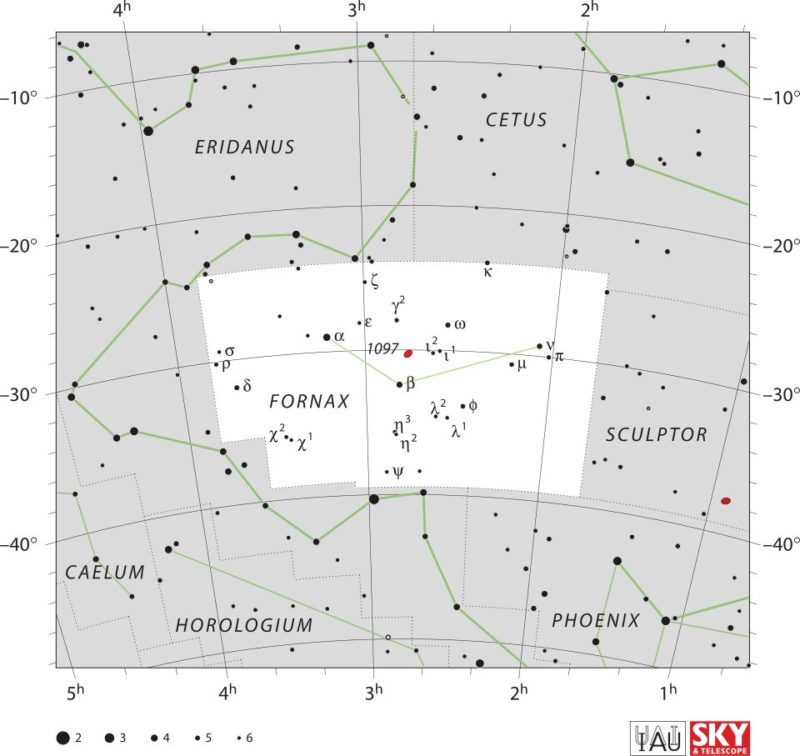
Fornax lies in the southern celestial hemisphere, roughly between right ascensions of 1 and 3 hours and declinations near -24 to -39 degrees. Observers in the Southern Hemisphere see it high in the sky during the appropriate season, while observers in the Northern Hemisphere must live at relatively low or middle latitudes to view it clearly.
It sits well away from the bright, dusty plane of the Milky Way. That matters. With fewer foreground stars and less interstellar obscuration, astronomers can inspect distant galaxies beyond the local star field.
Neighboring Constellations
Fornax is bordered by Eridanus to the north and west, Cetus toward the northwest, Sculptor to the south, and Phoenix and Columba farther around its southern and eastern edges. Horologium also lies nearby. The constellation is not part of the zodiac, and its location can be easier to understand through these neighboring patterns than through its own dim outline.
Apparent Shape
The whole constellation forms a loose, uneven shape rather than a bold geometric figure. A few fourth-magnitude stars create a shallow arc or irregular quadrilateral, but light pollution erases much of that structure. In suburban skies, Fornax can look like scattered points with no obvious identity.
Which Stars Define Its Shape?
Alpha Fornacis
Alpha Fornacis, also called Fornacis, is the brightest star in the constellation. It is a double-star system containing a yellow-white primary and a fainter companion. Its apparent magnitude is approximately 3.9, making it visible to the unaided eye under reasonably dark skies, though hardly conspicuous.
Beta Fornacis
Beta Fornacis is fainter, around fourth magnitude, and helps form the constellation’s western structure. Nu Fornacis and several other modest stars fill out the pattern. None matches the visual force of Orion’s bright stars or the Southern Cross. Fornax asks for patience.
Stellar Visibility
The constellation’s dim stars are best viewed from a dark location after the eyes have adapted for 20 minutes or more. A planisphere, astronomy app, or printed star chart can help, but use a red flashlight if you are observing outdoors. White light destroys the very night vision needed to find these subdued stars.
How Can You Observe Fornax?
Best Viewing Season
Fornax is most accessible in the evening during late fall and winter, especially around November and December. Southern observers gain the clearest view, while viewers in the northern United States may see only part of the constellation low above the southern horizon.
Dark-Sky Advantage
A dark sky makes the pattern easier to trace, but the major reason to seek darkness is the deep sky. The Fornax Cluster and its surrounding galaxies are beyond unaided-eye viewing. Even powerful binoculars reveal little more than a general haze; amateur telescopes with wide fields and good optics are far more useful.
Identification Steps
- Begin with bright Achernar or the broad path of Eridanus.
- Move southeast toward the dim stars of Fornax.
- Locate Alpha Fornacis, then use Beta Fornacis and Nu Fornacis to sketch the shape.
- Compare the view with a chart before searching for galaxies.
Which Deep-Sky Objects Stand Out?
Fornax Cluster
The Fornax Cluster lies about 60 million light-years away and contains numerous galaxies, including the giant elliptical galaxy NGC 1399 and the lenticular galaxy NGC 1404. X-ray observations from the Chandra study of the Fornax Cluster show hot gas, interactions, and activity around its central galaxies.
That gas reaches millions of degrees, forming part of the intracluster medium. Chandra observations have also examined a comet-shaped gas structure produced as NGC 1404 moves through the cluster environment, a remarkable example of motion written into million-degree plasma.
Fornax Dwarf Galaxy
The Fornax Dwarf Galaxy is a satellite galaxy of the Milky Way, located roughly 460,000 light-years from Earth. It is a dwarf spheroidal galaxy with very little current star formation, yet it contains several globular clusters. Observations of four of them, Fornax 1, 2, 3, and 5, are described in the ESA Hubble archive.
These clusters help astronomers investigate how dwarf galaxies formed, evolved, and retained stellar systems while orbiting a much larger galaxy.
NGC 1365
NGC 1365 is the region’s showpiece: a large barred spiral galaxy often called the Great Barred Spiral Galaxy. Its central bar channels gas toward the nucleus, where star formation and black-hole activity can occur. The galaxy is prominent in ESO’s near-infrared view of the Fornax region, which also captures the cluster environment.
Fornax A, or NGC 1316, is another major object, a radio galaxy shaped by past mergers. Its radio lobes and disturbed structure preserve evidence of violent galactic history.
What Has Fornax Revealed About Space?
Fornax became famous when astronomers selected it for the Hubble Ultra-Deep Field, a long exposure that revealed thousands of distant galaxies in an apparently empty patch of sky. The field demonstrated how much structure exists beyond the visible stars of the Milky Way.
More recently, the region has remained valuable for wide-field surveys. ESA’s Euclid mission previewed a Fornax deep field containing millions of galaxies across 12.1 square degrees, as reported in its Fornax deep-field release. A dim constellation, then, became a doorway to galaxy evolution, dark matter mapping, and the large-scale architecture of the universe.
FAQ
Is Fornax visible without a telescope?
Yes. Alpha Fornacis can be seen with the unaided eye under dark skies, but the full constellation is faint and difficult under city lights.
What is Fornax famous for?
It is famous for the Fornax Cluster, NGC 1365, Fornax A, the Fornax Dwarf Galaxy, and the Hubble Ultra-Deep Field.
Does Fornax have a myth?
No. Nicolas-Louis de Lacaille named it for a chemical furnace during the scientific mapping of the southern sky.
Conclusion
Fornax has little visual drama, yet it carries extraordinary scientific weight. Its modest stars mark a clear window beyond the Milky Way, where galaxy clusters, satellite galaxies, radio lobes, hot plasma, and deep-field discoveries fill the darkness. That is the constellation’s charm: the surface is quiet, while the universe behind it is anything but.
Would you like to receive similar articles by email?

Paul Tomaszewski
Paul Tomaszewski is a science & tech writer as well as a programmer and entrepreneur. He is the founder and editor-in-chief of CosmoBC. He has a degree in computer science from John Abbott College, a bachelor's degree in technology from the Memorial University of Newfoundland, and completed some business and economics classes at Concordia University in Montreal. While in college he was the vice-president of the Astronomy Club. In his spare time he is an amateur astronomer and enjoys reading or watching science-fiction. You can follow him on LinkedIn and Twitter.


You May Also Like
How Are Astronomers Able to Explore the Layers of the Sun Below the Photosphere?

NGC 4565: The Needle Galaxy