What Is the Extragalactic Background Light and Why Does It Matter?
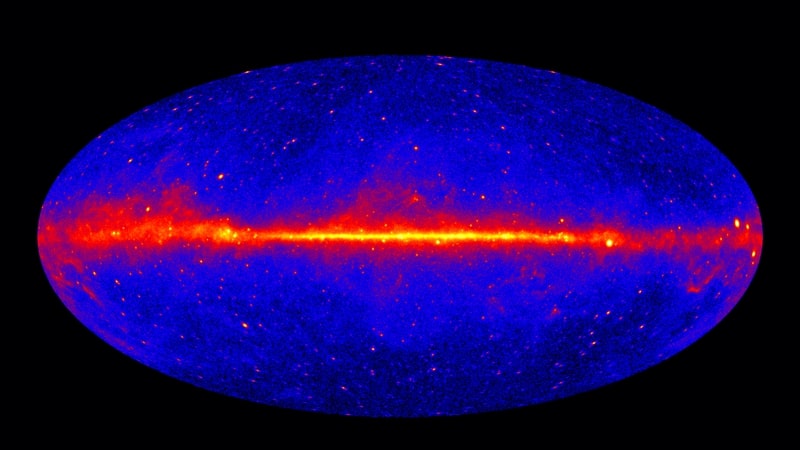
The extragalactic background light (EBL) is an elusive form of radiation that fills the entire universe. Its nature and origin were once poorly understood. However, recent studies using gamma-ray observations have shown that the EBL is almost entirely accounted for by the integrated light from known galaxies. Therefore, there is little room for extra diffuse sources.
Understanding the EBL is crucial for our understanding of the history and evolution of the universe. In addition, it can have implications for a range of fields, from astrophysics to cosmology.
What is the Extragalactic Background Light?
The extragalactic background light (EBL) is a diffuse background radiation that fills the entire universe. It consists of all the radiation that has been emitted by stars and active galactic nuclei throughout cosmic history. It spans ultraviolet through infrared wavelengths. However, the microwave range is dominated by the primordial cosmic microwave background (CMB).
About half of the EBL comes from direct starlight, while the other half originates from starlight absorbed by cosmic dust and re-emitted at infrared wavelengths.
The EBL is an important area of research in astronomy and astrophysics because it provides information about the evolution of galaxies and the large-scale structure of the universe. Moreover, the EBL plays a crucial role in attenuating very-high-energy (VHE) gamma rays from distant sources via pair production. This process is important for understanding the sources of these particles.
Exploring the Origin and Significance of EBL
In order to fully understand the importance of the extragalactic background light (EBL), we must first explore its origin and significance. The EBL is the cumulative light emitted by all sources outside of our Milky Way galaxy, which includes stars, galaxies, active galactic nuclei (AGN), and dust within galaxies. Furthermore, this light has been traveling through the universe for billions of years. It provides important clues to the evolution of the cosmos.
The significance of EBL lies in its ability to help us understand the distribution and evolution of galaxies, the formation of the first stars and galaxies, and the expansion of the universe. Recent gamma-ray-based measurements have confirmed that galaxy light explains nearly all of the EBL. As a result, scientists have placed tight limits on any unknown light sources. This enables astronomers to use the EBL as a precise tool for studying the history and structure of the cosmos.
Observations from the James Webb Space Telescope (JWST) have further improved estimates of the integrated light from distant galaxies. Consequently, these findings strengthen the conclusion that most of the EBL can be explained by known galaxy populations.
As we continue to make advancements in our understanding of EBL, we can expect to gain even more knowledge about the origins and evolution of the universe. This will lead to exciting new discoveries and breakthroughs in the field of astronomy. For example, new correlations between the gamma-ray background and large-scale structure have shed light on how blazars and other sources trace the cosmic web.
How Does EBL Affect Astronomical Observations?
Astronomical observations are greatly impacted by the extragalactic background light (EBL). This is because the EBL is a diffuse glow of light that fills the entire universe. It interacts with gamma rays from distant sources, absorbing them at certain energies.
The EBL affects astronomical observations in several ways. The main effect is attenuation. High-energy gamma rays interact with EBL photons to create electron-positron pairs. This process reduces the observable gamma-ray flux from distant blazars, active galaxies, and other energetic sources.
Furthermore, the EBL can absorb light at certain wavelengths. This can distort our understanding of the universe’s composition and evolution. In addition, it acts as a cosmic filter, removing certain gamma-ray energies from our observations and altering the apparent spectra of distant sources. Therefore, understanding the EBL is crucial for accurate astronomical observations and for advancing our knowledge of the universe.
Directly measuring the EBL is also challenging. This is because astronomers must separate it from much brighter foreground sources, including zodiacal light from interplanetary dust and emission from stars and dust within our own Milky Way galaxy.
The Impact of EBL on Our Knowledge about Space
EBL has had a significant impact on our understanding of space. By studying the extragalactic background light, we have been able to gain insight into the structure and evolution of the universe.
One of the key ways that EBL has helped us to expand our knowledge of space is by providing clues about the distribution of matter in the universe. By studying the patterns of EBL, scientists have been able to infer the location and characteristics of dark matter. Dark matter makes up a large portion of the universe’s mass.
EBL has also allowed us to study the early universe. It provides insight into the era when the first stars and galaxies formed and began illuminating the cosmos. With the latest developments in our understanding of EBL, we are able to explore even further into the mysteries of space.
Much of our current knowledge of the EBL comes from observations by facilities such as the Fermi Gamma-ray Space Telescope and ground-based gamma-ray observatories. These facilities use the interaction between gamma rays and EBL photons to measure the background light across cosmic history.
Conclusion: Why does the Extragalactic Background Light Matter?
The extragalactic background light (EBL) is a crucial element in our understanding of the universe. As we have explored in this article, it is the cumulative light emitted by all the sources outside of our galaxy.
EBL is significant because it provides us with essential information about the formation and evolution of galaxies. This light also allows us to study the universe’s history and its composition, including dark matter.
Moreover, EBL plays a vital role in astronomical observations. It can interfere with telescopes and distort the measurements. Yet, it can also be used as a tool to study distant objects and measure their distances.
Finally, EBL matters because it helps us expand our knowledge and understanding of space and the cosmos. Ultimately, it helps us gain a better understanding of our place in the universe.
Would you like to receive similar articles by email?

Paul Tomaszewski
Paul Tomaszewski is a science & tech writer as well as a programmer and entrepreneur. He is the founder and editor-in-chief of CosmoBC. He has a degree in computer science from John Abbott College, a bachelor's degree in technology from the Memorial University of Newfoundland, and completed some business and economics classes at Concordia University in Montreal. While in college he was the vice-president of the Astronomy Club. In his spare time he is an amateur astronomer and enjoys reading or watching science-fiction. You can follow him on LinkedIn and Twitter.


You May Also Like
Centaurus Constellation Guide

Dwarf Planet Makemake: Facts, Orbit, Moon, and Discovery