Exo-Gas Giant Atmospheres: Formation, Differences
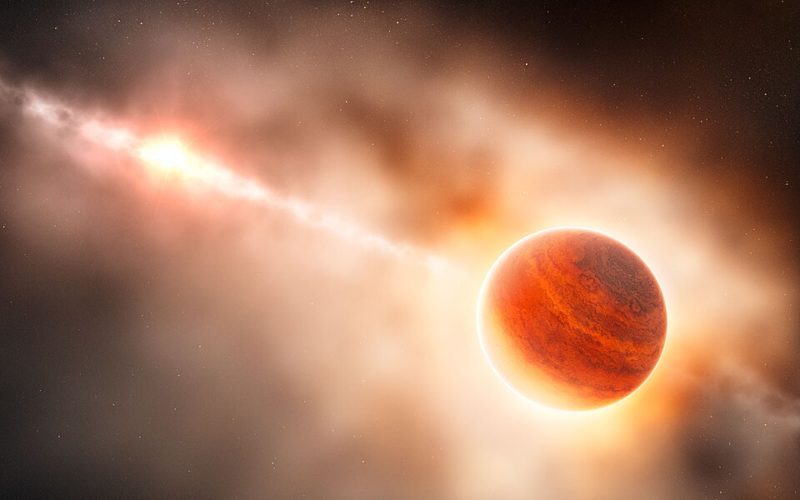
Exo-gas giant atmospheres form when a young planet grows fast enough inside a protoplanetary disk to pull in nebular hydrogen and helium, then keeps rewriting that first draft with ices, rocks, heat, clouds, chemistry, and sometimes plain atmospheric loss. That is the short answer. The longer one is messier, and more interesting, because two giant planets with similar mass can end up looking nothing alike once stellar heating, orbital distance, migration history, and internal mixing start pulling on the system from different directions.
That is why a hot Jupiter skimming its star may show an inflated outer atmosphere, broken molecules, silicate clouds, and fierce winds, while a colder giant farther out can hold onto methane gas, ammonia, and a deeper chemical memory of where it formed. Modern science keeps tightening this picture. The data are no longer just broad guesses, especially with JWST, high-resolution spectroscopy, and better models of radiative transfer.
How does formation begin?
Protoplanetary disks
Planet formation starts in planetary disks around young stars. Those disks are not chemically uniform. Temperature falls with distance, so different materials condense in different zones, and that matters more than people sometimes realize.
- Closer to the star, rock and metal dominate because water and other volatiles stay vaporized.
- Farther out, past snow lines, ices add a lot more solid material, which helps a giant planet core grow faster.
- If the disk disperses too soon, the planet may never capture a thick gaseous envelope.
NASA’s work on giant planet formation has leaned hard on that timing problem, and an ISSI overview of exoplanet atmosphere evolution makes the same point from the atmosphere side. Miss the disk window, and you do not get a Jupiter. You get something smaller.
Core growth
The leading model is still core accretion. A solid core, built from planetesimals and pebbles, reaches roughly several Earth masses, sometimes around 10 Earth masses, and then gravity starts winning decisively. Gas piles up. The envelope grows. Cooling helps it contract, which lets even more gas fall in.
This stage also pollutes the forming exo-gas giant atmosphere. Ices and rocks do not just build the core. They dissolve, vaporize, and enrich the planetary envelope with heavy elements. So the first atmosphere is not a clean sample of the disk. It is disk gas mixed with processed solids.
Gas capture
Once runaway gas accretion begins, growth gets dramatic. Molecular hydrogen and helium dominate by mass, much as they do in Jupiter and Saturn, because that is what the disk mostly contains. A giant gas planet is still not a star, of course. It never reaches the mass needed for sustained hydrogen fusion, and even super-Jupiters remain planets, not failed suns in the casual sense people throw around.
What sets the first atmospheric mix?
Hydrogen and helium
The starting point is usually near solar composition. Hydrogen is the bulk, helium comes next, and together they set the density, scale height, and basic thermal behavior of the outer atmosphere. That is the primary atmosphere in the strict sense.
A classic treatment of planetary atmosphere origin and evolution laid out this retention problem years ago, and the logic still holds well for giant planets.
Ices and rocks
What complicates the picture is enrichment. Water, methane, ammonia, sulfur species, and silicate material can all alter atmospheric composition. This is where metallicity, meaning the abundance of elements heavier than helium, becomes useful. High bulk metallicity usually means the planet swallowed a lot of solids during planetary formation.
Element ratios
Astronomers obsess over ratios like C/O for good reason. They are fingerprints.
- A high carbon-to-oxygen ratio can hint that the planet accreted gas in a carbon-richer part of the disk.
- Strong oxygen enrichment may point to heavy intake of water-rich ices.
- Nitrogen chemistry helps trace colder formation zones and later mixing.
JWST’s measurements of WASP-39b pushed this from theory toward data, and Sara Seager’s exoplanet atmospheres reference is still one of the best places to explore how those spectral clues are actually extracted.
Atmospheric structure
Pressure layers
What we observe is only the skin. Spectra usually probe pressures from tiny fractions of a bar to a few bars, depending on wavelength. Below that sits a much deeper atmosphere, then hotter planetary interiors, then conditions so extreme that Jupiter-like worlds may transition toward metallic hydrogen.
Heat transport
Some giants are strongly irradiated, so they develop radiative layers high in the exo-gas giant atmosphere. Others transport heat upward mainly by convection. In a cooler, less blasted gas planet, the interior may stay close to an adiabatic interior for long stretches, with planetary cooling gradually shrinking and settling the envelope.
Deep interiors
Deep down, pressure rewrites matter. In Jupiter and probably many giant exoplanets, hydrogen transitions into metallic hydrogen under high pressures. Saturn likely adds helium rain to the story, where helium droplets separate and sink, releasing extra heat. That interior heat then leaks back upward and can influence the upper atmosphere more than you might expect.
Weather and clouds
Winds
Weather on hot Jupiters is not just “windy.” It is dynamically strange. Many are tidally locked, so one hemisphere gets hammered by constant starlight while the night side cools off. That temperature contrast drives eastward jets, wave activity, and shifted hot spots.
Cloud species
Clouds depend on temperature. On very hot worlds, condensates may include silicates and iron. Cooler giants can form water clouds, ammonia crystals, or methane hazes. The chemistry is broad enough that cloud mapping work on hot Jupiters has become its own subfield.
Storm patterns
Storms emerge from rotation, convection, irradiation, and chemistry all at once. Some exo-gas giant atmospheres likely resemble oversized versions of Jupiter, though real exoplanet weather is often far more distorted than anything in our solar system.
Why do hot and cold worlds differ?
Stellar heating
Close-in giants absorb brutal stellar flux. Their outer atmosphere can puff up, molecules can dissociate, and energetic light drives photochemistry. A recent book on host stars and their effects on exoplanet atmospheres shows how active stars, especially M dwarfs, keep reshaping those upper layers.
Orbital distance
Move the same planet outward and the chemistry shifts. Methane becomes more stable. Water and ammonia clouds can condense. Cold giants often preserve atmospheric compositions that look more like young outer planets than scorched hot Jupiters.
Chemistry shifts
Temperature changes the dominant carbon chemistry. At higher temperatures, carbon monoxide often wins. At lower temperatures, methane becomes favored. That single switch alters light spectra, cloud formation, color, and even how easy the atmosphere is to characterize.
How does migration change outcomes?
Disk migration
Many hot Jupiters probably formed farther out and migrated inward through the disk. That means their atmospheric abundances may record several feeding zones, not one birthplace. A planet can accrete solids beyond the water snow line, then sweep up different gas later.
Tidal effects
Once inward migration ends, tides matter. Synchronous rotation changes circulation. Tidal heating can help keep the atmosphere expanded. Some inflated hot jupiters are probably carrying that thermal baggage long after migration stops.
Lost gases
Close to the star, escape becomes serious. Hydrogen and helium can stream away from low-density giants, changing the helium atmosphere fraction and upper chemistry over time. This does not usually strip a full Jupiter bare, but it can absolutely sculpt the outer atmosphere.
Internal processes that reshape upper layers
Even without migration, a giant planet keeps stirring itself. Vertical mixing drags deep gases upward, so carbon monoxide can appear where equilibrium chemistry would prefer methane. Photochemistry then hacks those molecules into hazes and hydrocarbons. Magnetic activity may also dump energy into the upper atmosphere, especially in strongly irradiated giants. So when we read an atmosphere, we are not reading a quiet archive. We are reading a moving target.
Gas giants and ice giants
People blur gas giants and ice giants together, though the distinction matters.
| Type | Bulk makeup | Typical atmosphere | Interior character |
|---|---|---|---|
| Jupiter/Saturn-like gas giants | Mostly hydrogen and helium | H2, He, with methane, ammonia, water traces | Deep metallic hydrogen, lower relative heavy-element fraction |
| Uranus/Neptune-like ice giants | Higher fraction of water, ammonia, methane rich ices and rock | H2/He outer layer over more enriched composition | No vast metallic hydrogen layer like Jupiter, higher bulk metallicities |
Exoplanets complicate this tidy split. Some sit in between, some look like oversized Neptune worlds, and some giant planet interiors probably mix features we would normally file under both categories.
FAQ
Are all giant exoplanet atmospheres mostly hydrogen and helium?
Most true gas giants are, yes. Their atmospheric composition is still dominated by hydrogen and helium, even when heavy elements, clouds, and hazes strongly affect the spectrum.
Why do two similar-mass giants look different?
Because mass is only one control knob. Irradiation, age, metallicity, planetary system history, rotation, and atmospheric escape all matter. Similar mass does not guarantee similar weather or chemistry.
Can we tell where a giant planet formed just from its atmosphere?
Sometimes, partially. Ratios such as C/O, along with water, methane, and bulk metallicity, can offer strong hints. Still, migration and later mixing blur the trail.
Conclusion
Exo-gas giant atmospheres are built in stages. First the disk sets the ingredients, then accretion mixes them, then stellar heating, internal heat, clouds, and escape keep editing the result. That is why the diversity feels so wide. It is real.
For anyone who likes to explore odd corners of planetary science, this field is a gift: free insights into a universal process, sharpened by telescope technology and the kind of innovation that keeps turning faint spectra into actual physical history. Even the offbeat cases teach something useful. Sometimes more than the neat ones.
Would you like to receive similar articles by email?

Paul Tomaszewski
Paul Tomaszewski is a science & tech writer as well as a programmer and entrepreneur. He is the founder and editor-in-chief of CosmoBC. He has a degree in computer science from John Abbott College, a bachelor's degree in technology from the Memorial University of Newfoundland, and completed some business and economics classes at Concordia University in Montreal. While in college he was the vice-president of the Astronomy Club. In his spare time he is an amateur astronomer and enjoys reading or watching science-fiction. You can follow him on LinkedIn and Twitter.


You May Also Like
What Heats the Chromosphere and Corona to High Temperatures?
The Local Interstellar Cloud: Characteristics and Significance