Europa vs. Enceladus: Subsurface Ocean Evidence Comparison
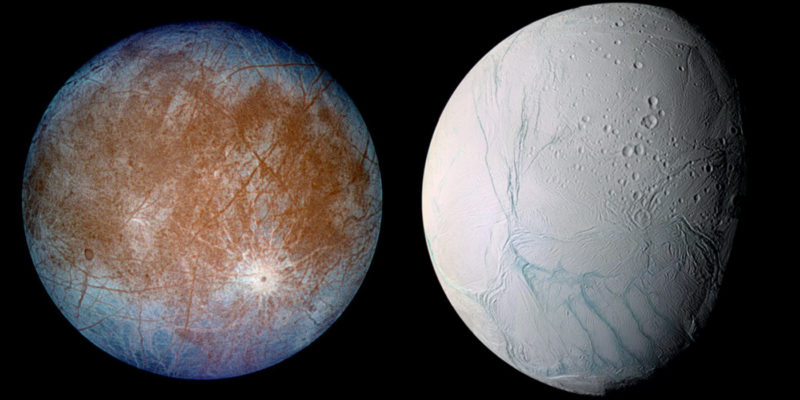
People tend to lump Europa and Enceladus together as if they are the same subsurface ocean story told under different giant planets. They are not.
If you want the strongest, cleanest proof of a subsurface ocean, Enceladus has the edge because Cassini actually sampled material blasted into space from the south polar plumes. If you want the bigger long-game target for life, Europa still feels larger, older, and chemically more ambitious, even if much of its case comes from geophysics instead of a convenient spray of ocean material.
Nobody has photographed an open sea under the ice. That matters. What scientists have, instead, is a stack of clues that fit together with unusual stubbornness: induced magnetic fields, chaos terrain, salts on the surface, gravity data, silica grains, molecular hydrogen, organics, and plume chemistry. Put those pieces on the table and both icy moons look real enough to keep astrobiology awake at night.
Which moon has stronger ocean evidence?
If you strip the romance out of it, the comparison is pretty sharp:
- Enceladus has the more direct case because plume material from the ocean is already escaping into space.
- Europa has the more geophysical case, especially from magnetic induction and surface geology that points to a salty global ocean.
- For habitability, the split remains awkward in a good way: Enceladus is easier to test now, while Europa may offer the broader extraterrestrial habitat over billions of years.
So yes, both likely host global subsurface oceans. Enceladus is the better laboratory sample. Europa is the bigger wager.
What proves Europa has a global ocean?
Induced magnetism
Europa’s strongest card is magnetometer data from Galileo. As Jupiter’s magnetic field sweeps past the moon, Europa appears to generate an induced magnetic response, which strongly suggests a conductive layer under the ice. The most persuasive explanation is salty liquid water. A metal shell would be bizarre here. Warm brine is the neat fit, and NASA’s own summary of why Europa is thought to hide an ocean still rests heavily on that result.
This is the kind of evidence that looks dry on paper and devastating in practice. You do not need a pretty photo when the physics lines up that well.
Chaotic terrain
Then there are the surface images from Galileo. Europa’s bright surface is cracked, rafted, churned, and in places downright wrecked. Chaos terrain looks as if plates of ice broke apart, shifted, and refroze over slush or liquid below. Long bands and cycloidal fractures also betray tides from Jupiter doing mechanical work on the shell. Tidal heating is not a side detail here. It is the engine that keeps the case alive.
Some models even allow for shallow brine pockets or perched water lenses within the ice crust. That matters because it lowers the practical barrier between the surface and the deeper ocean. You may not have to drill all the way down to the abyss to sample ocean-derived chemistry.
Salt and plumes
Europa’s surface is streaked with materials that appear to include salts, probably altered by fierce radiation. That can be messy to interpret, since sulfur from Io and radiation chemistry muddy the signal. Even so, the surface does not look chemically isolated from the interior.
Plumes are the squishier part of Europa’s story. Hubble spotted tentative ultraviolet signatures of water vapor, and later observations kept the idea alive, but not cleanly. A 2026 reassessment of Europa’s vapor plumes cooled some of the excitement. So, for honesty’s sake, Europa plume activity is plausible, not nailed down.
What proves Enceladus has a global ocean?
South polar plumes
Enceladus is almost rude in how generous it is. The south polar “tiger stripe” fractures vent plumes of water vapor and ice grains into space, and Cassini flew through them. That already moves the discussion out of the realm of inference and into sampling. Gravity and libration measurements also support a global ocean beneath the ice, not just a local sea under the pole.
For ocean-world science, this is gold. The moon is doing the drilling for us.
Salts and organics
Those plume particles contain salts and carbon-bearing compounds, which implies the water interacted with rock before getting ejected. That is the point where chemistry stops being decorative and starts looking metabolically relevant. A 2025 study on freshly ejected organics in Enceladus plumes strengthened that case by identifying larger and more complex compounds than earlier work could confidently isolate.
So when people say Enceladus has “direct” evidence, this is what they mean. Not speculation. Material in instruments.
Hydrothermal signals
The showstopper is hydrothermal chemistry. Cassini detected molecular hydrogen, and earlier work on tiny silica grains pointed toward hot water interacting with a rocky core. That looks a lot like water-rock reactions familiar from hydrothermal vent systems on Earth. An ESA analysis published in 2026 pushed the complex-chemistry angle even harder.
That does not prove life. It proves a serious energy source. In astrobiology, that is almost as seductive.
How do surface clues affect ocean access?
Ice shell thickness
Europa is the engineering headache. Its ice shell may be several km thick, and in some models much more, though local thin spots are possible. Enceladus also has a thick shell globally, but near the south pole the ice seems far thinner, perhaps only a few km above liquid reservoirs feeding the vents.
Thickness is not just a drilling problem. It controls exchange. A thinner, fractured shell lets chemistry move.
Fractures and vents
Europa has lineae, chaos blocks, and signs of a crust under stress. Enceladus has active vents you can point a spacecraft at. That difference is enormous. One world hints at a plumbing system. The other is spraying it into space.
Near-surface pockets
Europa may have near-surface brines, which is one reason the coming Europa Clipper mission matters so much. Radar and thermal mapping could tell us whether the ocean communicates upward more often than we guessed. Enceladus already shows that near-surface pathways exist at the south pole. The ocean interface is not theoretical there.
Which moon looks more habitable today?
Water and salts
On basic ingredients, both score well. Liquid water, dissolved salts, and a rocky interior are all in play. Enceladus has the cleaner chemical readout because the plume material is less filtered through remote sensing guesswork.
Energy and chemistry
This is where the debate gets delicious. Enceladus has direct signs of water-rock reactions and hydrogen that microbes could exploit. Europa may have something Enceladus struggles to match: a larger subsurface ocean, a longer lifespan, and possible delivery of oxidants from the surface downward thanks to the brutal radiation environment around Jupiter. That could create stronger redox gradients, though the exact efficiency of that transport is still argued over. A 2025 Frontiers paper on Europa’s chemical energy budget treats that possibility seriously, while a 2026 Reuters report on a colder, quieter Europan seafloor study reminds everyone not to get carried away.
Ecosystem potential
My candid read? Enceladus is the better near-term biosignature target. Europa is the grander stage. A vast ocean under an old, geologically active shell simply offers more room for niches, cycles, and long-lived experiments in chemistry. Whether that translates into an ecosystem is another matter. We do not know. We should not pretend otherwise.
Compare access, sampling, and mission risk
| Factor | Europa | Enceladus |
|---|---|---|
| Ocean proof style | Induced magnetism, geology, salts, tentative plumes | Direct plume sampling, gravity, libration, plume chemistry |
| Best sampling route | Flybys, radar, possible surface chemistry, maybe plume interception | Repeated plume flythroughs |
| Radiation exposure | Severe around Jupiter | Much gentler around Saturn |
| Mission difficulty | High shielding and tougher operations | Lower risk, cheaper paths to chemistry |
| Long-term life potential | Possibly larger and more diverse | Possibly more immediately testable |
Plume flythroughs
This is why Enceladus keeps winning practical arguments. Fly through a plume, grab grains and vapor, and you have water samples without a lander. That is absurdly valuable.
Radiation exposure
Europa sits inside a savage radiation environment. Any spacecraft has to survive repeated exposure, and any organics on the surface may be heavily altered. Enceladus is easier on hardware and easier on science return.
Future missions
The next verdict will be shaped by Europa Clipper. It is built to measure the ice shell, chemistry, and exchange processes in far better detail. Enceladus, meanwhile, still begs for a dedicated return mission focused on plume composition, isotopes, and maybe life-detection instruments tuned for complex organics.
What could change the current verdict?
A few things would shift the balance fast:
- A confirmed, repeatable Europa plume with direct sampling.
- Stronger proof that Europa’s surface oxidants reach the deep ocean efficiently.
- Better constraints on Enceladus’ ocean longevity and whether its hydrothermal activity is stable over very long timescales.
That is where recent discoveries will land hardest. Not in pretty images. In transport rates, redox chemistry, and persistence.
Follow-up questions for deeper comparison
- How much of Europa’s surface chemistry is truly ocean-derived rather than radiation-processed contamination?
- Are Enceladus’ plume sources sampling a broad ocean, or just one especially active region?
- Which moon offers the better shot at detecting cell-like structures or isotopic fractionation rather than just habitability markers?
FAQ
Has life been found on either moon?
No. Neither Europa nor Enceladus has yielded confirmed life.
Which moon is easier to explore first?
Enceladus, mainly because of plume access and lower mission risk.
Which moon is more likely to host a complex biosphere?
Europa is often seen as the stronger long-shot candidate because its ocean may be larger, older, and chemically more varied.
Conclusion
The comparison is not a tie, but it is also not a knockout. Enceladus gives scientists the more direct and persuasive ocean case right now, with plume chemistry that practically dares a spacecraft to sample it. Europa gives the deeper mystery: stronger clues to a vast hidden ocean, a rougher and more dynamic ice shell, and perhaps the wider chemical playground for life if the interior really is well connected. One moon is accessible. The other is consequential. Frankly, planetary exploration needs both.
Would you like to receive similar articles by email?

Paul Tomaszewski
Paul Tomaszewski is a science & tech writer as well as a programmer and entrepreneur. He is the founder and editor-in-chief of CosmoBC. He has a degree in computer science from John Abbott College, a bachelor's degree in technology from the Memorial University of Newfoundland, and completed some business and economics classes at Concordia University in Montreal. While in college he was the vice-president of the Astronomy Club. In his spare time he is an amateur astronomer and enjoys reading or watching science-fiction. You can follow him on LinkedIn and Twitter.


You May Also Like

What Is Time? Does it Even Exist?
NGC 7023: The Iris Nebula