
Eridanus Constellation Guide
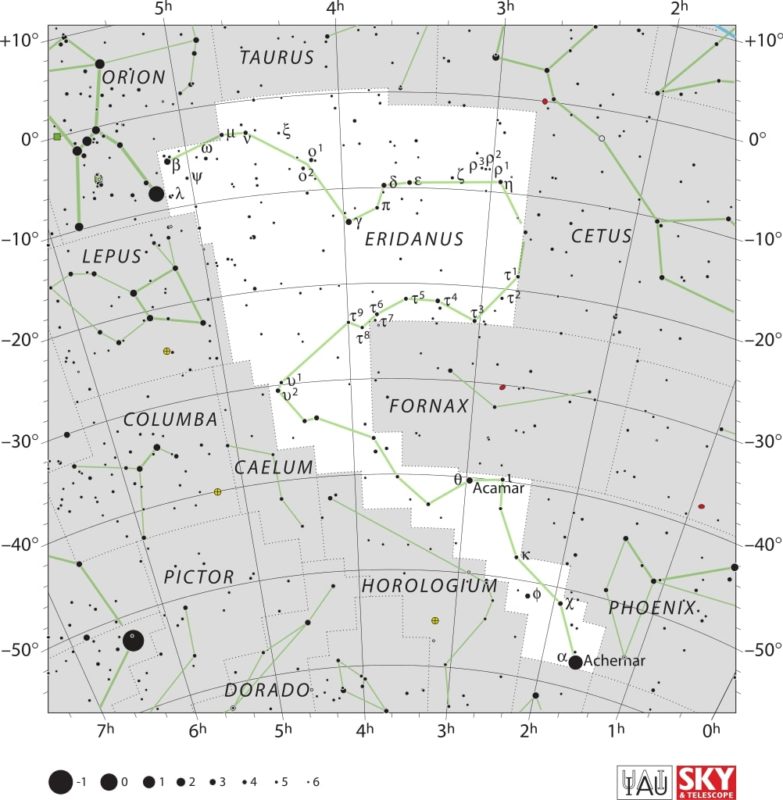
Eridanus is a large, winding constellation that represents a celestial river flowing from Orion toward the far southern sky. Its stars preserve several ancient river traditions, while its modern boundaries contain everything from the bright star Achernar to distant galaxies and the immense Eridanus Supervoid. For observers, it is both a mythological landmark and a practical route across the night sky.
What Does Eridanus Represent?
Celestial River
Eridanus appears as a long, irregular stream of stars. It begins near the bright star Rigel in Orion, bends westward, then stretches south until it reaches Achernar. The shape is loose rather than instantly recognizable, so western star charts often show it as a chain of modest stars instead of a sharply outlined figure.
The name may have roots in ancient Mesopotamia, possibly connecting the constellation with Eridu, a sacred Babylonian city associated with Enki-Ea and cosmic freshwater. Linguists have also proposed an Indo-European river origin. The matter remains debated, which is hardly surprising for a name that traveled across languages, empires, and several thousand years of astronomy.
Phaëthon’s Fall
In Greek mythology, Eridanus is commonly identified with the river into which Phaëthon fell after losing control of Helios’s solar chariot. His reckless journey scorched parts of Earth, and Zeus struck him down with a thunderbolt. The young driver plunged into the mythical river, giving the constellation a dramatic place in Greek myths.
Ancient authors did not always agree on the earthly equivalent. Some connected the river with the Nile, while later Roman tradition often favored the Po in Italy. The celestial river was therefore less a fixed geographical claim than a flexible symbol mapped onto familiar waterways.
Cultural River Traditions
Babylonians associated the region with the Euphrates, while Egyptian interpretations connected it with the Nile. In Indian astronomical tradition, the stream is linked with Srotaswini, a sacred flowing course associated with the Ganges. These interpretations share a simple idea: rivers carry life, movement, and divine power. Eridanus became a universal image of that motion written across the stars.
How Did Eridanus Enter Astronomical History?
Babylonian Origins
The constellation’s older history likely reaches beyond the Greek catalog. The proposed connection with Eridu gives Eridanus a Mesopotamian layer, although the exact linguistic path is not settled. What is clear is that ancient skywatchers treated the region as a river-like celestial feature long before modern constellation borders existed.
Ptolemy’s River
Claudius Ptolemy included Eridanus among the 48 constellations in his second-century Almagest. He called it “The River,” or Potamos. From Ptolemy’s location near Alexandria, much of the southern extension was invisible. His version ended near Theta Eridani, also called Acamar.
The NOIRLab historical overview explains how later southern observations changed the river’s shape and reach.
Renaissance Extension
During the 1590s, Dutch navigators charting southern waters recorded stars that Ptolemy could never have seen. Their maps helped extend Eridanus toward Alpha Eridani, or Achernar. Johann Bayer later incorporated this southern structure into influential star atlases, producing the modern constellation Eridanus.
Where Is Eridanus Located?
Orion Connection
The easiest entry point is Orion. Find bright star Rigel, the blue-white star marking Orion’s lower-right foot. Eridanus begins nearby, with Cursa, or Beta Eridani, acting as an important northern marker. From there, the river curves west and south across a broad section of sky.
Its approximate northern end lies near right ascension 5 hours, while the southern end reaches roughly 1 hour. The constellation crosses the celestial equator, though most of its length lies south of it.
Southern Reach
Achernar sits at Eridanus’s southern end and is one of the brightest stars in the entire sky. It has a strongly flattened shape because of rapid rotation, a result highlighted by the European Southern Observatory’s interferometric study. Observers at southern latitudes see Achernar high above the horizon, while many northern observers cannot see it at all.
Modern Boundaries
The International Astronomical Union treats Eridanus as one of the modern 88 constellations, defined by precise boundary lines rather than by the visible pattern alone. An Eridanus constellation map helps separate its stars from neighboring Cetus, Fornax, Phoenix, and Orion.
Which Stars Define the River?
Achernar
Achernar, or Alpha Eridani, is a hot, blue-white main-sequence star roughly 140 light-years from Earth. Its name means “the river’s end,” an apt description for the southern anchor of the constellation. Its low declination makes it a difficult target from much of the northern hemisphere.
Cursa
Cursa, or Beta Eridani, is the practical starting point for many observers. It lies close to Rigel and has an apparent magnitude near 2.8, making it easy to identify under a reasonably dark sky.
Acamar
Theta Eridani, known as Acamar, is a striking double star. Its name means “the end of the river,” reflecting the older Ptolemaic boundary. In a small telescope, the pair can appear as contrasting white stars, though the split depends on aperture and seeing conditions.
Two other targets add scientific interest. Epsilon Eridani is a nearby orange main-sequence star with a planetary system and debris structures, while Upsilon-1 Eridani is part of a multiple-star system.
| Star | Common designation | Observing significance |
|---|---|---|
| Alpha Eridani | Achernar | Bright southern anchor |
| Beta Eridani | Cursa | Northern starting point |
| Theta Eridani | Acamar | Double-star target |
| Epsilon Eridani | Epsilon Eridani | Nearby planetary system |
What Deep-Sky Objects Lie Within It?
Witch Head Nebula
The Witch Head Nebula, or IC 2118, is a faint reflection nebula near Orion. It is illuminated largely by Rigel and resembles a ghostly profile in long-exposure photographs. Visual observers should temper expectations: this is an extremely difficult object under ordinary backyard conditions because its surface brightness is low.
Eridanus Supergroup
Eridanus contains numerous galaxy groups, including the Eridanus Supergroup, a loose concentration of galaxies interacting through gravity. The broader region also features the Eridanus Supervoid, a vast underdense structure associated in some studies with the cosmic microwave background’s Cold Spot. A research summary on the supervoid provides useful large-scale context.
Several individual galaxies reward imaging. NGC 1487 shows signs of galactic merging, as documented in this Hubble analysis. NGC 1291, a barred spiral galaxy with an outer ring, has also been examined in ultraviolet light by NASA’s GALEX mission.
Planetary Nebulae
NGC 1535, often called the Cleopatra’s Eye Nebula, is among Eridanus’s better-known planetary nebulae. A medium-sized telescope can reveal its compact bluish disk, while higher magnification may show a central star. It is a stellar remnant, not a planet, despite the historical name.
How Can You Find It?
Seasonal Visibility
From the northern hemisphere, Eridanus is best placed during winter evenings, especially from December through February. The northern section is accessible from much of the United States, but Achernar remains below the horizon for most locations. Southern observers can follow nearly the entire river, with the southern hemisphere offering the clearest view.
Star-Hopping Route
Start at Rigel, move to Cursa, and trace the uneven chain westward. Use a planisphere or a sky-mapping app to confirm the sequence, since several stars have similar brightness. From a dark site, binoculars reveal the river’s branching texture more effectively than the unaided eye.
Southern Latitude Advantage
Observers south of the equator gain a major advantage. Achernar rises higher, the full north-to-south structure becomes visible, and southern stars suffer less atmospheric extinction. From northern locations, concentrate on Cursa, Acamar, the Witch Head Nebula, and the galaxies around northern Eridanus.
How Should You Observe It?
Begin with binoculars before reaching for a telescope. Eridanus is wide, and its scale makes a narrow field of view frustrating. Once the pattern is familiar, use a telescope for Acamar, NGC 1535, and selected galaxies. A dark site matters more than sheer aperture for faint nebulae, while astrophotography benefits from long exposures, careful guiding, and strong control of gradients.
Avoid judging the whole constellation by its brightest stars. Eridanus is deliberately subtle. Its reward arrives slowly, as the loose chain near Orion starts to resemble a river rather than a random scatter of lights.
FAQ
Is Eridanus visible from the northern hemisphere?
Part of it is. Northern observers can see the section near Orion, but Achernar is below the horizon from most northern locations.
What is the brightest star in Eridanus?
Achernar, or Alpha Eridani, is the brightest star in the constellation.
Is Eridanus a real river?
No. It is a constellation, a defined region of the sky. Its river identity comes from mythology and ancient sky traditions.
Conclusion
Eridanus connects mythology, navigation, stellar physics, and deep-sky astronomy in one sprawling pattern. Follow it from Rigel and Cursa toward Acamar and Achernar, and the constellation gradually reveals its character: an ancient celestial river whose faint current still carries stories across the night sky.
Would you like to receive similar articles by email?

Paul Tomaszewski
Paul Tomaszewski is a science & tech writer as well as a programmer and entrepreneur. He is the founder and editor-in-chief of CosmoBC. He has a degree in computer science from John Abbott College, a bachelor's degree in technology from the Memorial University of Newfoundland, and completed some business and economics classes at Concordia University in Montreal. While in college he was the vice-president of the Astronomy Club. In his spare time he is an amateur astronomer and enjoys reading or watching science-fiction. You can follow him on LinkedIn and Twitter.


You May Also Like

Sustainable Practices in the Oil and Gas Industry
How Did Phobos and Deimos Get Their Names
