Equuleus Constellation Guide
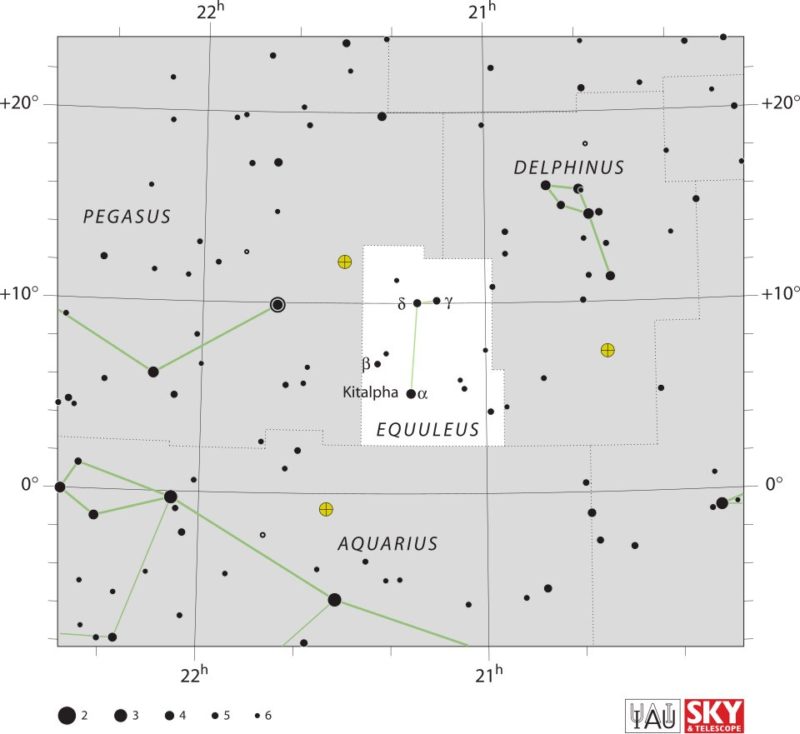
Equuleus is the small, faint constellation known as the “Little Horse,” tucked beside Pegasus in the northern sky. It is difficult to see, but that is precisely why finding it feels like a private victory rather than another routine stop among brighter constellations.
The name, stars, and boundaries are standardized by the International Astronomical Union, which recognizes Equuleus among the 88 modern constellations. Its importance comes less from spectacular nebulae or bright stars and more from its survival: this modest patch of sky reaches back to the earliest formal star catalogues.
What Is the Little Horse?
Name and Meaning
Equuleus is Latin for “little horse” or “foal.” The constellation is sometimes confused with Pegasus, the much larger winged horse, but they are separate sky regions. Equuleus represents a small horse’s head and neck, while Pegasus occupies the broad pattern marked partly by the Great Square.
Its identity is therefore relational. Remove Pegasus from the picture and Equuleus becomes much harder to recognize, almost like a small signature written beside a large illustration.
Size and Ranking
Equuleus covers roughly 72 square degrees, making it the second-smallest of the 88 modern constellations, ahead of only Crux in area. The IAU constellation framework defines its official boundaries, which matter because modern astronomy assigns every star and deep-sky object to a specific region.
A few useful facts frame the challenge:
| Feature | Equuleus |
|---|---|
| Latin name | Equuleus |
| Meaning | Little horse or foal |
| Area | About 72 square degrees |
| Ranking | 87th of 88 constellations |
| Brightest star | Alpha Equulei, or Kitalpha |
| Best season | Late summer through autumn |
Visual Character
Equuleus contains no first-magnitude star and no Messier object. Its brightest star, Kitalpha, shines at approximately magnitude 3.9, which means suburban skyglow can erase it entirely. This is not a showpiece like Orion. It is a test of attention.
What Does Its Mythology Represent?
Celeris and Pegasus
Equuleus has no single, securely established Greek myth. Later traditions connected it with Celeris, sometimes described as the brother or offspring of Pegasus. That association explains why the Little Horse appears near the winged horse, although ancient sources do not agree on every detail.
Hippe and Chiron
Another interpretation links Equuleus with Hippe, the daughter of the centaur Chiron. In the story, Hippe became a horse and was placed among the stars, sometimes to conceal her from her father. It is a poetic explanation, but not an original, universally accepted identity.
Mythology here behaves like an old house with several additions. The structure is ancient; the rooms were furnished at different times.
The First Horse
Because Equuleus rises before Pegasus, it acquired the title Equus Primus, or “First Horse.” Arab astronomers also associated it with the idea of the first horse. This practical observation helped preserve its identity even though its mythology remained uncertain. The historical star tales surrounding Equuleus make that dependence on Pegasus especially clear.
Why Does Its History Matter?
Ptolemy’s Catalogue
Equuleus was one of the 48 constellations listed by the Greek astronomer Claudius Ptolemy in the second century. Ptolemy described it as a horse’s head and neck, not as a complete animal. That distinction explains the constellation’s oddly compact shape.
Ancient Preservation
The Little Horse survived into the modern 88-constellation system despite its dimness and limited visual structure. In that sense, it is a historical artifact of astronomical mapping, carried from ancient catalogues into the age of CCD cameras, digital sky surveys, and space observatories.
Cultural Interpretations
Different cultures have interpreted the same stars through local stories and practical sky knowledge. Equuleus shows how constellations are cultural patterns laid over physical stars. The stars are real entities, but the horse is an act of human imagination.
Where Can You Find It?
Northern-Sky Position
Equuleus lies near the celestial equator, between approximately right ascension 20 and 21 hours. It is visible from much of the Northern Hemisphere and also from many southern locations, although it appears lower in the sky as observers travel south.
Neighboring Constellations
Its most important neighbor is Pegasus. Aquarius lies to the southwest, Delphinus sits nearby to the northeast, and Aquila and Sagitta occupy the broader surrounding region. The constellation’s proximity to the Great Square of Pegasus provides the most reliable starting point.
Best Viewing Season
For observers in the United States, Equuleus is best placed during late summer and early autumn, especially around September evenings. It reaches a useful altitude after darkness, when Pegasus is rising in the east and southeast.
How Can You Locate It?
Start With Pegasus
Find the Great Square of Pegasus first. Its four conspicuous stars are far easier to recognize than anything in Equuleus. Look just south of the square for a small, bent chain of moderately faint stars.
Trace the Star Pattern
The outline resembles a tiny, irregular wedge or horse’s head. Use Kitalpha as the anchor, then look for the nearby stars forming the short neck. A planetarium app can help, but reduce the screen brightness before observing. White light will damage your dark adaptation faster than most beginners expect.
Choose Dark Skies
A rural site or recognized dark-sky location makes a dramatic difference. The NOIRLab constellation profile is useful for connecting the pattern with its stellar setting. Binoculars may reveal the field more clearly, though they can also make the pattern less obvious by showing too many stars.
Which Stars and Objects Matter?
Kitalpha
Kitalpha, or Alpha Equulei, is the constellation’s brightest star. It is a multiple-star system whose primary component is a yellow-white giant, roughly 186 light-years from Earth according to commonly cited astronomical data. Its name means “part of the horse,” fitting the constellation’s anatomy.
Double Stars
Equuleus rewards close inspection of double stars more than naked-eye spectacle. Gamma Equulei and Delta Equulei are useful targets for small telescopes, with color and separation becoming more apparent under steady seeing.
Deep-Sky Targets
There are few famous deep-sky objects inside Equuleus. It contains no Messier object, and galaxies in the region are generally faint targets for larger amateur instruments. The scarcity is part of the lesson: constellation boundaries do not guarantee a rich inventory of nebulae, clusters, or galaxies.
What Should Observers Expect?
Expect subtlety. From a dark location, you may see Kitalpha and the surrounding stars without much trouble, but city observers could mistake Equuleus for an empty patch of sky. A small telescope will not transform it into a carnival of color. It offers something quieter: historical depth, a compact star pattern, and the satisfaction of recognizing one of the sky’s least advertised figures.
FAQ
Is Equuleus the smallest constellation?
No. Equuleus is the second-smallest modern constellation. Crux is smaller.
Is Equuleus part of Pegasus?
No. The two are separate constellations, although Equuleus lies beside Pegasus and is mythologically associated with it.
Can you see Equuleus without a telescope?
Yes, under dark skies. Binoculars are helpful from suburban locations, while a telescope is mainly useful for its double stars.
When is Equuleus easiest to see?
In the United States, look during August, September, and October evenings, with September generally offering the most convenient placement.
Conclusion
Equuleus will never dominate a stargazing session. That is exactly its appeal. The Little Horse preserves an ancient piece of sky lore in a faint, compact pattern beside Pegasus, inviting observers to explore the overlooked corners of the celestial map rather than chase only the brightest sights.
Would you like to receive similar articles by email?

Paul Tomaszewski
Paul Tomaszewski is a science & tech writer as well as a programmer and entrepreneur. He is the founder and editor-in-chief of CosmoBC. He has a degree in computer science from John Abbott College, a bachelor's degree in technology from the Memorial University of Newfoundland, and completed some business and economics classes at Concordia University in Montreal. While in college he was the vice-president of the Astronomy Club. In his spare time he is an amateur astronomer and enjoys reading or watching science-fiction. You can follow him on LinkedIn and Twitter.


You May Also Like
NGC 281: The Stunning Pacman Nebula

Dwarf Planet Ceres: Facts, Discovery, Surface, and Water Ice