Earth, Mars, Venus, Mercury, And Moon Tectonics Guide
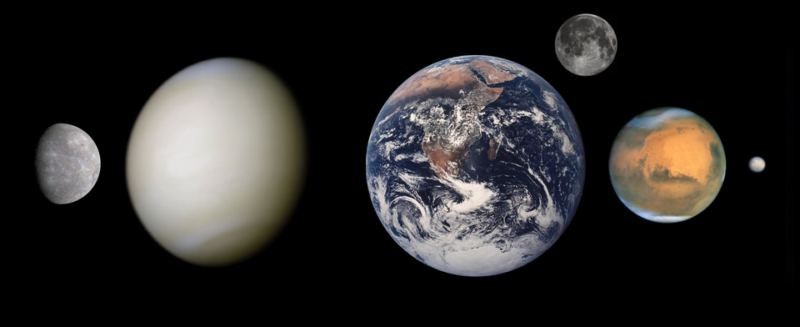
People tend to assume the rocky worlds all cracked and shifted in roughly the same way. They did not. Earth is the only one in this group (Earth, Mars, Venus, Mercury, and the Moon) with a fully developed global plate-tectonic system where rigid slabs of lithosphere move, collide, dive, and renew the planetary surface. Venus looks restless but mostly behaves like a stagnant-lid planet. Mars is a one-plate world with giant volcanic loading and rifting. Mercury and Earth’s Moon mostly record shrinkage as their interiors cooled.
Core contrast
The contrast is really about how each planet handles heat.
| World | Tectonic style | Main geologic signal | Present-day vibe |
|---|---|---|---|
| Earth | Mobile-lid plate tectonics | Subduction, ridges, transforms | Fully active |
| Venus | Stagnant lid, maybe episodic overturn | Coronae, volcanism, deformation belts | Likely active in places |
| Mars | Single-plate, localized tectonism | Tharsis, Valles Marineris, faults | Mostly dormant, not dead |
| Mercury | Contractional tectonics | Lobate scarps, thrust faults | Cooling, minor recent activity possible |
| Moon | Contractional tectonics with mare deformation | Scarps, wrinkle ridges, moonquakes | Weak but geologically recent faulting |
Why it matters
Comparative planetology gives away the deeper story. Tectonics is a surface symptom of interior heat, mantle convection, crustal strength, water content, gravity, and time.
Read the cracks correctly and you can infer how a planet lost heat, whether its mantle stayed mobile, whether its atmosphere trapped enough surface temperature to soften crust, even whether long-term climate chemistry had a shot at staying stable. That is not trivia. That is biography written in rock.
Which world has moving plates?
Earth
Earth is the outlier, and I do mean outlier. Oceanic crust forms at mid-ocean ridges, moves laterally, and gets recycled at subduction zones. Continents raft around on top of that system, collide, split, and reassemble. This mobile lid works because Earth still has strong internal heat, active mantle convection, a broken lithosphere, and liquid water that weakens minerals and helps subduction get started and keep going. In the inner solar system, nobody else clearly does all of that at once.
Venus
Venus is the irritating near-twin that refuses to behave. Similar size, similar bulk composition, wildly different tectonics. Most models still place Venus in the stagnant-lid camp, meaning its lithosphere acts more like one global shell than a mosaic of migrating plates. Still, the shell is hardly quiet. A recent Magellan reanalysis from NASA and this broader Venus reawakening review in Nature Communications both point to deformation and probable ongoing geologic activity.
Mars, Mercury, Moon
Mars, Mercury, and the Moon are much simpler tectonically, though “simple” can hide drama. The planet Mars kept one rigid outer shell and piled up immense volcanic provinces because crust was not being recycled. Mercury and the Moon mostly responded to planetary cooling by shrinking. Their crusts crumpled under compression, producing thrust faults, wrinkle ridges, and scarps rather than plate boundaries in the terrestrial planet sense.
- Earth recycles crust
- Venus deforms and resurfaces without clear global plates
- Mars stretches and loads locally
- Mercury and the Moon mostly contract
What drives these contrasts?
Interior heat
Big bodies hang onto heat longer. Earth and Venus still have enough internal heat for vigorous mantle motion. Mars lost heat faster. Mercury and the Moon lost it faster still, despite Mercury’s oversized core. Once the mantle cools and stiffens, tectonics changes character. You stop getting broad plate mobility and start getting a more locked-up planet.
Lithosphere strength
Strength matters as much as heat. A hot mantle under a stubborn lithosphere can still leave you with a stagnant lid. Venus may be the classic case. Its dense atmosphere, mostly carbon dioxide, keeps the surface hot enough to alter rock mechanics, but not in a way that automatically creates Earth-style subduction. Mars developed a thick, strong lithosphere early. Mercury and the Moon became brittle shells that mostly responded to contractional stress.
Water and volatiles
Water is the sneaky variable. On Earth it lowers melting temperatures, changes mineral chemistry, lubricates faults, and weakens subducting slabs. I suspect this is one reason Earth became the only real tectonics playground in our neighborhood. Venus once may have had more water vapor, maybe even an early magma ocean and a wetter start, but its present atmosphere is brutally dry. Mars lost most of its easy-access volatiles. Mercury and the Moon were never great candidates for hydrated plate cycling.
Earth’s mobile-lid system
Subduction
Subduction is the hard part, and Earth does it. Cold, dense oceanic lithosphere sinks into the mantle, dragging the surface into a conveyor-belt system that links trenches, volcanic arcs, earthquakes, and mantle return flow. Without sustained subduction, plate tectonics is mostly cosplay.
Seafloor renewal
Earth continuously renews its seafloor. That matters because the crust never gets too old, too thick, or too buoyant to resist the system. Ridges create basaltic crust. Trenches destroy it. Continents survive the grinder more selectively, which is why Earth ends up with a patchwork of ancient cratons and younger mobile belts.
Climate link
This part gets overlooked. Plate tectonics helps regulate carbon dioxide over geologic time through volcanism, weathering, burial, and recycling. Mountains change erosion rates. Ocean chemistry shifts. Climate gets feedbacks instead of pure chaos. For life, that is gold.
Venus’s stagnant-lid world
Resurfacing
Venus looks like a world that stores stress and then lets go in ugly, planet-wide ways. Much of its surface appears comparatively young, which hints at major resurfacing episodes. A NASA study on Venusian crustal thickness sharpened that picture by showing a crust that may limit how heat escapes.
Mantle plumes
Mantle plumes are probably doing a lot of the heavy lifting. Coronae, volcanic rises, fractures, and broad doming all suggest upwelling magma deforming the lithosphere from below. Venus may be active, just not organized into plates.
Ancient plate debate
Did Venus once have plate tectonics? Maybe, early on. I would call it plausible, not settled. Some features smell faintly plate-like, and a hotter young planet with different water inventory might have behaved differently. Still, present-day Venus is not Earth with worse weather. It is a different machine.
Mars as a one-plate planet
Tharsis load
Mars tells its story through excess. Tharsis is an enormous volcanic load, and because the martian surface did not ride over a chain of hot spots the way Earth’s plates do, volcanoes such as Olympus Mons could keep building in one place for absurd spans of time.
Rift zones
Valles Marineris and related fractures show crustal stretching, not plate boundaries in the Earth sense. The planet could crack. It just could not sustain mobile plates.
Early heat loss
Mars cooled faster, its mantle weakened as a heat engine, and its thin atmosphere did little to preserve a warm, deformable surface. That left an old world with giant scars and fading volcanism.
Mercury and the Moon shrank
Global contraction
Mercury and the Moon are the cleanest contraction stories in the solar system. As their interiors cooled, volume dropped, and the crust had to adjust.
Thrust faults
On Mercury, long lobate scarps mapped by NASA show the crust being shoved over itself. Some work even suggests this tectonic activity may have persisted surprisingly late.
Wrinkle ridges
The Moon shows a similar logic on a smaller stage. NASA’s report on the shrinking Moon ties thrust faulting and moonquakes to ongoing contraction, while mare wrinkle ridges record compression in basalt-filled basins.
Surface clues that reveal interior behavior
Planetary surfaces are blunt confessionals.
- Mid-ocean ridges and trenches betray mantle circulation plus subduction on Earth.
- Coronae and volcanic plains on Venus point to plume-driven deformation under a stagnant lid.
- Giant shield volcanoes and rifts on Mars imply a fixed crust over long-lived upwellings.
- Scarps and ridges on Mercury and the Moon record cooling, shortening, and a shrinking radius.
What these worlds reveal about evolution
These five bodies are like five drafts of rocky-planet evolution. Earth stayed dynamic. Venus stayed hot but mechanically locked. Mars aged early. Mercury and the Moon became brittle relics with aftershocks.
If you want a wider insight for planetary sciences, this is it: tectonics is not a universal setting on rocky planets. It is an emergent outcome of heat budget, water, lithosphere behavior, mantle vigor, and history. Change one ingredient and the whole cookbook changes.
FAQ
Is Venus tectonically active today?
Probably in some fashion, yes. The current evidence favors ongoing deformation and volcanism, though not a global mobile-plate system like Earth.
Why does Mars have huge volcanoes if it lacks plate tectonics?
Because the crust stayed mostly fixed. A mantle plume could keep feeding the same volcanic center for a very long time.
Are Mercury and the Moon geologically dead?
Not completely. They are far less active than Earth, but recent faulting and quakes suggest weak tectonic adjustment still happens.
Why is Earth special?
Because it seems to have the rare combination of sustained internal heat, the right lithosphere strength, active mantle convection, and enough water to help plates break, sink, and keep moving.
Conclusion
If you strip the comparison down to one clean insight, it is this: Earth rebuilds itself, Venus smolders under a stubborn shell, Mars remembers, and Mercury plus the Moon mostly shrank into their scars.
Same solar system, same sun, same basic rocky ingredients. Very different outcomes. That is the fun of comparative geology. It keeps reminding us that a planet is not just a ball of rock in orbit. It is a long argument between heat, time, and stone.
Would you like to receive similar articles by email?

Paul Tomaszewski
Paul Tomaszewski is a science & tech writer as well as a programmer and entrepreneur. He is the founder and editor-in-chief of CosmoBC. He has a degree in computer science from John Abbott College, a bachelor's degree in technology from the Memorial University of Newfoundland, and completed some business and economics classes at Concordia University in Montreal. While in college he was the vice-president of the Astronomy Club. In his spare time he is an amateur astronomer and enjoys reading or watching science-fiction. You can follow him on LinkedIn and Twitter.


You May Also Like
How Intraoral Scanners Accelerate Clear Aligner Treatment
NASA Astronaut Victor Glover: From Naval Aviator to Artemis II Pilot