Dwarf Planet Makemake: Facts, Orbit, Moon, and Discovery
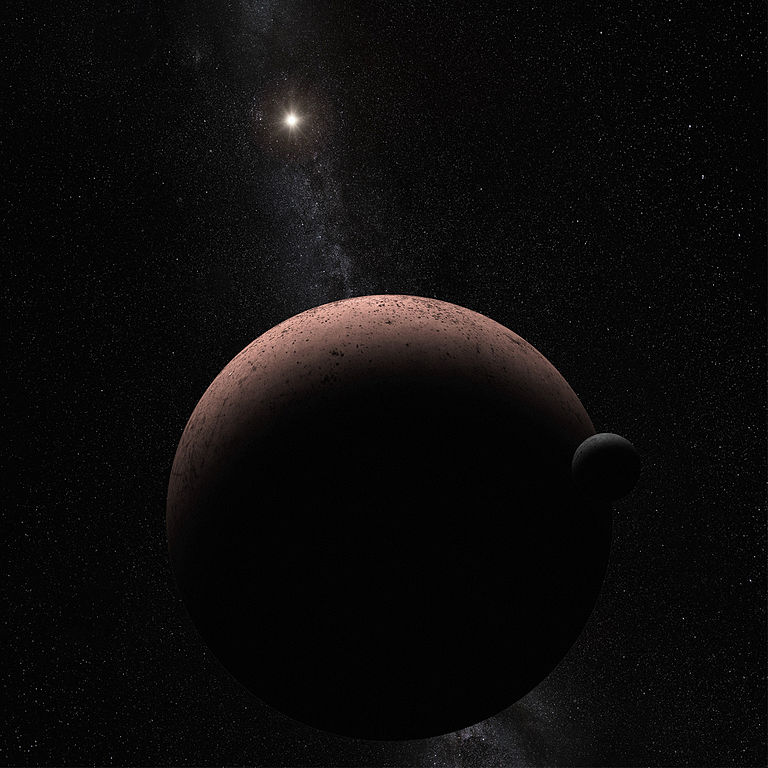
Makemake is a dwarf planet and a bright classical Kuiper belt object, discovered in March 2005 by American astronomers Michael Brown, Chad Trujillo and David Rabinowitz using the 48-inch Samuel Oschin telescope at Palomar Observatory. It sits roughly 45.8 astronomical units from the Sun on average, takes about 305 Earth years to complete one orbit, and measures near 1,430 km across. That makes it roughly two-thirds the size of Pluto, and the second-brightest icy body in that far region after Pluto itself. It is a plutoid, not an asteroid, and not a moon of anything.
Two-thirds of Pluto sounds like a footnote. It isn’t. That size determines whether the world can hold a thin atmosphere, whether it differentiated internally, and whether it could keep a satellite. Makemake answers those questions in ways nobody quite predicted.
What Makes Makemake a Dwarf Planet?
Discovery in 2005
The object was catalogued first as 2005 FY9, then given minor planet number 136472 by the Minor Planet Center. Brown’s team was sweeping for large trans-Neptunian objects during the same run that turned up Eris and Haumea, so 2005 was a genuinely strange year in solar system studies. Three heavyweights in one season.
Naming from Rapa Nui
The word Makemake comes from the creator god of the Rapa Nui people of Easter Island. Brown chose it partly because the discovery was announced near Easter. The International Astronomical Union formalized the name in July 2008, classifying it as the third plutoid after Pluto and Eris.
Classification criteria
Under IAU planetary system nomenclature, a dwarf planet must orbit the Sun, have enough mass for its own gravity to pull it into a near-round shape, not have cleared its orbital neighborhood, and not be a satellite. Makemake ticks all four. Add the requirement that it orbit beyond Neptune and you get plutoid status.
Orbit and Place in the Kuiper Belt
305-year orbital period
One Makemake year runs roughly 305 Earth years. NASA’s profile pins the mean distance at 45.8 AU with perihelion around 38 AU, so it never crosses inside Neptune’s path the way Pluto does.
Distance and inclination
The orbit is mildly eccentric and tilted about 29 degrees off the ecliptic. That inclination matters more than the eccentricity, because it’s the fingerprint of a violent past.
Dynamically hot classical
Astronomers file Makemake among the dynamically hot classical Kuiper belt objects. Translation: something stirred it. Most likely Neptune’s outward migration flung it into a steep, wobbly path early on, then left it there.
| Property | Makemake | Pluto |
|---|---|---|
| Mean distance from Sun | 45.8 AU | 39.5 AU |
| Orbital period | ~305 Earth years | ~248 Earth years |
| Diameter | ~1,430 km | ~2,377 km |
| Known moons | 1 (MK 2) | 5 |
| Global atmosphere | None detected | Thin nitrogen-methane |
Size, Shape, and Mass
Diameter near 1,430 km
The best size constraints came from watching Makemake pass in front of a background star. Those stellar occultations gave a mean diameter near 1,430 km, with an unusually high albedo of 0.77 measured by the European Southern Observatory campaign, meaning the surface reflects like fresh snow.
Ellipsoidal, not spherical
Multi-telescope timing suggests the body is slightly flattened, an ellipsoid rather than a clean sphere. Not dramatic. But enough that “round dwarf planet” is a convenient simplification rather than a literal description.
Density around 1.7 g/cm³
Roughly 1.7 grams per cubic centimeter puts it in ice-plus-rock territory, similar to Pluto’s neighborhood of values. Something in the mid-range between a dirty snowball and a differentiated little world.
Surface Composition, Color, and Temperature
Frozen methane dominates. Large grains of it, some estimated at a centimeter across, which is odd and suggests a slow annealing process rather than fresh frost. Ethane and other irradiation products sit alongside, produced when sunlight and cosmic rays crack methane apart and let the fragments recombine, a process Brunetto and colleagues traced through Makemake’s spectra in 2015.
The color leans faintly reddish, though far less so than Sedna or some other neptunian objects. Surface temperature hovers near 30 K, cold enough that nitrogen would be a solid, not a gas.
Then the James Webb Space Telescope changed the story. Webb’s spectrometry turned up gaseous methane emission near 3.3 microns plus a mid-infrared excess implying warm patches, and Sci.News covered the gas-phase peaks that nobody expected from a body this frigid. The Southwest Research Institute team floated plume-like outbursts comparable to Enceladus, which would mean subsurface geochemical activity on a world 45 AU out.
Why Does Makemake Lack a Global Atmosphere?
Occultation evidence
During a stellar occultation, the background star winked out abruptly. No gradual dimming. A real atmosphere refracts light and produces a soft fade, so the sharp cutoff ruled out anything like Pluto’s envelope.
Contrast with Pluto
Pluto holds a thin atmosphere because nitrogen ice sublimates near perihelion. Makemake’s surface chemistry and thermal history apparently don’t cooperate the same way.
Possible local outgassing
Webb’s methane gas detection doesn’t overturn the occultation result. Both can be true:
- A global, hydrostatic atmosphere is ruled out by the sharp stellar occultation profile
- Localized plumes or transient outgassing remain entirely viable
- Cryovolcanic eruptions from a warm subsurface would produce exactly this signature
MK 2, the Dark Moon
Alex Parker found it in April 2015 using Hubble’s Wide Field Camera 3, and SwRI announced the satellite discovery shortly after. The moon is about 175 km wide and charcoal-dark, some 1,300 times fainter than its parent according to the ESA Hubble archival release. It hid in plain sight because the technique that found it, the same one Parker’s team described in the original Makemakean moon paper, required suppressing Makemake’s glare first.
Why a dark moon orbiting a brilliant white planet? Best guess: MK 2 is too small to retain methane frost, so its ices boiled off and left a lag of carbon-rich residue. NASA’s Hubble team framed the find as a mass-measurement opportunity, since a satellite’s orbit is the cleanest handle you get on a distant body’s mass and interior structure. Feather on a balance scale.
Rotation, Interior, and Formation History
Makemake rotates in roughly 22.8 hours, though the lightcurve amplitude is small enough that the period has been argued over. If it differentiated, rock sank and ice floated, giving a mantle where residual heat from radioactive decay could sustain a subsurface reservoir. The moon’s existence hints at a collisional origin, a smashup that ejected debris which later reaccreted, much like the leading model for Pluto and Charon.
How Astronomers Study a World This Distant
No spacecraft has visited. No flyby mission is funded. Everything comes from:
- Stellar occultation timing across coordinated telescope networks
- Near-infrared and mid-infrared spectroscopy from Hubble and Webb
- Thermal modeling to reconcile albedo with measured infrared emission
Even a high-end amateur telescope struggles, since Makemake sits around magnitude 17. A New Horizons-style probe with a Jupiter gravity assist would need well over a decade in transit.
Could Makemake Support Life?
Almost certainly not. A 30 K surface, no protective atmosphere, no liquid water at the surface, constant radiation processing. If methane gas really does vent from below, though, then some warm, chemically active subsurface layer exists. That’s not habitability. It’s a reason to keep looking.
FAQ
Is Makemake bigger than Eris?
No. Eris is larger and considerably more massive.
Can I see it with a backyard telescope?
Realistically no. It requires a large aperture and dark skies to register as a faint dot.
Why isn’t it a planet?
It hasn’t cleared its orbital neighborhood of other icy bodies.
Conclusion
Makemake rewards attention precisely because it refuses to behave. Bright as snow, ringed by a soot-colored companion, atmosphere-free by one measurement and venting methane by another. The outer solar system isn’t a tidy gallery. It’s a messy frontier, and every new data point tilts the whole model.
Would you like to receive similar articles by email?

Paul Tomaszewski
Paul Tomaszewski is a science & tech writer as well as a programmer and entrepreneur. He is the founder and editor-in-chief of CosmoBC. He has a degree in computer science from John Abbott College, a bachelor's degree in technology from the Memorial University of Newfoundland, and completed some business and economics classes at Concordia University in Montreal. While in college he was the vice-president of the Astronomy Club. In his spare time he is an amateur astronomer and enjoys reading or watching science-fiction. You can follow him on LinkedIn and Twitter.


You May Also Like
How to Participate in Galaxy Zoo: A Volunteer Guide
How Did Uranus’ Moon Oberon Get Its Name