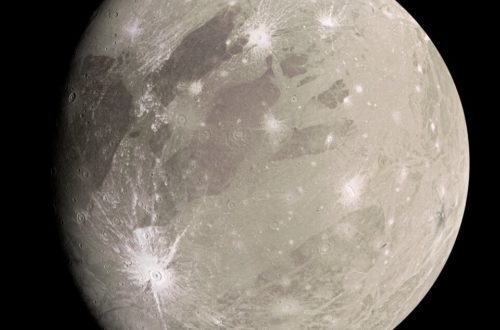
Dwarf Planet Ceres: Facts, Discovery, Surface, and Water Ice
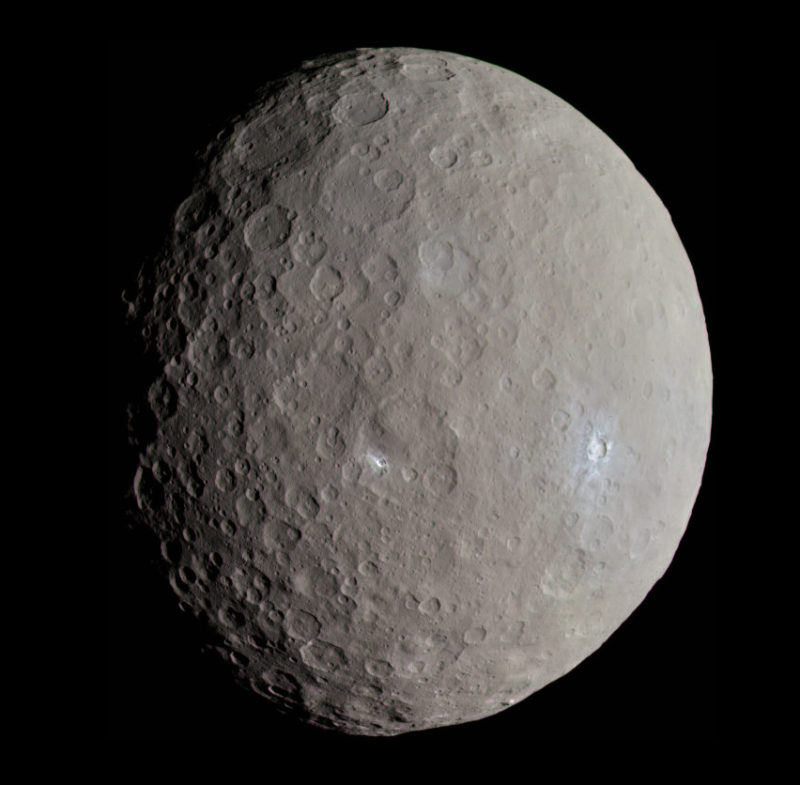
Ceres is a dwarf planet and, at the same time, the largest object in the main asteroid belt between Mars and Jupiter. Both labels are correct, and that double identity is exactly what makes it interesting. With a mean diameter of roughly 940 km, it holds about a third of the belt’s entire mass, which puts it in a class of its own among the millions of rocks orbiting out there. Water ice, salt deposits, organic molecules, and possibly the remnant of an ancient ocean sit inside it.
This guide walks through what Ceres is, how it was found, and what NASA’s Dawn mission actually revealed once we got close enough to look.
What Makes Ceres Both an Asteroid and a Dwarf Planet?
Reclassification timeline
Ceres has had an identity crisis for two centuries. Discovered in 1801, it was called a planet for roughly half a century, then demoted to asteroid once astronomers realized it had neighbors. Lots of them. In 2006, the International Astronomical Union created the dwarf planet category, and Ceres was folded in alongside Pluto. Depending on which catalog you consult, NASA’s own reference material still lists both designations without apology.
Dwarf planet criteria
Three conditions define a dwarf planet: it orbits the Sun, it has enough self-gravity to pull itself into a nearly round shape, and it has failed to clear its orbital neighborhood. Ceres ticks all three. That last point is where the argument gets fun. It shares the belt with countless asteroids, so it never became a proper planet. Jupiter’s gravitational bullying during the early solar system stopped that from happening.
Largest belt object
There’s a persistent take online that Ceres is “just a big asteroid.” Frankly, that misses the geology. Radio-tracking during the Dawn encounter measured spacecraft velocity to a precision of 0.004 inches (0.1 mm) per second, and that gravity data confirmed a differentiated body close to hydrostatic equilibrium. Rubble piles don’t do that. This is a world in miniature.
Physical and Orbital Profile
Compared with the asteroid Vesta, Dawn’s earlier target, Ceres is rounder, wetter, and colder. Vesta looks like a battered protoplanet with a basaltic crust. Ceres looks like something that nearly turned into an icy moon and then got stranded in the wrong part of the solar system.
- Mean diameter: 940 km, roughly 27% the width of Earth’s Moon
- Orbital period: 4.6 Earth years, at an average distance of 2.77 astronomical units
- Rotation: a fast 9-hour day, which Hubble observations pinned down before any spacecraft arrived
- Surface temperature: around minus 105 Celsius at midday near the equator
There’s also a wispy, intermittent exosphere. Water vapor shows up and vanishes, likely tied to sublimating ice and possibly to the transient water-ice and dust clouds that researchers spotted forming inside major impact craters. Not an atmosphere in any meaningful sense. More like breath on cold glass.
How Was Ceres Discovered and Named?
Giuseppe Piazzi, working from Palermo on the first night of 1801, logged a moving point of light he initially took for a comet. He was actually hunting something else. The Titius-Bode relation predicted a missing planet in the gap between Mars and Jupiter, and a group of European astronomers had organized a search. Piazzi found it by accident, more or less, and then lost it to illness and the Sun’s glare before Carl Friedrich Gauss recovered it mathematically.
The name comes from the Roman goddess of grain and harvest, a patroness of Sicily. Fitting, given where the telescope was pointed. The element cerium was named after it a couple of years later, which is a small piece of trivia I like more than I probably should.
Surface Features and the Occator Bright Spots
Craters and Ahuna Mons
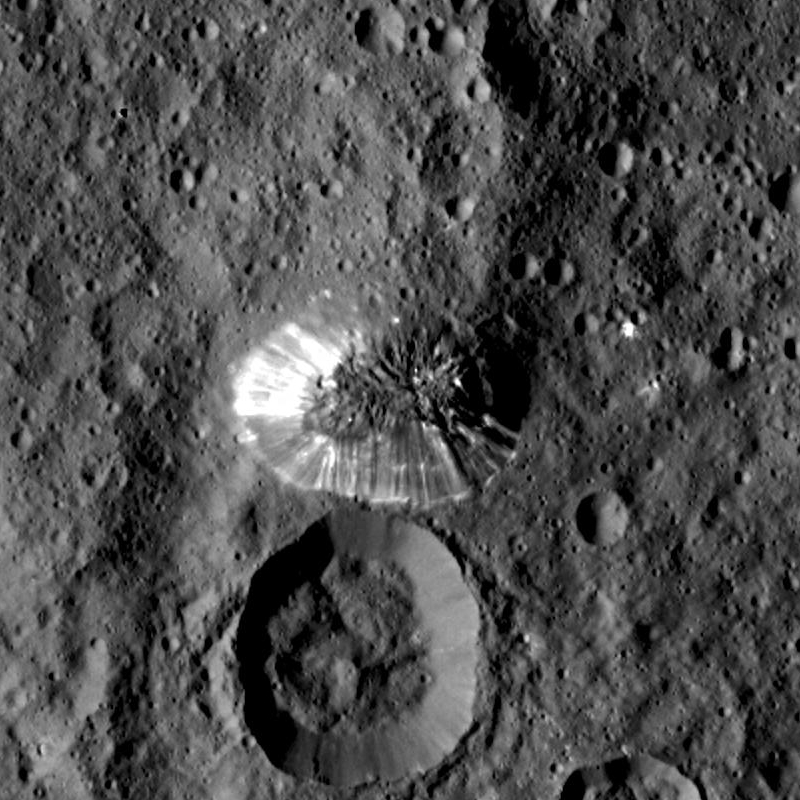
The surface is heavily cratered, as you’d expect for a body that’s been sitting in a shooting gallery for 4.5 billion years. What’s odd is what’s missing. There are fewer enormous basins than models predicted, which suggests a crust soft enough to relax and erase them over time. Rising from an otherwise flat plain, Ahuna Mons is a lone mountain about 4.1 km high with bright streaks running down its flanks.
Salt deposits
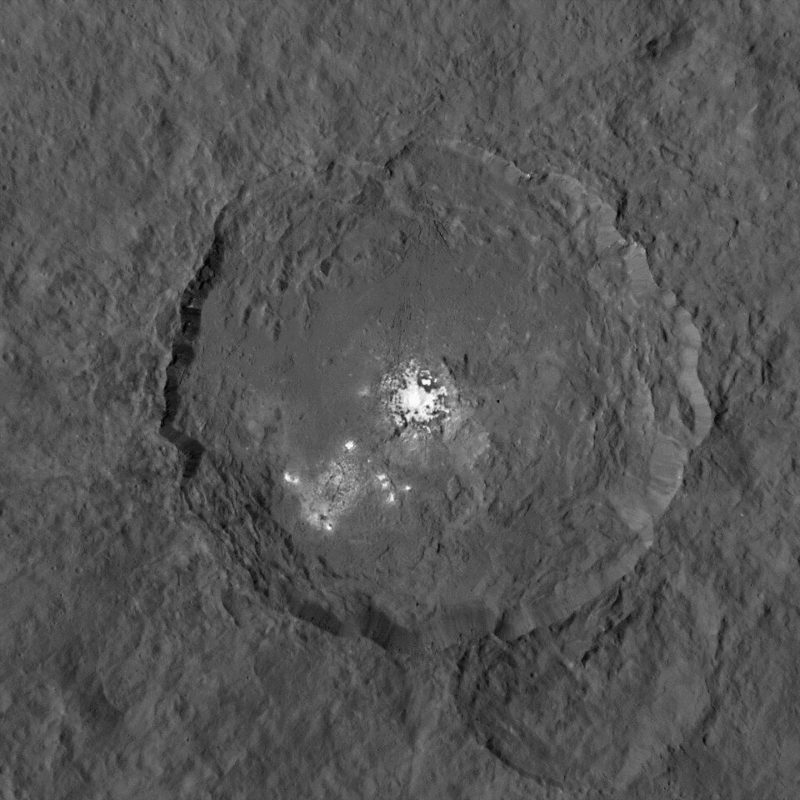
Those famous bright spots inside Occator crater turned out to be sodium carbonate, not ice. Salt. Left behind when briny liquid reached the surface and the water flashed away. Similar high-albedo material shows up in Oxo and other young craters, which tells you the source is shallow and still accessible.
Cryovolcanic activity
Ahuna Mons is best read as a cryovolcano, built by slushy brine pushing up through the crust rather than molten rock. The single most useful takeaway from the extended mission is that this activity is geologically recent. Ceres is not a dead rock.
Interior Structure, Water Ice, and the Subsurface Brine Ocean
The interior sorts into layers: a rocky, hydrated core, then a thick crust laced with ice, salts, and clathrates. Water ice may account for something like a quarter of the total mass. Structural planetary modeling of Ceres describes the deep subsurface as a frozen, progressively impurity-laden ancient ocean rather than a clean liquid layer.
Pockets of residual brine likely persist beneath Occator. Data from Dawn’s lowest orbital passes supported reading Ceres as an active inner-system ocean world, which was not the expectation going in.
Could Ceres Have Supported Life?
Aliphatic organic compounds were confirmed spectroscopically near Ernutet crater, and laboratory work on how fast radiation destroys those molecules implies the surface deposits have been replenished from shallow stores within the past few million years. Machine-learning mapping of organic-rich terrain across the globe has since sharpened where those materials sit and whether impacts delivered them or cryovolcanism brought them up.
Thermal models suggest that between 500 million and 2 billion years after formation, radiogenic heating pushed core temperatures past 527 degrees Celsius, enough for hydrothermal circulation and a steady chemical energy supply. That’s a habitability argument, not a life claim. Nobody found organisms. What Ceres offers is the ingredient list plus a plausible kitchen.
How Dawn Changed What We Know About Ceres
Dawn launched September 27, 2007, reached Ceres on March 6, 2015, and went silent November 1, 2018. It remains the only spacecraft to orbit two extraterrestrial bodies. The mapping campaign moved through Survey, HAMO, and LAMO phases, eventually resolving surface detail down to about 415 meters per pixel and finer during the final low passes. Before that, our best views were Hubble frames showing little more than albedo blotches.
Ceres Compared With Pluto, Eris, Haumea, and Makemake
Ceres is the only dwarf planet inside Neptune’s orbit. The others are cold, distant, and Kuiper belt residents. It’s also the smallest of the five, which people sometimes treat as a demerit. Size isn’t destiny out here.
Why Ceres Still Matters for Future Missions
A sample return from Occator would test the habitability case directly. Ceres is also close, low-gravity, and water-rich, which makes it a legitimate resource stop for anything ambitious happening beyond Mars.
FAQ
Is Ceres visible from Earth?
With binoculars, yes, as a faint moving star near magnitude 7.
Does Ceres have moons?
None found.
Could we land there?
Easily, in engineering terms. Surface gravity is about 3% of Earth’s.
Conclusion
Ceres deserves better than the footnote treatment. It’s a surviving protoplanet with ice, salts, organics, and a warm past, parked where we can actually reach it.
Would you like to receive similar articles by email?

Paul Tomaszewski
Paul Tomaszewski is a science & tech writer as well as a programmer and entrepreneur. He is the founder and editor-in-chief of CosmoBC. He has a degree in computer science from John Abbott College, a bachelor's degree in technology from the Memorial University of Newfoundland, and completed some business and economics classes at Concordia University in Montreal. While in college he was the vice-president of the Astronomy Club. In his spare time he is an amateur astronomer and enjoys reading or watching science-fiction. You can follow him on LinkedIn and Twitter.


You May Also Like

What Causes Stretch Marks and How to Support Skin Health?
Earth’s First Trojan Asteroid discovered by NASA’s WISE