Draco Constellation Guide
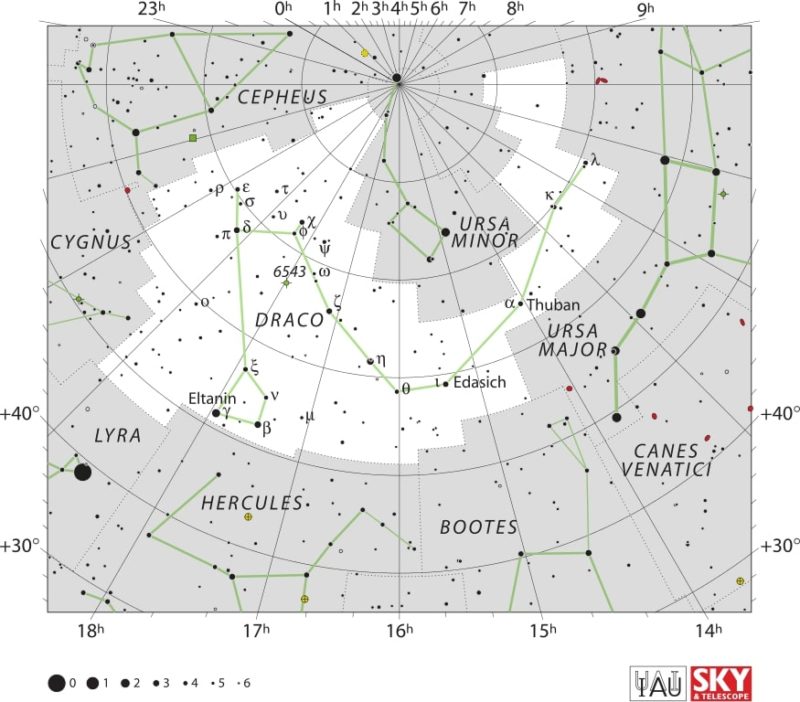
The Draco constellation is easy to underestimate. It has no first-magnitude star dominating the view, yet this long, winding figure occupies a remarkable position around the north celestial pole. From northern latitudes, Draco can remain visible all year, curling between the Big Dipper and Little Dipper like a celestial serpent that never quite leaves the sky.
Its importance comes from geometry, history, and deep-sky targets rather than sheer brightness. The star Thuban once served as Earth’s pole star, while the Cat’s Eye Nebula offers telescope observers an intricate glimpse of a dying star. There is plenty here for curious stargazers to explore.
What Is the Draco Constellation?
Official Boundaries
Draco is one of the 88 modern constellations recognized by the International Astronomical Union. Its boundaries cover a broad region of the northern sky, wrapped around Ursa Minor and extending toward Cepheus, Cygnus, Lyra, Hercules, Boötes, and Ursa Major.
The name comes from the Latin draco, meaning dragon. In star charts, however, the creature is less a sharply drawn animal than a crooked chain of stars whose head rests near Hercules and whose tail winds toward the Big and Little Dippers.
Shape and Position
The easiest visual description is a serpentine line. Four stars mark the dragon’s head, while a long, uneven body loops around the north celestial pole before narrowing toward its tail. The pattern is faint compared with Orion or Scorpius, so city light can erase much of its outline.
Draco sits in the northern sky between the two Dippers. Its position makes it especially useful for learning celestial navigation, because the constellation’s stars appear to circle Polaris as Earth rotates. That slow nightly motion is an effect of Earth’s rotation, not movement by the stars themselves.
Astronomical Significance
The star Thuban, also called Alpha Draconis, was near the north celestial pole around 2600 BCE. Earth’s axial precession gradually shifted the pole away from it, a reminder that the sky’s reference points are not permanently fixed. EarthSky’s historical overview of Thuban as a former pole star connects this shift with ancient Egyptian astronomy and possible pyramid alignments, though claims about deliberate architectural alignment should be treated with appropriate caution.
Draco also contains galaxies, variable stars, and a planetary nebula, giving amateur astronomers more to investigate than its modest naked-eye appearance suggests.
How Do You Locate It?
Find the Big Dipper
Start with the Big Dipper, part of Ursa Major. Find the two stars at the outer edge of its bowl and follow their line toward Polaris, the North Star. The Little Dipper’s handle ends at Polaris, and Draco coils between the two familiar patterns.
A dark site helps enormously. Under suburban skies, begin with the brighter stars in the dragon’s head, then let your eyes adapt for several minutes before tracing the fainter body.
Trace the Dragon’s Body
Look for the four-star head near Hercules. Eltanin and Rastaban are the most useful guides there, forming the dragon’s eyes or head region in common sky charts. From this point, follow the uneven chain eastward and northward toward Thuban, then around Polaris toward the tail.
The pattern will not snap into view like the Big Dipper. It emerges gradually. A planisphere or astronomy app can help, but compare the screen with the real sky often. Blindly waving a phone around tends to ruin night vision and patience at the same time though.
Check Seasonal Visibility
Draco is best placed for evening observation during spring and summer in the Northern Hemisphere, though much of it remains visible throughout the year from northern latitudes. Observers in the far southern hemisphere may see little or none of it.
Which Constellations Border Draco?
Ursa Major
Ursa Major lies along Draco’s western and southern side. The Big Dipper acts as the most practical landmark, especially when you are trying to locate the dragon’s tail.
Ursa Minor
Ursa Minor sits inside the broad curve of Draco. Polaris, at the end of the Little Dipper’s handle, provides the fixed-looking center around which Draco appears to turn.
Cepheus and Cygnus
Cepheus borders Draco toward the north and east, while Cygnus lies farther south. Hercules and Lyra also approach the dragon’s lower regions, creating a busy neighborhood for observers comparing several northern constellations in one session.
Which Stars Matter Most?
Thuban
Thuban is a fourth-magnitude multiple-star system and the constellation’s historic centerpiece. It is not currently close to the celestial pole, but precession made it a useful pole star thousands of years ago.
Eltanin
Eltanin, or Gamma Draconis, is a bright orange giant and the most prominent star in Draco’s head. Its visibility makes it a better starting point than Thuban for many beginners.
Rastaban
Rastaban, or Beta Draconis, is another giant star in the head. Together, Eltanin and Rastaban give the dragon its recognizable forward shape. For a compact reference:
| Star | Common designation | Why it matters |
|---|---|---|
| Thuban | Alpha Draconis | Former pole star |
| Eltanin | Gamma Draconis | Bright orange giant |
| Rastaban | Beta Draconis | Major head star |
What Deep-Sky Objects Can You See?
The Cat’s Eye Nebula, NGC 6543, is Draco’s showpiece. It is a planetary nebula formed when a dying star expelled its outer layers, leaving hot gas glowing around the exposed stellar core. Through a small telescope, it may look like a tiny blue-green disk. Larger instruments reveal more structure.
Hubble imagery shows the nebula’s nested shells and fast-moving gas, while a NASA multi-wavelength view of the Cat’s Eye combines optical observations with X-ray data from the Chandra X-ray Observatory. NASA also explains how the dying star produced this elaborate sculpture of gas and dust.
Draco also contains the Draco Dwarf Galaxy, a faint satellite of the Milky Way, and several galaxies that challenge observers under dark skies. These are not casual binocular targets. A telescope, patient searching, and accurate star charts are usually necessary.
How Have Cultures Interpreted the Dragon?
Greek mythology commonly links Draco with Ladon, the serpent-like guardian of the golden apples in Hera’s garden. Some traditions instead connect the constellation with a dragon defeated by Athena during a battle between the gods and the Titans. The stories changed, even when the stars remained overhead.
Arabic sky traditions offered a different reading, seeing parts of the region as camels rather than a dragon. Chinese astronomy associated the broader celestial region with the Azure Dragon of the East. These interpretations matter because constellations are cultural maps laid over physical stars, not universal pictures hidden in nature.
FAQ
Is Draco visible all year?
From much of the Northern Hemisphere, Draco is circumpolar, meaning it never fully sets below the horizon. Its exact visibility depends on latitude.
Is Draco the largest constellation?
No. It is large, but Hydra is the largest of the 88 modern constellations.
Can you see the Cat’s Eye Nebula without a telescope?
Usually not. It requires optical aid, and its small size makes it difficult even through modest amateur telescopes.
Why was Thuban important?
Earth’s axial precession placed Thuban near the north celestial pole around 2600 BCE. It was once a much better marker of north than it is today.
Conclusion
Draco rewards observers who slow down. Its stars are not arranged for instant recognition, yet the constellation’s position, ancient pole-star history, planetary nebula, and layered mythology make it one of the northern sky’s most interesting long-term discoveries. Find the Dippers first, follow the crooked body, and let the dragon reveal itself gradually.
Would you like to receive similar articles by email?

Paul Tomaszewski
Paul Tomaszewski is a science & tech writer as well as a programmer and entrepreneur. He is the founder and editor-in-chief of CosmoBC. He has a degree in computer science from John Abbott College, a bachelor's degree in technology from the Memorial University of Newfoundland, and completed some business and economics classes at Concordia University in Montreal. While in college he was the vice-president of the Astronomy Club. In his spare time he is an amateur astronomer and enjoys reading or watching science-fiction. You can follow him on LinkedIn and Twitter.


You May Also Like
How Did Neptune Get Its Name?
Space Elevator (Non-Rocket Spacelaunch)