Dorado Constellation Guide
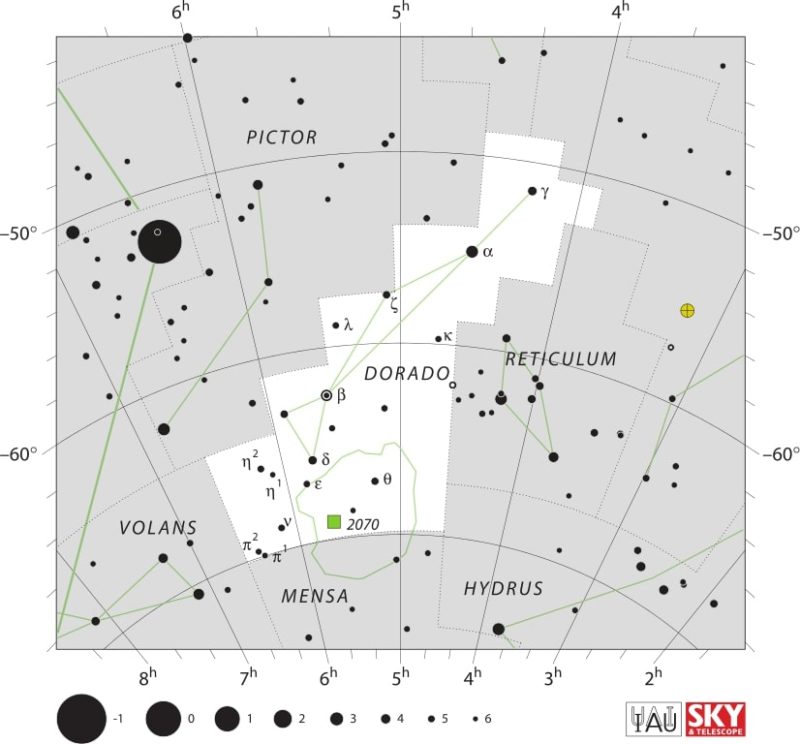
Dorado looks like a minor southern constellation, and visually, that judgment is fair. Its brightest stars are modest, especially beside Orion or the Southern Cross. Yet this faint patch of sky contains the Large Magellanic Cloud, the Tarantula Nebula, Supernova 1987A, and a remarkable collection of galaxies and star clusters. Dorado is a quiet-looking region with unusually loud science.
What Does the Dolphinfish Constellation Represent?
Name and Meaning
The name Dorado refers to the dolphinfish, commonly called mahi-mahi, a fast, vividly colored ocean fish. It does not represent a dolphin in the modern marine-mammal sense, and it is not the swordfish constellation, although early star atlases created that confusion by using the name Xiphias.
The imagery reflects European voyages into southern waters during the late 16th century. The fish itself is not a mythological figure from Ptolemy’s ancient catalog. Dorado belongs to the newer group of western IAU constellations created to fill in skies invisible from much of Europe.
Discovery and History
Dutch navigators Pieter Dirkszoon Keyser and Frederick de Houtman recorded the southern stars during a 1595 expedition to the East Indies. Dutch astronomer Petrus Plancius later placed Dorado on celestial globes, while later mapmakers sometimes altered its identity. Johannes Bayer used Xiphias, or swordfish, in his Uranometria, a small cartographic detour that survived for a while.
French astronomer Nicolas-Louis de Lacaille surveyed the region more systematically in the 18th century. Modern astronomy settled the matter: the International Astronomical Union recognizes Dorado, abbreviated Dor, as one of the 88 official constellations.
IAU Boundaries
The IAU boundaries define a precise patch of the celestial sphere, rather than a fish-shaped drawing that every observer must interpret the same way. The whole constellation covers about 179 square degrees. Its borders include Mensa, Hydrus, Reticulum, Horologium, Caelum, Pictor, and Volans.
Where Is It Located in the Southern Sky?
Coordinates and Neighbors
Dorado lies deep in the southern hemisphere, roughly around right ascension 5 hours and declination -65 degrees. It sits well below the celestial equator, near the south ecliptic pole, which helps explain why observers at northern latitudes struggle to see it.
The neighboring constellation Mensa is especially important because the Large Magellanic Cloud overlaps both regions. The boundary is an astronomical convenience, not a visible wall.
Seasonal Visibility
For observers in Australia, New Zealand, southern Africa, and southern South America, Dorado is best placed during the southern summer, particularly from November through February. At suitable latitudes, much of the constellation remains visible for long periods and some of it approaches circumpolar status.
From the northern hemisphere, Dorado becomes difficult or impossible to observe as latitudes rise. Around the equator, it can appear low in the southern sky, but atmospheric haze and light pollution will erase its faintest stars.
Shape and Size
Dorado’s outline resembles an elongated fish, though imagination does most of the work. The constellation contains no star brighter than magnitude 3.0, so its shape is not immediately obvious. A dark rural sky helps, but even then Dorado is more of a framework for locating deep-sky objects than a striking naked-eye pattern.
Which Stars Define Its Shape?
Alpha Doradus
Alpha Doradus is a close binary star system with a white primary star and a hot companion. It is among the brighter points in Dorado, but its visual dominance is limited. The system matters more as a stellar laboratory than as a dramatic beacon.
Beta Doradus
Beta Doradus is the constellation’s most useful bright marker and a classic Cepheid variable star. Its brightness changes over a regular period of about 9.8 days, making it valuable for understanding the distance scale of the universe. Cepheids are cosmic mileposts because their pulsation period relates to intrinsic luminosity.
Gamma Doradus
Gamma Doradus is the prototype of the Gamma Doradus variables, stars whose brightness fluctuates through non-radial pulsations. In plain language, different parts of the star’s surface move in complicated rhythms rather than expanding and contracting as one perfect sphere.
How Can You Find and Observe It?
Best Viewing Regions
A dark-sky location in the southern hemisphere is the sensible starting point. Find the Large Magellanic Cloud first, then use its position relative to Mensa and Dorado to work backward toward the constellation’s brighter stars. A planisphere or astronomy app can make the job much less guesswork.
Naked-Eye Limits
Dorado is faint enough that city observing is unrewarding. Light pollution washes away its outline, while humid air near the horizon adds another layer of trouble. Under clear rural skies, the main stars become easier to trace, but the constellation still lacks the immediate punch of Orion or Crux.
Binocular and Telescope Targets
Binoculars reveal scattered star fields within the Large Magellanic Cloud. A telescope begins to separate nebulae and clusters, especially under steady, transparent skies. The LMC itself is an irregular satellite galaxy of the Milky Way, not a nebula inside Dorado.
Why Does the Large Magellanic Cloud Matter?
The Large Magellanic Cloud lies about 160,000 light-years away and overlaps Dorado and Mensa. Because it is close enough for individual stars and nebulae to be studied in detail, astronomers use it as a natural test range for stellar evolution, chemical enrichment, and galactic dynamics.
Dorado contains more than half of the visible LMC, including its active stellar nurseries. Its proximity turns broad questions about galaxy formation into measurable problems involving actual stars.
Which Deep-Sky Objects Deserve Attention?
Tarantula Nebula
The Tarantula Nebula, or NGC 2070, is the showpiece. It is an enormous star-forming region inside the LMC, energized by young, massive stars and intense ultraviolet radiation. Through a telescope, its web-like structure becomes apparent, while long-exposure images reveal glowing gas, dark dust, and crowded stellar associations.
Supernova 1987A
Supernova 1987A erupted in the LMC in Dorado and became the closest observed supernova since the invention of the telescope. Its expanding rings, created by material shed before the explosion, remain a valuable record of stellar death.
Star Clusters and Galaxies
Dorado also includes open clusters, nebulae, and distant galaxies. NGC 1566 is a grand-design spiral galaxy, while NGC 1672 is a barred spiral and Seyfert galaxy with an active nucleus. The larger Dorado Group, a collection of interacting galaxies roughly 62 million light-years away, gives the constellation importance far beyond its local Magellanic Cloud. NOIRLab’s constellation guide offers a useful map of these relationships.
What Makes This Faint Region Scientifically Important?
Dorado demonstrates why visual brightness is a poor measure of astronomical value. Its foreground stars are subdued, yet the region contains a nearby satellite galaxy, massive star formation, pulsating variables, stellar remnants, and remote galaxy groups. It is both a navigational label and a scientific window.
The constellation’s real significance emerges when the eye stops chasing bright stars and begins tracing structure: gas becoming stars, stars ending as supernovae, and galaxies reshaping one another across immense distances. That is Dorado’s particular charm. Quiet at first glance, astonishing once explored.
FAQ
What does Dorado mean?
Dorado means dolphinfish, or mahi-mahi.
Can Dorado be seen from the United States?
Only from far southern parts of the country, and usually very low on the horizon. It is far better placed in the southern hemisphere.
What is Dorado’s brightest star?
Alpha Doradus is generally listed as the brightest, although Beta Doradus is especially notable because it is a Cepheid variable.
What is Dorado’s best deep-sky target?
The Tarantula Nebula is the standout, followed closely by the wider Large Magellanic Cloud.
Conclusion
Dorado may never win a beauty contest among constellations, but it is an astrophysical goldmine. Its faint outline leads observers toward the Large Magellanic Cloud, the Tarantula Nebula, Supernova 1987A, and distant galaxies that make this southern sky region remarkably rich. Discovery starts with a fish-shaped pattern, then quickly becomes something much larger.
Would you like to receive similar articles by email?

Paul Tomaszewski
Paul Tomaszewski is a science & tech writer as well as a programmer and entrepreneur. He is the founder and editor-in-chief of CosmoBC. He has a degree in computer science from John Abbott College, a bachelor's degree in technology from the Memorial University of Newfoundland, and completed some business and economics classes at Concordia University in Montreal. While in college he was the vice-president of the Astronomy Club. In his spare time he is an amateur astronomer and enjoys reading or watching science-fiction. You can follow him on LinkedIn and Twitter.


You May Also Like

What Is the Zenithal Hourly Rate: Understanding Meteor Shower Peaks
The Roche Limit: What Happens When a Moon Gets Too Close?