Delphinus Constellation Guide
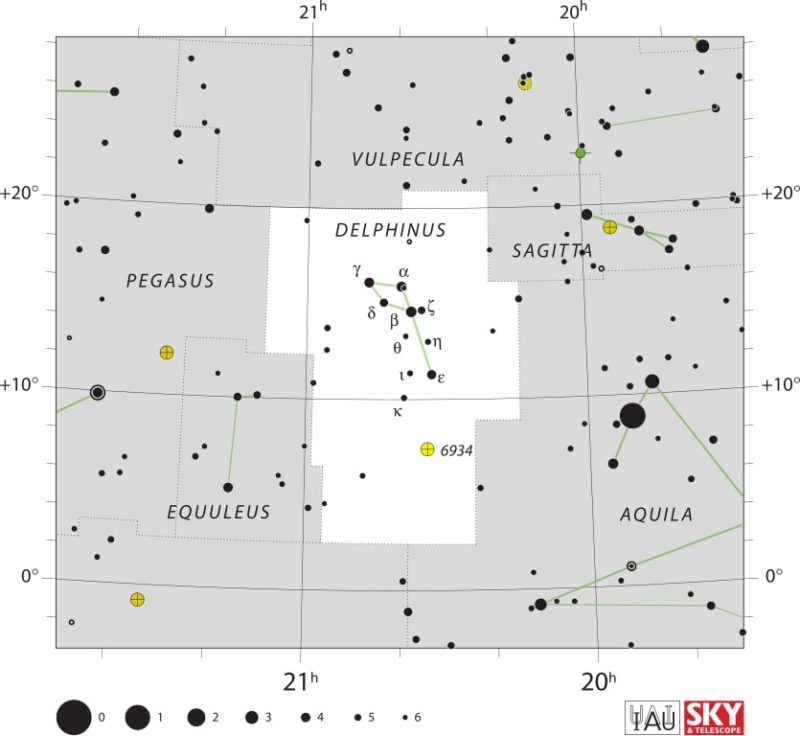
Small constellations are often dismissed as minor players, yet Delphinus is one of the easiest patterns to recognize on a summer night. Its four principal stars form a compact diamond, traditionally called Job’s Coffin, with a short line of stars suggesting a tail. The result looks surprisingly dolphin-like, especially when viewed beside the bright Summer Triangle.
Delphinus is a northern-sky constellation, one of the 88 modern constellations recognized by the International Astronomical Union. It contains no first-magnitude star, but its tidy geometry, double stars, globular clusters, and long mythological history make it a rewarding target for beginners and experienced observers alike.
What Is Delphinus and Where Is It Located?
Dolphin Shape
Delphinus occupies a small patch of sky between Aquila and Cygnus. Its central diamond represents the body of the dolphin, while fainter stars extend toward the southeast like a tail. The pattern is compact enough to survive moderate suburban light pollution, which is a welcome trait among summer constellations.
The constellation covers roughly 189 square degrees, making it the 69th-largest of the 88 recognized patterns. Its brightest stars are around third magnitude, so a truly dark sky helps, though Delphinus can still be identified from many towns.
Celestial Neighbors
Delphinus is surrounded by several useful landmarks. Aquila, the Eagle, lies to the southwest and contains bright Altair. Cygnus, the Swan, stretches to the northeast. Sagitta and Vulpecula sit nearby, while Pegasus and Equuleus appear farther east and southeast.
This location places Delphinus near a rich Milky Way star field. A telescope pointed through the region can reveal dense stellar backgrounds, although the constellation itself lies away from the brightest central band of the galaxy.
Constellation Boundaries
The official boundaries give Delphinus a narrow, irregular outline. Its position is approximately between right ascension 20 and 21 hours and declination +2 to +21 degrees. Those coordinates explain why it is primarily associated with northern summer and early autumn observing.
When Can You See Delphinus?
Best Viewing Season
Delphinus is best viewed from July through September, when it rises high during the evening in the Northern Hemisphere. In August, it stands near the meridian during the late evening, giving observers a comfortable, elevated view.
By autumn, it remains visible after sunset, though it gradually shifts westward as winter approaches. The constellation is small, so haze near the horizon can erase its fainter tail stars.
Northern Visibility
Observers across the United States, Canada, Europe, and much of northern Asia can see Delphinus clearly. From mid-northern latitudes, it climbs high enough for binocular and telescope work. The farther north you travel, the lower its southernmost stars appear, but the main diamond remains accessible.
Southern Visibility
Delphinus can also be seen from much of Australia, southern Africa, and South America. It appears lower in the northern sky, especially from locations well south of the equator. Far-southern observers may need a level horizon and a darker site, but the constellation is not permanently hidden from most populated southern regions.
Which Stars Define Its Shape?
Sualocin and Rotanev
Alpha Delphini, called Sualocin, and Beta Delphini, called Rotanev, are two of the constellation’s defining stars. Their unusual names conceal a nineteenth-century joke: reversed, “Sualocin” and “Rotanev” become “Nicolaus Venator,” the Latinized form of Niccolò Cacciatore, an astronomer associated with the Palermo Observatory. The naming history is documented in discussions of Delphinus’s star names.
Sualocin (Alpha Delphini) is itself a spectroscopic binary whose two components are separated by only 0.2 arcseconds and orbit each other every 17 years; astronomers detect the companion through shifting spectral lines rather than by splitting it visually. Rotanev (Beta Delphini) is a close visual pair resolvable with a large amateur telescope, with a 27-year orbital period and a separation near 0.65 arcseconds.
Job’s Coffin
Alpha, Beta, Gamma Delphini, and Delta Delphini create Job’s Coffin, an old asterism whose name has nothing to do with the dolphin myth; the most widely cited account traces it to the elongated, box-like four-star diamond resembling a coffin, with the “Job” element possibly referring to the biblical figure of Job, though no source documents who coined the name or when.
The diamond shape is the constellation’s visual anchor. Observing guides describe the pattern as a compact four-star figure with a few trailing stars that suggest the animal’s tail.
Gamma and Delta Delphini
Gamma Delphini is a well-known visual binary, with two stars separated by only a few arcseconds. A small telescope may split them under steady atmospheric conditions, though magnification alone cannot overcome poor seeing.
Delta Delphini is another important member of the diamond. Together with Epsilon Delphini and Zeta Delphini, it gives the constellation enough structure to resemble a leaping marine animal rather than a random scatter of stars.
How Do You Find It in the Night Sky?
Summer Triangle
Start with the Summer Triangle, formed by Vega in Lyra, Deneb in Cygnus, and Altair in Aquila. Delphinus lies southeast of the line between Vega and Altair, close to the Milky Way’s brighter summer constellations. A visual guide to Delphinus’s kite shape is useful because the constellation is easy to overlook when searching by name alone.
Altair Guide
Locate Altair first. It is the bright star at the southern point of the Summer Triangle. From Altair, move east and slightly north toward a small, tight diamond. Delphinus should appear as a tiny geometric mark surrounded by darker sky and scattered stars.
Binocular Viewing
Binoculars are often better than a telescope for the first search because their wide field keeps Altair and nearby landmarks visible. Once the diamond is identified, switch to a telescope for Gamma Delphini or the constellation’s faint deep-sky objects.
What Deep-Sky Objects Does It Contain?
The standout targets are the globular clusters NGC 6934 and NGC 7006. NGC 6934 lies roughly 52,000 light-years away, shines at magnitude 9.75, and is classified as Shapley–Sawyer Class VIII. It appears as a compact, hazy patch in modest telescopes. NGC 7006 is much more distant at roughly 137,000 light-years, shines at magnitude 11.5, and is classified as Shapley–Sawyer Class I. It sits in the Milky Way’s outer halo and demands darker skies and larger aperture. Its remote location is why it appears faint despite containing many thousands of stars.
Delphinus also contains the planetary nebula NGC 6905, sometimes called the Blue Flash Nebula. Its blue-green appearance becomes more apparent through larger telescopes and suitable filters. It is a planetary nebula, meaning the glowing shell came from a dying star, not from planet formation.
How Did Delphinus Shape Mythology and Culture?
Greek mythology connects Delphinus with Poseidon, the god of the sea. In one story, a dolphin helped Poseidon find Amphitrite, a sea nymph who became his consort. Another legend tells how dolphins rescued Arion, a poet thrown overboard by pirates after his music charmed one of the animals. These stories explain why Delphinus became associated with rescue, intelligence, and safe passage across the ocean. Ian Ridpath’s account of the constellation traces these traditions in detail.
The pattern has never belonged exclusively to Greek mythology. Chinese sky traditions interpreted parts of it through different celestial groupings, where Job’s Coffin and Zeta Delphini formed the constellation Hugua, a dried gourd, while Epsilon, Eta, Theta, Iota, and Kappa Delphini formed Baigua, an over-ripe gourd. In Polynesia, skywatchers on Pukapuka called the pattern Te Toloa and the people of the Tuamotus called it Te Uru-o-tiki. The same stars, naturally, but a different cultural landscape.
Why Does Delphinus Matter to Astronomy?
Delphinus matters because it demonstrates how much science can hide inside a modest patch of sky. Its binary stars help astronomers measure stellar masses and orbital behavior, while NGC 6934 and NGC 7006 provide laboratories for studying globular clusters and the structure of the Milky Way’s halo.
Nova Delphini 2013 also reminded observers that familiar star fields can change suddenly. The nova, designated V339 Delphini, peaked at magnitude 4.3 and was the first classical nova observed to produce lithium, the result of a thermonuclear eruption on a white dwarf. For a few days, a normally faint region held a temporary beacon. Earlier, HR Delphini had flared to magnitude 3.5 in December 1967, an unusually slow rise that hinted at a barely-satisfied thermonuclear runaway.
FAQ
Is Delphinus easy to see?
Yes. Its diamond shape is distinctive, and binoculars make the search much easier.
Does Delphinus contain a bright star?
No first- or second-magnitude stars belong to it. Its brightest stars are near third magnitude.
When is Delphinus visible?
It is best seen during summer and early autumn evenings, especially from July through September.
Is Delphinus a dolphin-shaped galaxy or nebula?
No. Delphinus is a constellation, an apparent pattern of stars that may lie at very different distances.
Conclusion
Delphinus rewards patience rather than brute force. Find Altair, look for the small diamond, and let the pattern settle into view. Once it does, the tiny dolphin becomes a gateway to binary-star astronomy, globular clusters, ancient sea legends, and the broader human habit of turning distant points of light into stories.
Would you like to receive similar articles by email?

Paul Tomaszewski
Paul Tomaszewski is a science & tech writer as well as a programmer and entrepreneur. He is the founder and editor-in-chief of CosmoBC. He has a degree in computer science from John Abbott College, a bachelor's degree in technology from the Memorial University of Newfoundland, and completed some business and economics classes at Concordia University in Montreal. While in college he was the vice-president of the Astronomy Club. In his spare time he is an amateur astronomer and enjoys reading or watching science-fiction. You can follow him on LinkedIn and Twitter.


You May Also Like
Cetus Constellation Guide
Carina Constellation Guide