December Phi Cassiopeid Meteor Shower Guide
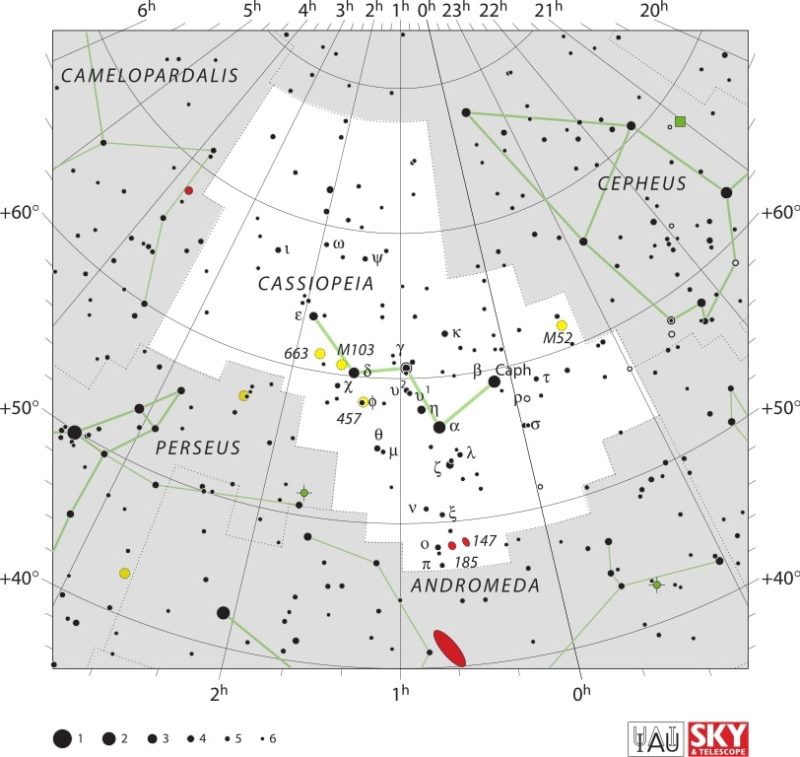
The December Phi Cassiopeids are a minor meteor shower that occurs every year in early December. It occurs in the northern sky close to the constellation of Cassiopeia.
Its peak is short-lived and not quite as spectacular as the stronger Geminids shower. These meteors travel at a low average speed. Late evening or early morning offer the best chance of spotting them.
Be sure to get away from urban lighting for maximum enjoyment! You’ll find tips below on how to best catch sight of the shower.
What Is the December Phi Cassiopeid Meteor Shower?
The December Phi Cassiopeids are one of our smaller, more obscure meteor showers that come around every December. While not as famous as the Geminids or Perseids, this shower still offers unique traits for those who follow the night sky.
The name “December Phi Cassiopeids” comes from the constellation of Cassiopeia. The radiant, the point from which the meteors seem to originate, is located in Cassiopeia.
The December Phi Cassiopeid meteor shower peaks in activity on December 6. You might expect to see an average of 2 meteors per hour on a clear night at most.
This puts it in the ranks of the lower yield showers, but it does provide diversity to the seasonal meteor calendar.
Unlike most shower parent bodies, the December Phi Cassiopeids’ remains a mystery. Like most meteor showers, the Phi Cassiopeids originate from debris left behind by comets or asteroids. Such particles impact Earth’s atmosphere at speeds of 16 km/s.
Spotting the December Phi Cassiopeid Meteor Shower
The December Phi Cassiopeids provide a unique meteor shower experience, peaking every year around early December. With such a radiant deep in Cassiopeia and a short-lived appearance, good planning will certainly be required.
Pinpointing the Peak Viewing Window
The December Phi Cassiopeid meteor shower takes place beetween December 1 and 8. They go from nothing to a dramatic peak on December 6.
Concentrate your meteor-hunting session close to the peak, as activity outside that range tapers off sharply, to improve your odds of spotting meteors.
Let’s not forget weather’s a factor, too. Check forecasts and look for clear, cloud-free nights. Even scattered clouds will cut down your meteor tally, so be sure to keep the forecast in mind. Many weather apps now allow you to track cloud cover forecasts hour by hour, so you can plan accordingly.
Finding the Radiant in Cassiopeia
The radiant for the December Phi Cassiopeids sits in the constellation Cassiopeia. If you’re looking skyward in early December, look straight up!
When seen from the northern hemisphere, Cassiopeia appears as a “W” or “M” shape, based on the constellation’s orientation in the sky.
By observing the sky from this location, you will be able to follow the meteors’ paths back to their origin. This is important in order to verify that you are indeed looking at the right shower.
Many stargazing apps will superimpose constellations and radiant points on your device’s screen in live view as you look around. Printed star charts are just as good, particularly if you’d like to avoid glare from a screen.
Ideal Sky Conditions Needed
Just as sky position is important, so too is it condition. High humidity or haze scatters light, dulling meteor trails. Cold, clear winter nights usually provide the finest transparency.
Don’t forget moonlight. Moonlight is a significant factor. A new moon or crescent phase will result in less glare and make them more visible. If the moon is almost full, however, its brightness can wash out all but the very brightest meteors.
So, remember to look at the lunar phase before you plan your adventure. Clouds are a deal-breaker. Check cloud cover with weather tools.
Gauging Expected Meteor Rates
Even on excellent nights of activity, the December Phi Cassiopeids should only yield a maximum of around 2 meteors per hour at the peak. This might sound like a dribble, especially when you consider the drenching showers such as the Geminids or Perseids.
Logging your sightings, even with a simple notebook, helps track trends and adds a personal record to your observing experience.
Simple Gear for Better Views
Comfort is important when spending long winter nights outside. With a reclining lawn chair, heavy blanket, and warm clothing, the hours of waiting can be quite pleasant.
Binoculars and small telescopes aren’t needed for meteors but can help you scan Cassiopeia or nearby star fields between meteors. Warm beverages and simple snacks help make the night enjoyable, particularly if you’re spending the night with friends or family.
Hand warmers, hats, and other layered clothing will keep you out longer and more pleasantly.
My Personal Viewing Strategy Tips
Patience is one of your greatest allies when it comes to meteor showers. It will take about 20 minutes for your eyes to fully adjust to darkness and for the meteors to become visible.
Resting, stretching, pacing, or changing your viewing angle keeps blood circulating and fatigue and cold at bay. Get comfortable, minimize or avoid using your phone, and allow your eyes to adjust.
Being hydrated and having a little circulation will help fight the cold. Whether you’re sharing stories or counting with your friends, suddenly the hours go by quicker.
Dealing with Winter Weather Challenges
Midwestern winters are a beautiful thing, but they pose their own challenges. The combination of snow, wind and below-freezing temperatures requires additional preparation.
Waterproof boots, insulated jackets, and layered gloves make a world of difference. Don’t forget to check weather conditions before you go out!
In case of inclement weather, check out meteor shower livestreams or other virtual events. Many astronomy clubs organize group viewings, and viewing in a group can be more enjoyable and safer during severe weather.
My Perspective on This Elusive Shower
Tuning into the December Phi Cassiopeid meteor shower opens the door to a rare and wonderful stargazing experience. No meteor shower will hold you in thrall quite like these elusive showers. Unlike many meteor showers, this shower favors slow, faint meteors—around 16 kilometers per second.
That’s not as fast or bright as the widely known Geminids, which can produce over 120 meteors per hour at their peak. Yet, there’s no denying the quiet thrill that comes from spotting these delicate streaks, particularly from a dark sky location. Because light pollution washes out many of the fainter meteors, getting away from the glare of the city lights makes a significant difference.
Stargazing in this way is meditative and inspiring. There’s an emotional reward in slowing down and letting your eyes adjust to the dark, waiting to spot those brief flashes. Intellectually, it’s some consolation that the cosmos is filled with phenomena rare and ephemeral.
Other years, the show falters if the Moon is full. Enthusiasm must carry on other occasions when inclement weather puts a damper on the experience. Yet, the ambiguity is what makes it exciting. I invite others to share their stories, whether you caught a rare burst or just spent a quiet hour watching the sky for something unexpected.
Conclusion
The December Phi Cassiopeids shouldn’t overshadow the bigger meteor showers, but they have as equally an impressive display to offer. When you glance upwards, you will be rewarded with a stunning show. People who are accustomed to urban living might overlook a few, but that’s easily remedied by a quick drive outside the city limits.
Let these meteors be a reason to take it slow and look to the sky during even the frigidest of months. Luckily, every clear night is a new opportunity to see one last one. Put on your warm winter coat, and get ready! With a bit of patience, the December Phi Cassiopeids will make an average night a spectacular one. If you have clear skies soon, try to catch this shower, and let us know what you discover.
Frequently Asked Questions
What are the December Phi Cassiopeids?
The December Phi Cassiopeids are a very small meteor shower that becomes visible each early December. They are called the Phi Cassiopeids, as they come from the constellation of Cassiopeia.
Where should I look to spot the December Phi Cassiopeids?
Head in the direction of Cassiopeia to see them! It makes up this specific “W” shape you can see on December nights in the northern sky.
How many meteors can I expect to see during the peak?
You can expect to see up to 2 meteors per hour on average at the peak of the December Phi Cassiopeid meteor shower.
What causes the December Phi Cassiopeids meteor shower?
These meteors are the result of tiny debris from a parent comet or asteroid burning up in Earth’s atmosphere.
See also:
- Previous meteor shower: Phoenicid Meteor Shower
- Next meteor shower: Puppid-Velid Meteor Shower
Would you like to receive similar articles by email?

Paul Tomaszewski
Paul Tomaszewski is a science & tech writer as well as a programmer and entrepreneur. He is the founder and editor-in-chief of CosmoBC. He has a degree in computer science from John Abbott College, a bachelor's degree in technology from the Memorial University of Newfoundland, and completed some business and economics classes at Concordia University in Montreal. While in college he was the vice-president of the Astronomy Club. In his spare time he is an amateur astronomer and enjoys reading or watching science-fiction. You can follow him on LinkedIn and Twitter.


You May Also Like

Zombie Satellites: Risks, Impacts, and Mitigation Strategies
Kappa Cygnid Meteor Shower Viewing Guide