Cygnus Constellation Guide
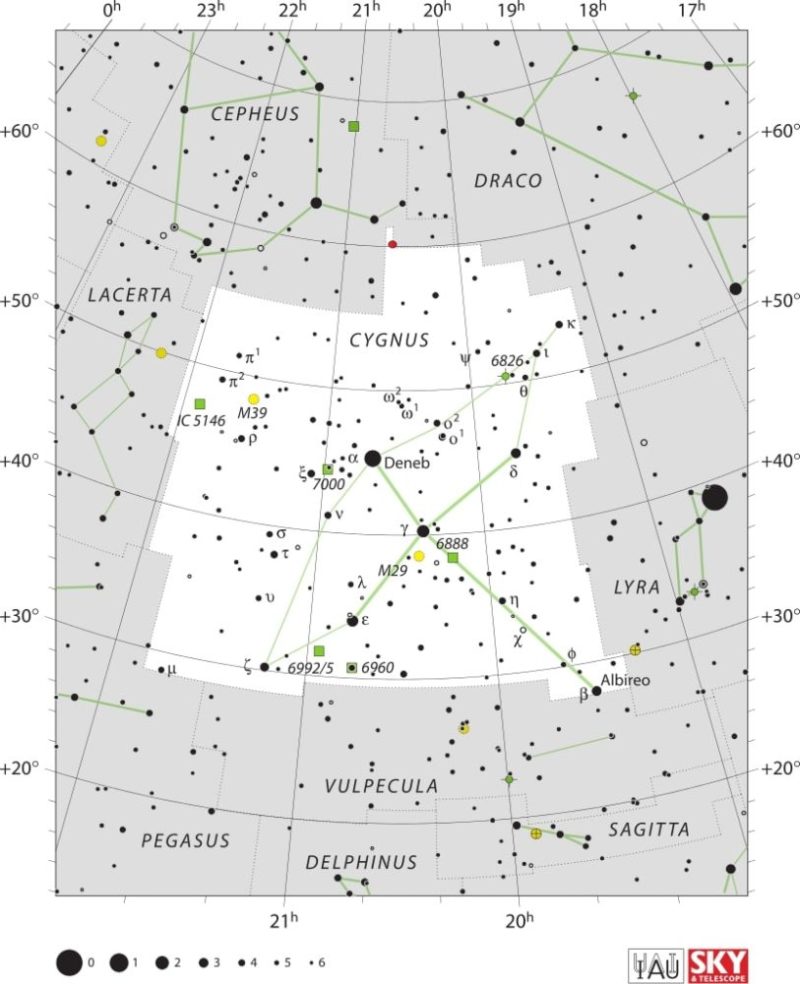
Cygnus, the Swan, is one of the easiest constellations to recognize in the northern summer sky. Its brightest stars form the Northern Cross, while the entire pattern stretches along the Milky Way, placing it among the richest regions for stargazing, astrophotography, and scientific discovery. Even from a suburban yard, Cygnus offers something useful: a clear shape for beginners, colorful double stars, glowing nebulae, open clusters, and a famous black hole hidden among ordinary-looking stars.
What Is Cygnus and Why Does It Matter?
Cygnus is a northern constellation centered near right ascension 20 hours and declination +40 degrees. The International Astronomical Union established its modern boundaries in 1922, and its official abbreviation is Cyg. These borders matter to astronomers because a constellation is now a defined region of the sky, not merely a stick-figure pattern. The IAU explains how these standardized boundaries organize the official constellations.
Official Boundaries
Cygnus lies between Lyra, Draco, Cepheus, Lacerta, Pegasus, Vulpecula, and Delphinus constellations. It follows the dense plane of the Milky Way galaxy, where gas clouds, star-forming regions, and distant stellar populations crowd the view. Cygnus OB2, a powerful association of young, massive stars, sits in this wider region, along with a portion of the Cygnus arm of our galaxy.
Seasonal Visibility
For observers in the northern hemisphere, Cygnus becomes prominent from late spring through early autumn, with the best views during summer evenings. It rises in the northeast, crosses high overhead, and later settles toward the northwest. From much of the United States, Deneb remains visible for hours. Farther south, the constellation appears lower and is more affected by haze and trees.
Milky Way Setting
Cygnus is almost theatrically placed. The Milky Way runs directly through it, creating a broad lane of unresolved stars that can be seen under dark skies. Away from city lights, binoculars reveal star clouds, dark rifts, and pale nebulae. The view is a reminder that the sky is not empty between the bright stars. It is crowded.
How Can You Find Its Distinctive Shape?
Northern Cross
The Northern Cross is the most practical way to identify Cygnus. Deneb marks the top, Albireo marks the southern tip, and Sadr forms the central intersection. Delta and Epsilon Cygni extend across the crossbar. The swan’s body follows the long axis, with its wings spread across the Milky Way.
The shape may look more like a cross than a bird at first. That is perfectly normal. Star patterns depend on imagination, viewing angle, and sky darkness.
Deneb
Deneb, or Alpha Cygni, is the brilliant tail star of the swan and one point of the Summer Triangle, alongside Vega and Altair. It is a blue-white supergiant with enormous intrinsic luminosity. Its apparent brightness is especially impressive because it lies hundreds or perhaps more than a thousand light-years away, depending on the distance method used.
Albireo
Albireo, also called Beta Cygni, marks the swan’s head. Through a small telescope, it is celebrated as a double star with contrasting golden and blue components. The color impression is striking, although the system’s physical relationship is more complicated than the simple visual pairing suggests. Either way, it is a fine target for an amateur telescope.
Which Stars Define the Swan?
Deneb’s Luminosity
Deneb is a useful example of why apparent magnitude can mislead. A star can look bright because it is close, intrinsically powerful, or both. Deneb’s classification as a luminous supergiant places it among the most energetic naked-eye stars in the sky.
Albireo’s Colors
Albireo is best viewed at moderate magnification. Too much power can make the pair harder to frame, especially under unsteady atmospheric conditions. A steady tripod-mounted telescope or small tracking instrument usually gives a cleaner view than an oversized, poorly aligned setup.
Variable Stars
The Cygnus constellation contains several variable stars, including Gamma Cygni near Sadr and Eta Cygni. Their brightness changes can result from pulsation, eclipses, stellar winds, or interaction within a binary star system. Monitoring them turns casual observation into a small scientific project, particularly when observations are recorded over many nights.
Which Deep-Sky Objects Can You See?
North America Nebula
The North America Nebula, or NGC 7000, is an emission nebula shaped vaguely like the continent. It is large but surprisingly difficult through a telescope because its light is spread across a wide area. Under dark skies, binoculars and a low-power, wide-field eyepiece often work better. An oxygen or hydrogen-beta filter can improve contrast.
NASA infrared observations show the complex star-forming material around Sadr and the IC 1318 region in a field nearly five degrees wide, as seen in this wide Cygnus star-forming field.
Veil Nebula
The Veil Nebula is the expanding remnant of a supernova. Its filaments include NGC 6960, NGC 6992, and related arcs spread across a broad section of Cygnus. Filters are extremely helpful, but dark skies matter even more. The shock front contains gas heated to extraordinary temperatures, and NASA’s Cygnus Loop observations reveal its delicate structure.
Open Clusters
M29 and M39 are accessible open clusters for small telescopes and binoculars. M39 is broader and easier to resolve, while M29 is more compact and sits close to the Gamma Cygni region. The Crescent Nebula, NGC 6888, is a more demanding target formed by stellar wind activity around a massive Wolf-Rayet star.
What Scientific Discoveries Come From This Region?
Cygnus is a working laboratory, not merely a pretty outline. Cygnus X-1 is an X-ray binary containing a black hole drawing matter from a blue supergiant companion. NASA describes the system’s accretion process and stellar partnership in its Cygnus X-1 research overview.
The Kepler Space Telescope also studied a dense field near Cygnus and Lyra, finding thousands of candidate planets. Systems such as Kepler-11 and Kepler-22 demonstrated that compact planetary systems and potentially habitable worlds are common subjects in modern exoplanet science.
How Did Ancient Cultures Interpret the Stars?
Greek mythology connected Cygnus with several stories. One tradition identifies the swan with Cycnus, who mourned Phaethon and was transformed by the gods. Other stories associate the bird with Zeus, who used a swan’s form during one of his disguises. Greek myths were not a single fixed catalog, so competing explanations existed.
Across cultures, the same stars received different meanings. Some Indigenous North American traditions described a goose or crane traveling along the Milky Way, sometimes understood as a river of souls. In Chinese astronomy, stars in Cygnus formed part of the celestial river and the magpie bridge associated with the Qixi love story. The cross-cultural history of Cygnus shows how astronomy and storytelling grow from the same visual evidence, yet produce very different maps of the heavens.
What Should Beginners Observe First?
Start with the Northern Cross, then move to Deneb and Albireo. After that, scan the Milky Way with binoculars before attempting faint nebulae. A sensible first session looks like this:
- Find Vega and Altair, then trace the Summer Triangle to Deneb.
- Use Albireo to test your telescope’s focus and color separation.
- Sweep toward Sadr for star clouds and the Gamma Cygni Nebula.
- Try M39 before attempting the Veil or Crescent Nebula.
A red flashlight, a star chart, and patience will outperform a mountain of equipment. Frankly, Cygnus rewards wandering.
FAQ
Is Cygnus visible all year?
It can be seen during part of the year from mid-northern latitudes, but it is most prominent on summer evenings. From far-northern locations, several of its stars are circumpolar.
What is the brightest star in Cygnus?
Deneb is the brightest star in the constellation. It is also one of the three stars forming the Summer Triangle.
Is Cygnus X-1 inside the constellation?
Yes. Cygnus X-1 lies within Cygnus and is one of the best-known stellar-mass black hole systems.
Can you see the Cygnus Loop without a telescope?
Under exceptionally dark skies, some observers can detect parts of it with unaided vision, but binoculars and a nebula filter make the attempt far more realistic.
Conclusion
The Cygnus constellation combines a friendly shape with serious astronomical depth. The Northern Cross helps newcomers orient themselves, while Deneb, Albireo, the North America Nebula, the Veil Nebula, and Cygnus X-1 lead toward deeper questions about stellar evolution, supernovae, and planetary systems. Few constellations make that journey so naturally, from mythological swan to modern science.
Would you like to receive similar articles by email?

Paul Tomaszewski
Paul Tomaszewski is a science & tech writer as well as a programmer and entrepreneur. He is the founder and editor-in-chief of CosmoBC. He has a degree in computer science from John Abbott College, a bachelor's degree in technology from the Memorial University of Newfoundland, and completed some business and economics classes at Concordia University in Montreal. While in college he was the vice-president of the Astronomy Club. In his spare time he is an amateur astronomer and enjoys reading or watching science-fiction. You can follow him on LinkedIn and Twitter.


You May Also Like

September Lyncid Meteor Shower Guide

How Did NASA Choose the First Astronauts to Walk on the Moon