Crux Constellation Guide
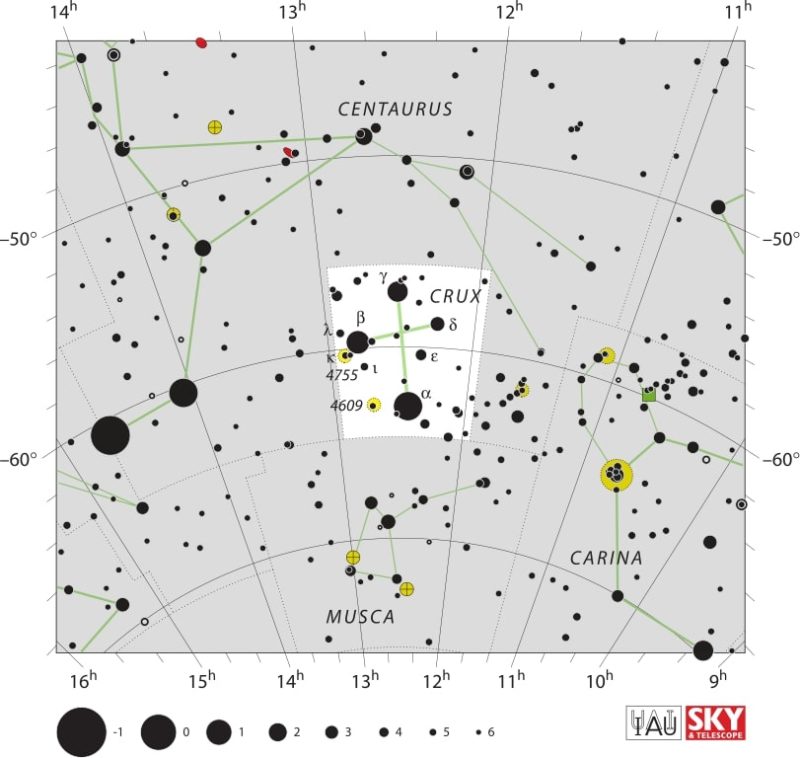
The Crux constellation, better known as the Southern Cross, is a compact pattern of four bright stars in the southern sky. It matters for two reasons: Crux is the smallest of the 88 official constellations, and its long axis gives observers a practical route toward the South Celestial Pole and due south.
That usefulness has made it a celestial landmark for sailors, explorers, Indigenous skywatchers, and anyone trying to make sense of the southern Milky Way. It is also a beautiful patch of sky, crowded with star fields, dark nebulae, and one of the finest open clusters visible through binoculars.
Where Is Crux in the Night Sky?
Southern Celestial Hemisphere
Crux lies deep in the Southern Celestial Hemisphere, between roughly 12 and 13 hours of right ascension and about 56 to 64 degrees south declination. In ordinary language, it sits far below the celestial equator, close to the South Celestial Pole.
From Australia, New Zealand, southern Africa, and much of South America, Crux is a familiar presence. It can remain visible for much of the year, although its position changes with the season and time of night. In southern latitudes, the constellation often feels less like a special event and more like part of the permanent architecture of the sky.
Northern observers face a different situation. Crux may appear briefly near the southern horizon from tropical and subtropical locations, but it becomes increasingly difficult to see as latitude increases. Around the southern United States, only its highest stars may be visible under very favorable conditions, and north of about +20° latitude Crux stays permanently below the horizon. Atmospheric haze, buildings, and trees usually finish the job.
Milky Way Setting
Crux is embedded in a rich section of the Milky Way, where the Sagittarius-Carina arm creates a bright, uneven background of stars. The contrast is striking: brilliant stars stand beside dark lanes of interstellar dust, giving the Southern Cross more visual character than its simple geometry suggests.
The constellation is also surrounded by Centaurus. The bright stars Alpha Centauri and Beta Centauri, known as the Pointer Stars, sit nearby and help confirm that you have found the correct cross rather than a similar star pattern.
Smallest Official Constellation
Crux covers about 68 square degrees, only around 0.165 percent of the entire sky. That makes it the smallest official constellation recognized by the International Astronomical Union.
Small does not mean insignificant. Its stars are bright, its outline is unusually clean, and its position gives it a navigational role that larger constellations cannot easily replace.
Which Stars Define the Southern Cross?
Acrux
Acrux, or Alpha Crucis, marks the southern end of the cross. The name combines “Alpha” with “Crux,” and the star is actually a septuple (seven-star) system rather than one solitary sun. Through a small telescope, its main components can be separated under good conditions.
Acrux is the brightest star in Crux and a useful anchor when tracing the constellation’s long axis toward the south.
Mimosa
Mimosa, also called Beta Crucis, forms one of the cross’s horizontal arms. It is a blue-white giant star, much hotter and more luminous than the Sun, although its great distance makes it appear as a sharp point of light rather than a blazing disk.
The name “Mimosa” is a relatively modern Western designation. Older star traditions did not necessarily treat these stars as parts of a cross at all.
Gacrux
Gacrux, or Gamma Crucis, is the orange-red star at the northern end of Crux. Its color becomes especially noticeable when viewed beside the blue-white stars nearby. This contrast is one of the constellation’s small pleasures, and binoculars make it even easier to appreciate.
The remaining principal stars, Delta Crucis and Epsilon Crucis, help complete the cross shape, though they are less prominent than Acrux, Mimosa, and Gacrux.
How Can You Find Crux?
Southern Hemisphere
Look south after dark and search for four bright stars arranged in a slightly tilted cross. Crux is compact, so its stars appear close together compared with the much larger patterns of Centaurus or Carina.
In Australia, South Africa, and New Zealand, Crux is generally unmistakable once it rises above the horizon. A dark location helps because the surrounding Milky Way contains so many stars that the pattern can briefly seem buried in glitter.
Northern Hemisphere
From the Northern Hemisphere, your best opportunity comes at low northern latitudes during the southern autumn and winter months. Face south and look low, especially from an unobstructed coastline, desert, or elevated site.
Crux will not rise high from most northern locations. Observers should also remember that visibility depends on both latitude and the season. Ancient sky positions were slightly different because Earth’s axial precession changes the apparent coordinates of stars over thousands of years, but modern northern observers should not expect a high Southern Cross.
Pointer Stars
Alpha Centauri and Beta Centauri point toward Crux, though they do not form part of the constellation. Follow the line between them toward the compact group of brighter stars, then check the shape carefully.
The nearby False Cross causes frequent confusion. It is a larger, looser asterism formed by stars in Carina and Vela, and it lacks the same relationship to the Pointer Stars and the South Celestial Pole.
How Does Crux Point Due South?
Long Axis
Imagine a line running from Gacrux through the center of the cross to Acrux. Extend that line about four times its own length beyond Acrux. The point it approaches is the South Celestial Pole.
This is an approximation, not a laser pointer. The pole lies between Crux and the constellation Octans, where no bright pole star marks the location.
Celestial Pole
Once you estimate the South Celestial Pole, drop an imaginary line straight down to the horizon. That direction is due south. The technique works because the stars appear to rotate around the celestial pole as Earth turns.
At first, the geometry feels vague. After a few attempts, it becomes surprisingly reliable.
Latitude Limits
Crux is circumpolar in much of the Southern Hemisphere, meaning it never fully sets. Near the equator it rises and sets normally, while farther north it may appear only briefly. The farther north you travel, the lower and less dependable the view becomes.
What Can You See Near Crux?
Coalsack Nebula
The Coalsack Nebula is a dark cloud of dust beside the stars of Crux. It blocks background starlight, creating a distinct black patch against the Milky Way. Australian Aboriginal traditions often connect this dark shape with a celestial Emu, demonstrating how sky patterns can be built from negative space rather than bright stars.
Jewel Box Cluster
The Jewel Box, or NGC 4755, is an open star cluster near Mimosa. Binoculars reveal a tight scatter of stars, while a small telescope begins to show the color contrast that inspired its name. It is an excellent target for first-time southern-sky observing.
Why Does Crux Matter Across Cultures?
European navigators adopted the Southern Cross as a guide after voyages into southern waters, and it later became a powerful symbol in Australia, New Zealand, Brazil, and other nations. Its presence on national flags reflects geography, exploration, and identity all at once.
Western tradition often interpreted Crux as a Christian cross, partly because the constellation became clearly recognizable to European observers only after southern voyages. In other traditions, the same region of sky carried entirely different stories. Indigenous Australian astronomy, for example, often emphasizes the Coalsack and surrounding dark clouds, treating the Milky Way as a living landscape rather than a backdrop for fixed mythological figures.
That difference is worth lingering over. The stars do not arrive with one universal meaning. People discover patterns, then attach memory, navigation, ancestry, and belief to them.
FAQ
Is Crux the same as the Southern Cross?
Yes. Crux is the constellation’s official Latin name, while Southern Cross is its common English name.
Can you see Crux from the United States?
Only from the far southern United States, and even there it stays very low on the horizon. Southern Florida and Hawaii offer better chances than most mainland locations.
Is Crux the smallest constellation?
Yes. Among the 88 constellations recognized by the International Astronomical Union, Crux has the smallest area.
Does Crux point exactly to the South Pole?
No. Extending its long axis provides a useful approximation. The South Celestial Pole is several degrees away from the line.
Conclusion
Crux is tiny, bright, and unusually useful. Its stars help locate due south, its surrounding Milky Way reveals dark nebulae and star clusters, and its cultural history stretches from European navigation to Indigenous astronomical traditions. For observers in southern latitudes, the Southern Cross is less a distant curiosity than a nightly companion, a compact piece of the sky with a remarkably large reach.
Would you like to receive similar articles by email?

Paul Tomaszewski
Paul Tomaszewski is a science & tech writer as well as a programmer and entrepreneur. He is the founder and editor-in-chief of CosmoBC. He has a degree in computer science from John Abbott College, a bachelor's degree in technology from the Memorial University of Newfoundland, and completed some business and economics classes at Concordia University in Montreal. While in college he was the vice-president of the Astronomy Club. In his spare time he is an amateur astronomer and enjoys reading or watching science-fiction. You can follow him on LinkedIn and Twitter.


You May Also Like
NGC 281: The Stunning Pacman Nebula

NASA Astronaut Christina Koch: Artemis II Mission Specialist