Crater Constellation Guide
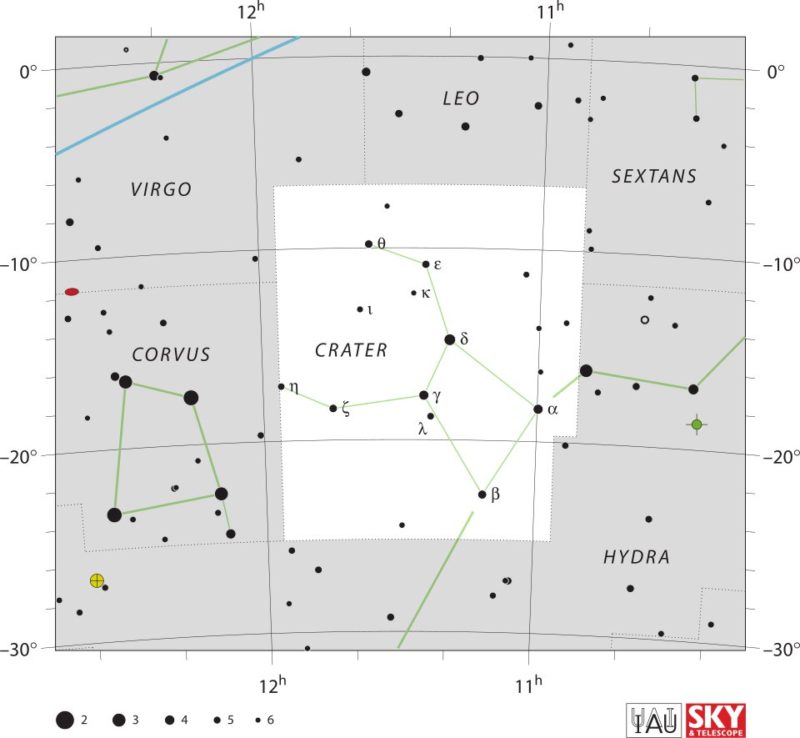
Crater is a small, faint southern constellation representing a drinking cup, and its real appeal is less about dazzling stars than the compact mythological scene it shares with Corvus and Hydra. You can see it best during spring evenings in the Northern Hemisphere, although observers farther south get a higher, cleaner view.
The constellation is easy to overlook. Its brightest stars hover around fourth magnitude, so urban atmospheric cloud cover and light pollution can erase the pattern entirely. Under dark skies, though, Crater becomes a pleasing exercise in celestial patience.
What Does This Celestial Cup Represent?
Name And Abbreviation
The name Crater comes from the Greek krater, a broad vessel used for mixing wine and water. Its official abbreviation is Crt, and the constellation is one of the 48 constellations recorded by the second-century astronomer Ptolemy. It remains one of the 88 modern Western IAU constellations.
The shape is modest. Think of a tilted goblet traced by several faint stars, rather than a sharply outlined symbol like Orion. Its Latin name means “cup,” while the word crater in geology refers to an impact depression or volcanic cavity. Same linguistic root, entirely different celestial idea.
Greek Mythology
In the best-known Greek story, Crater is the cup of Apollo. The god sent Corvus, the Crow, to fetch water, but the bird lingered beside a fig tree and returned with a water snake as an excuse. Apollo saw through the lie and placed the crow, cup, and Hydra in the sky, arranging them so Corvus could never reach the water.
It is an unusually legible piece of mythology. The neighboring constellations Corvus and Hydra are not random decorations; together they preserve the accusation, the punishment, and the unreachable cup. This narrative relationship is one reason Crater receives more attention from sky storytellers than its faint stars might suggest.
Cross-Cultural History
Crater’s history stretches beyond classical Greece. Studies of ancient sky traditions connect cup-like stellar patterns with Mesopotamian material, including the Babylonian compendium MUL.APIN.
Later Chinese astronomy placed many of these stars within the Vermilion Bird of the South, a major figure associated with the southern celestial hemisphere. The details differ across cultures, naturally, but the instinct is universal: people turn scattered lights into memorable forms.
Where Is It Located In The Sky?
Coordinates And Boundaries
Crater lies roughly between right ascension 10 hours 50 minutes and 11 hours 50 minutes, with declinations from about 6 degrees north to 25 degrees south, depending on the boundary reference used. It sits near the celestial equator, making it observable from much of the populated world.
Crater is the 53rd-largest constellation by area. That sounds substantial until you see it in the night sky. Its stars occupy a relatively compact region, squeezed between Hydra and Virgo.
Corvus And Hydra
Look first for Corvus, the Crow. Its four brighter stars form a distinctive quadrilateral, sometimes called the “Sail.” Crater lies northwest of Corvus, while the immense constellation Hydra stretches beneath both. This arrangement is more useful than memorizing coordinates because it gives you a visual route through the sky.
Virgo lies nearby as well, and its brighter star Spica can serve as a useful landmark. On a clear April evening, trace from Spica toward Corvus, then search westward for the dimmer cup.
Celestial Shape
Crater’s outline is often described as a two-handed chalice. That description is generous, frankly. The pattern becomes clearer through binoculars, which separate faint stars and reveal the rough geometry without the narrow field of many telescopes.
When Can You See It Best?
Northern Hemisphere
From the United States and southern Europe, Crater rises in the southeast during spring evenings and reaches its best position around April. It remains fairly low for observers at higher northern latitudes, where haze and trees can become more troublesome than the astronomy.
Southern Hemisphere
Observers in Australia, southern Africa, and South America see Crater higher above the horizon. The southern hemisphere offers a more favorable perspective, especially from rural locations with dry air and little artificial light.
Seasonal Visibility
Crater is most prominent from March through June, with April providing a practical peak. Plan your session after astronomical twilight, when the Sun is at least 18 degrees below the horizon. Moonlight matters too. A thin crescent or moonless night will reveal far more than a bright full Moon, even under otherwise good conditions.
Which Stars Define Its Shape?
Delta Crateris
Delta Crateris is generally the brightest star in the constellation, shining at about magnitude 3.56. It is an orange giant, considerably more evolved than a main-sequence star like the Sun. Its warm color can be subtle, but binoculars make the contrast easier to appreciate.
Alpha Crateris
Alpha Crateris, also called Alkes, marks part of the cup and has an apparent magnitude near 4.1. Its name comes from Arabic and refers to the cup. The star’s designation as Alpha does not mean it is the brightest; historical naming systems are messy that way.
Gamma Crateris
Gamma Crateris is another useful marker, close to magnitude 4.1. Amateur observers often examine it as a double star or possible double-star system, although the visual separation and quality of the pair depend heavily on aperture, magnification, and seeing.
What Deep-Sky Objects Are Worth Observing?
Crater 2
Crater 2 is an extremely faint dwarf galaxy, associated with the Milky Way, but it lies in the constellation of Crater. It was discovered in 2016 and is notable for its enormous size and low surface brightness. It is a serious imaging target, not a casual backyard sight.
NGC 3511
NGC 3511 is a barred spiral galaxy within Crater. Its elongated form can appear through moderate telescopes under dark skies, though the view is usually subdued rather than theatrical. Galaxies are judged by surface brightness, not merely total brightness, and NGC 3511 rewards steady observing more than a quick glance.
NGC 3887
NGC 3887 is another spiral galaxy in the constellation. A small telescope may show it as a faint oval smudge, while larger telescopes begin to suggest structure.
How Can You Find And Observe It?
Start with Corvus, which is easier to recognize. Move northwest toward the loose cup shape, using a star chart or a planisphere. Binoculars are often the best first tool because they brighten faint stars while preserving enough field of view to show the surrounding sky.
Choose a dark site, let your eyes adapt for 20 minutes, and avoid white phone screens. A red light helps preserve night vision. For galaxies such as NGC 3511 and NGC 3887, use a small telescope with a low-power eyepiece first, then increase magnification only if the atmosphere is steady.
FAQ
Is Crater easy to see?
No. It is recognizable under dark skies, but its stars are faint and its shape is less obvious than nearby Corvus.
Is Crater a zodiac constellation?
No. It lies near the zodiac but is not one of the 12 zodiac constellations.
What does Crater represent?
It represents a cup or mixing bowl in Greek mythology, associated with Apollo’s story of Corvus and Hydra.
Conclusion
Crater is a quiet constellation, though “quiet” does not mean empty. Its stars preserve ancient stories, its boundaries contain distant galaxies, and its proximity to Corvus and Hydra makes it part of one of the night sky’s most coherent mythological scenes. Find a dark evening in spring, bring binoculars, and give the faint cup time to emerge. That patience is where the discovery begins.
Would you like to receive similar articles by email?

Paul Tomaszewski
Paul Tomaszewski is a science & tech writer as well as a programmer and entrepreneur. He is the founder and editor-in-chief of CosmoBC. He has a degree in computer science from John Abbott College, a bachelor's degree in technology from the Memorial University of Newfoundland, and completed some business and economics classes at Concordia University in Montreal. While in college he was the vice-president of the Astronomy Club. In his spare time he is an amateur astronomer and enjoys reading or watching science-fiction. You can follow him on LinkedIn and Twitter.


You May Also Like

Bunion Causes and Treatments: What You Need to Know
Canes Venatici Constellation Guide