Cosmic Hearts
Saint Valentine’s Day isn’t just about hearts on Earth—the universe joins in too. Scattered across space, cosmic hearts appear in planets, nebulae, and galaxies, and these striking images turn the night sky into a celestial celebration of love.
Heart-Shaped Crater on Mars
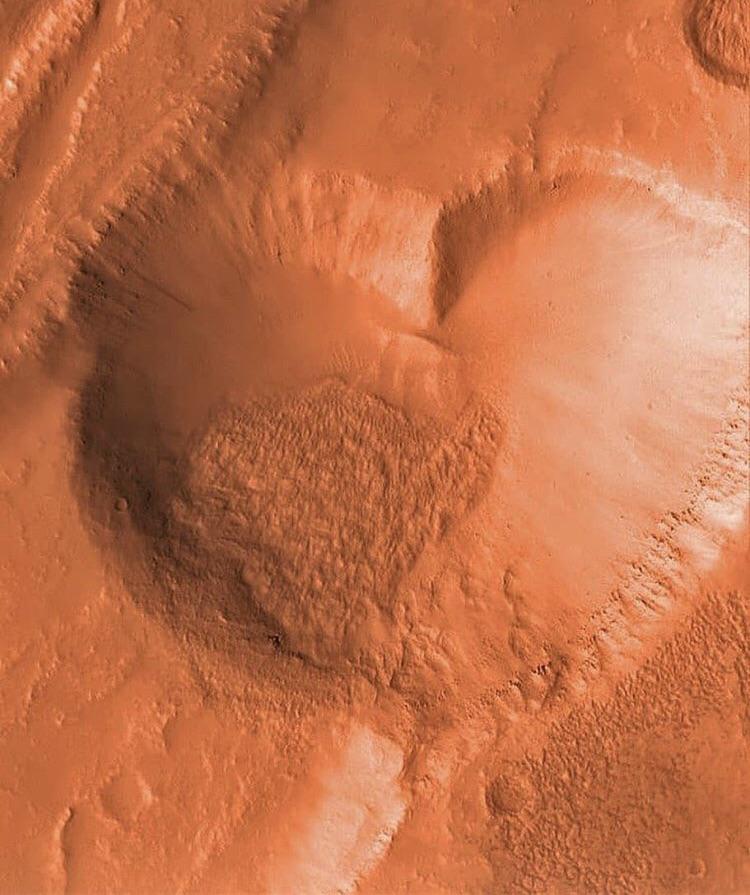
Saint Valentine’s Day reaches all the way to the Red Planet with this striking heart-shaped crater captured by the Mars Orbiter Camera aboard Mars Global Surveyor. It was carved by ancient impacts and shaped over time by erosion. This natural formation looks like a love note written into the Martian surface. Among the most charming cosmic hearts, it reminds us that even harsh, dusty worlds can produce surprisingly poetic shapes. Furthermore, as one of the more unexpected cosmic heart images, it highlights how planetary geology can mimic familiar symbols. This turns a cold, airless landscape into something that feels oddly romantic from millions of kilometers away.
The Heart-Shaped W5 Nebula
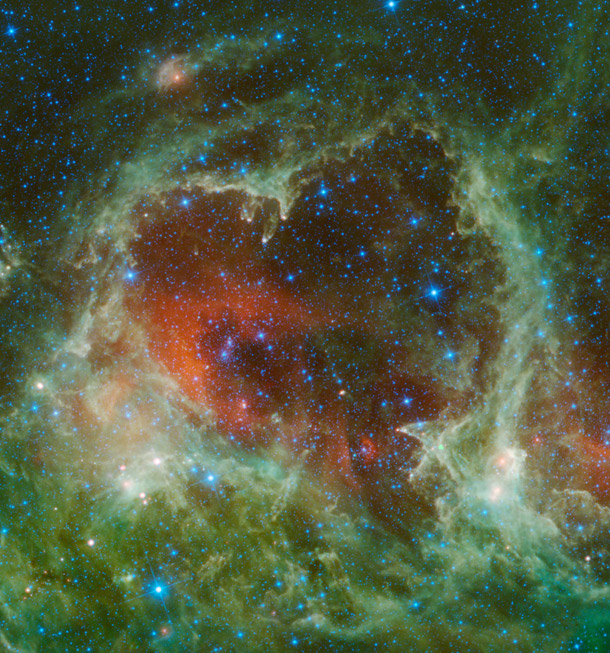
Floating 6,000 light-years away in the constellation Cassiopeia, the W5 nebula forms a glowing, heart-like outline that feels tailor-made for a Valentine’s Day skywatch. This vast cloud of gas and dust is a stellar nursery. Here, intense radiation from young stars sculpts the surrounding material into luminous walls and cavities. Seen through the infrared eyes of NASA’s WISE telescope, W5 becomes one of the most beautiful cosmic hearts. It reveals hidden structures invisible in visible light. In fact, these breathtaking cosmic heart images show that love-themed shapes aren’t just optical illusions. They’re written into the very process of star formation.
The Antennae Galaxies’ Cosmic Embrace
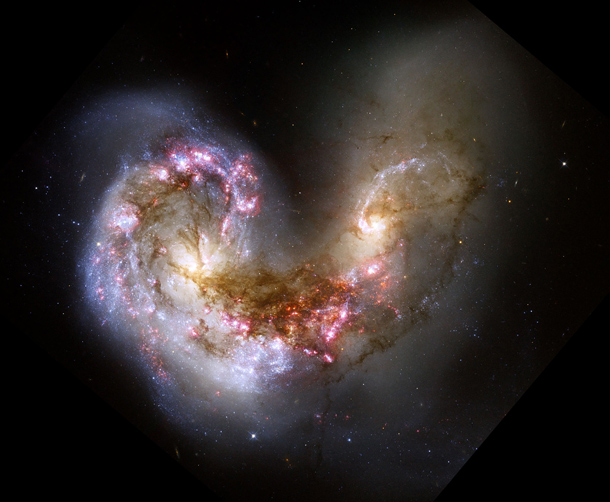
Few sights are more fitting for Saint Valentine’s Day than two galaxies caught in a slow-motion embrace. The Antennae Galaxies are located about 45 million light-years away. As they collide and merge, they appear to form a heart. Their stars, gas, and dust are pulled into sweeping arcs by gravity. Captured by the Hubble Space Telescope, this dramatic interaction is one of the most iconic cosmic hearts ever observed. These extraordinary cosmic heart images remind us that even on the grandest scales, the universe is shaped by attraction, connection, and spectacular encounters. These unfold over hundreds of millions of years.
Conclusion
From heart-shaped craters to glowing nebulae and colliding galaxies, these cosmic hearts show that the universe has its own way of celebrating love. Together, these stunning cosmic heart images prove that romance can be found written across the stars.
Would you like to receive similar articles by email?

Paul Tomaszewski
Paul Tomaszewski is a science & tech writer as well as a programmer and entrepreneur. He is the founder and editor-in-chief of CosmoBC. He has a degree in computer science from John Abbott College, a bachelor's degree in technology from the Memorial University of Newfoundland, and completed some business and economics classes at Concordia University in Montreal. While in college he was the vice-president of the Astronomy Club. In his spare time he is an amateur astronomer and enjoys reading or watching science-fiction. You can follow him on LinkedIn and Twitter.


You May Also Like
What Is the Hubble Volume?
Common Tools Used to Gather Data in Space