Corvus Constellation Guide
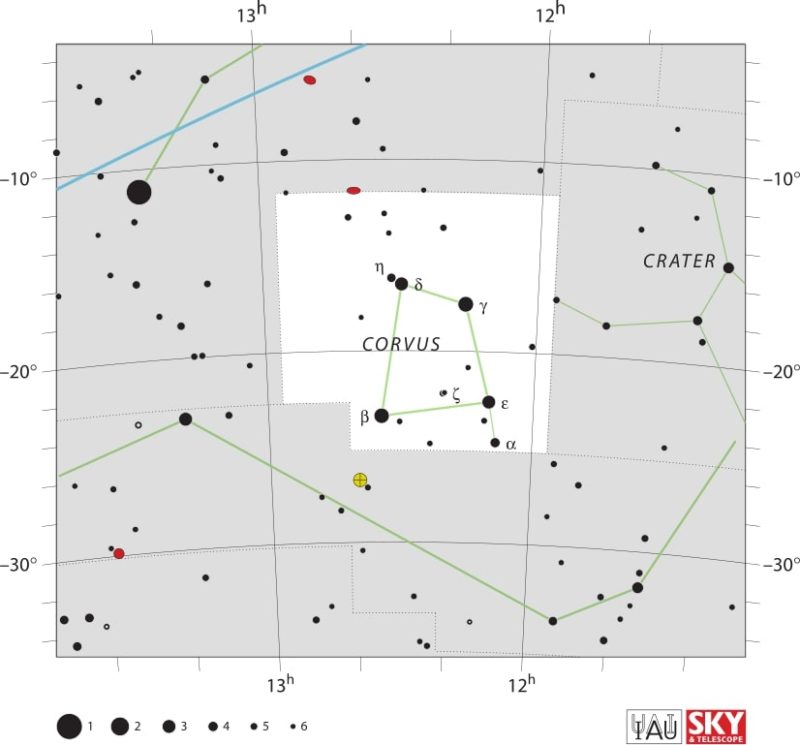
The Corvus constellation is a small southern-sky pattern shaped like a lopsided diamond, or perhaps a raven with folded wings. Its four principal stars make it unusually easy to recognize once you know where to look, even though Corvus is neither large nor especially bright. In spring, it offers sky watchers a compact meeting point of Greek mythology, ancient star lore, and deep-sky science.
What Is the Corvus Constellation?
Identity and Meaning
Corvus is the Latin word for “raven,” and the constellation traditionally represents a sacred bird connected with Apollo. In ordinary conversation, people may call it a crow, but the astronomical name is Corvus, one of the 88 modern constellations recognized by the International Astronomical Union.
Its meaning comes from the bird’s supposed role as a messenger. The shape is stylized rather than anatomically convincing, with the star pattern suggesting a body, wings, and a small beak. That imaginative leap is part of the charm. Constellations are maps of human memory laid over unrelated stars.
Size and Classification
Corvus covers roughly 184 square degrees, making it a small constellation by modern standards. It ranks near the lower end of the 88 western IAU constellations, yet its compact outline gives it more visual presence than its size suggests.
The constellation lies in the southern celestial hemisphere, close to the celestial equator. That placement makes it accessible to observers across much of the world, although its appearance is higher and more comfortable from the southern United States and other southern latitudes.
Quadrilateral Shape
Four stars form Corvus’s defining quadrilateral:
- Gamma Corvi, also called Gienah, marks one corner.
- Delta Corvi, or Algorab, helps form the western side.
- Beta Corvi, known as Kraz, sits among the brightest stars in the pattern.
- Epsilon Corvi, called Minkar, completes the uneven diamond.
The shape is sometimes compared to a sail, a bird, or a crooked box. Frankly, the “lopsided diamond” description works best. It gives beginners a practical visual handle without forcing the stars into an elaborate bird drawing.
Where Is Corvus Located?
Celestial Coordinates
Corvus occupies a region around 12 hours of right ascension and declinations near 18 degrees south. Its position places it well below the ecliptic, so it is not a zodiac constellation, even though the nearby constellation Virgo contains the bright star Spica and lies along the zodiac.
Look for Corvus southeast of Spica. The bright star is an excellent landmark because it outshines the main stars of Corvus and remains easy to identify from suburban skies.
Nearby Constellations
Corvus is bordered by Virgo to the north, Crater to the west, and the enormous constellation Hydra to the south and east. The constellation’s relationship with Hydra and Crater matters both geographically and mythologically. Together, these three patterns create a memorable spring grouping.
Pegasus lies farther north and is not an immediate neighbor, despite occasionally appearing in broad seasonal sky guides near the same viewing routes.
Hydra and Crater
Hydra stretches across a huge section of the sky, its snake shape running beneath Virgo and Leo. Crater, the Cup, sits just west of Corvus. Their proximity makes the region useful for learning star patterns, though Hydra’s faint stars are harder to trace than Corvus’s compact quadrilateral.
How Did Corvus Enter Ancient Mythology?
Greek Raven Myth
In Greek mythology, Corvus was the raven of Apollo. The bird was sent to fetch water but stopped to eat figs before returning. To excuse the delay, it brought back a water snake and claimed that Hydra had blocked its path.
Apollo recognized the lie and placed the raven, the cup, and the snake in the sky together. The story explains why Corvus appears beside Crater and Hydra, while also giving the bird an eternal punishment: it cannot reach the cup of water.
Apollo and the Cup
The myth is less a scientific explanation than a moral fable about disobedience and dishonesty. Ancient Greek sky lore frequently linked neighboring constellations through narrative, turning an otherwise scattered collection of stars into a coherent scene.
Ptolemy included Corvus in his second-century catalog of constellations, helping preserve the pattern within the classical tradition that later shaped European astronomy.
Global Astronomical Traditions
The raven’s identity is not universal. Babylonian star catalogues included bird-related figures in the same broad region, but their interpretations belonged to a different religious and observational system. Indian astronomy also developed its own nakshatra framework rather than simply adopting Corvus as a direct equivalent.
That distinction matters. The stars are universal; the stories are cultural.
Which Stars Define Its Shape?
Gamma Corvi is a blue-white giant and one of the most noticeable stars in the figure. Delta Corvi is a binary star system, while Beta Corvi is another prominent star used to anchor the quadrilateral. Epsilon Corvi is a cooler orange giant that adds color contrast under steady observing conditions.
Alpha Corvi, or Alchiba, lies near the eastern part of the constellation but is not one of the four stars that produces the classic diamond. Eta Corvi is also worth noting because it is a nearby star system with a circumstellar debris disk, a faint ring of dust that offers clues about planetary formation.
| Star | Common name | Role |
|---|---|---|
| Gamma Corvi | Gienah | Bright corner of the quadrilateral |
| Delta Corvi | Algorab | Binary system and western anchor |
| Beta Corvi | Kraz | Major shape-defining star |
| Epsilon Corvi | Minkar | Orange giant and lower corner |
What Deep-Sky Objects Does Corvus Contain?
Corvus is far more rewarding with a telescope than with the naked eye. Its most famous target is the Antennae Galaxies, NGC 4038 and NGC 4039, a pair of interacting galaxies about 72 million light-years away. Their long tidal tails were created by gravitational encounters, making them a striking preview of how galaxy collisions reshape stars, gas, and dust.
The Antennae are challenging visually. A dark sky and an aperture of at least 8 inches improve the odds, while long-exposure astrophotography reveals their delicate structure far more clearly. Nearby NGC 4027 is another interacting galaxy in the region, though it is a demanding target for amateur telescopes.
How Can You Find Corvus?
Seasonal Visibility
Corvus is best viewed on spring evenings, especially from March through May in the Northern Hemisphere. It rises in the southeast after sunset and reaches a useful altitude later in the evening. From the Southern Hemisphere, it appears higher and remains a comfortable target for longer.
In far northern locations, Corvus stays low above the southern horizon, where trees, buildings, and atmospheric haze can interfere.
Star-Hopping Route
Start with Spica, the brightest star in Virgo. From Spica, move southeast and look for four moderately bright stars forming a tilted box. The pattern should stand apart from the sprawling stars of Hydra. A free planisphere or astronomy app can confirm the field, but give your eyes a few minutes to adjust before judging the shape.
Northern and Southern Views
Observers in the southern United States can often see the quadrilateral clearly from a dark rural site. In southern Australia, South Africa, and South America, Corvus climbs higher and becomes especially conspicuous during autumn evenings.
What Equipment Reveals Its Best Features?
Naked-eye viewing is enough to identify the constellation. Binoculars help separate the surrounding star field, but they will not show the Antennae Galaxies well. A 4-inch telescope reveals several fainter stars and improves the view of nearby galaxies; an 8-inch or larger telescope is a more realistic choice for serious deep-sky work.
Use a low-power eyepiece first to frame Corvus, then increase magnification for individual stars. A red flashlight protects night vision, and a dark location matters more than costly equipment. Light pollution erases faint galaxies with ruthless efficiency.
FAQ
Is Corvus visible from the Northern Hemisphere?
Yes. It is visible from most temperate northern locations, although it stays low in the sky at high northern latitudes.
What is the brightest star in Corvus?
Gamma Corvi, or Gienah, is generally regarded as the brightest major star in the constellation.
Does Corvus contain a nebula?
Corvus is better known for galaxies, especially the Antennae Galaxies, than for bright nebulae.
Conclusion
The Corvus constellation rewards attention because it combines a practical shape with an unusually rich backstory. Find Spica, shift southeast, and the crooked diamond should emerge. From there, you can explore ancient mythology, binary star systems, and colliding galaxies in one compact patch of sky. That is a fine return on a few minutes outdoors.
Would you like to receive similar articles by email?

Paul Tomaszewski
Paul Tomaszewski is a science & tech writer as well as a programmer and entrepreneur. He is the founder and editor-in-chief of CosmoBC. He has a degree in computer science from John Abbott College, a bachelor's degree in technology from the Memorial University of Newfoundland, and completed some business and economics classes at Concordia University in Montreal. While in college he was the vice-president of the Astronomy Club. In his spare time he is an amateur astronomer and enjoys reading or watching science-fiction. You can follow him on LinkedIn and Twitter.


You May Also Like

How Are Astronomers Able to Explore the Layers of the Sun Below the Photosphere?
Comae Berenicid Meteor Shower Guide