Corona Borealis Constellation Guide
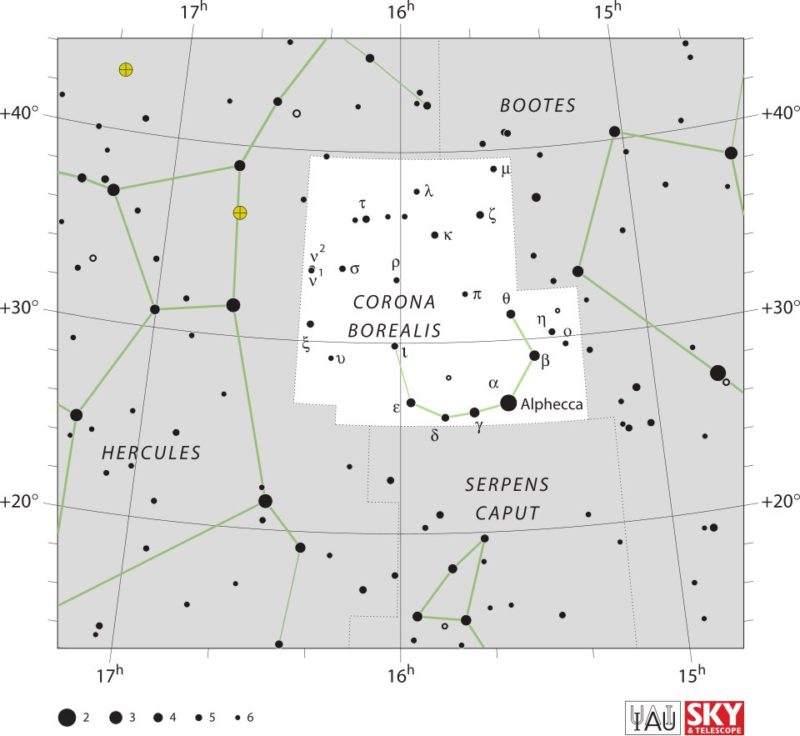
Corona Borealis, the Northern Crown, is a small constellation in the northern sky recognized by a graceful semicircle of stars between Boötes and Hercules. Its brightest star, Alphecca, shines at magnitude 2.2, making the pattern surprisingly easy to find once Arcturus has given you a starting point. The International Astronomical Union’s official constellation framework recognizes Corona Borealis as one of the 88 modern constellations.
It is modest in size, but hardly minor. The region contains a recurrent nova, variable stars, a famous exoplanet system, and distant galaxy clusters. There is also an old story attached to that curved arrangement: a crown worn by Ariadne, the Cretan princess connected with Dionysus. A tidy little arc, carrying an untidy amount of history.
Where Can You Find the Northern Crown?
Northern Sky Position
Corona Borealis lies in the northern celestial hemisphere, roughly between right ascension 15 and 16 hours. From much of the United States, Europe, and Asia, it becomes prominent during spring and summer evenings. It is not fully circumpolar for most observers, so its altitude changes with latitude and season.
Look first for Arcturus, the bright orange star in Boötes. Corona Borealis sits east of Arcturus, closer to the Hercules constellation. The EarthSky observing guide identifies Alphecca as the constellation’s visual anchor and one of the brighter stars in the entire night sky.
Neighboring Constellations
Boötes forms the western reference point, while Hercules lies to the east. Serpens Caput and the small constellation of Canes Venatici are also nearby. Corona Borealis can seem isolated at first, especially from suburban locations, yet its neighbors make excellent navigational landmarks.
Do not confuse it with Corona Australis, the Southern Crown. Corona Australis appears in the southern celestial hemisphere and has a different star pattern and mythology.
Best Viewing Season
The best time to observe Corona Borealis is from April through July, when it climbs high in the evening sky for northern observers. In May and June, the crown is especially well placed after sunset. Southern observers can still see it, although the constellation remains low and may be difficult to distinguish through atmospheric haze.
How Does Its Crown Shape Guide Stargazers?
Semicircular Star Pattern
The constellation’s main stars form a curved chain rather than a closed ring. Alphecca sits near the western end of the arc, followed by Nusakan and several fainter stars that complete the crown-like shape. Under dark skies, the pattern is obvious. Under city lights, it may look more like a bent hook.
That visual shorthand is the constellation’s great advantage. Beginners often find the Big Dipper first, then use Arcturus and Boötes to reach the Northern Crown. It offers a quick win, which is no small thing when the sky seems packed with anonymous points of light.
Star-Hopping Route
Start with Arcturus, then move eastward toward the curved line of Corona Borealis. Alphecca is the next major landmark. From there, scan along the semicircle with binoculars or a small telescope.
For T Coronae Borealis, also called the Blaze Star, observers can use Delta Coronae Borealis as a reference. It lies roughly 2.2 degrees west of the recurrent nova, according to this guide to locating T Coronae Borealis. A sky app helps, but a printed chart or a planisphere preserves the old-fashioned pleasure of learning the neighborhood rather than outsourcing every glance.
Visibility Conditions
Dark skies reveal more of the fainter arc, while binoculars improve contrast without overwhelming the pattern. Give your eyes 20 minutes to adapt, use a dim red light, and avoid looking directly at bright screens. Corona Borealis is not a deep-sky showpiece for casual viewing. Its charm comes from shape, position, and what the stars represent.
Which Stars Define the Constellation?
Alphecca
Alphecca, officially Alpha Coronae Borealis, is a blue-white binary star with an apparent magnitude near 2.2. It is also known as Gemma, a Latin word meaning “jewel.” The brighter component is an A-type star, while its companion passes across the primary and causes small changes in brightness.
Nusakan
Nusakan, or Beta Coronae Borealis, is another important reference point. It is a spectroscopic binary and a chemically peculiar star, meaning its atmosphere contains unusual concentrations of certain elements. Its name comes from Arabic star traditions, a reminder that constellation history is rarely owned by one civilization.
T Coronae Borealis
T Coronae Borealis is a recurrent nova system consisting of a red giant and a compact white dwarf. When material from the giant accumulates on the white dwarf, nuclear fusion can trigger a sudden eruption. The system has brightened dramatically in recorded history, with eruptions roughly eight decades apart.
The Astronomy.com observing report describes it as a rare viewing opportunity because a future outburst could make the Blaze Star visible to the unaided eye. It is a nova, not a supernova. The binary system survives the event.
What Astronomical Features Make It Important?
Corona Borealis hosts more than attractive star patterns. The exoplanet XO-1b is a hot Jupiter orbiting the Sun-like star XO-1. Its close orbit produces a heated gas giant with a year lasting only a few days, and transit observations helped astronomers study its atmosphere.
The region also contains distant galaxy clusters. Chandra observations of Abell 2142 examine million-degree gas trapped in a massive cluster about 1.2 billion light-years away. A Hubble image of SDSS J1531+3414 shows another dense galaxy cluster in the broader celestial region.
Variable stars add another layer. R Coronae Borealis is the prototype of a rare class of hydrogen-deficient variable stars that can fade unpredictably when carbon-rich dust forms around the star. These objects give astrophysicists an unusual laboratory for late stellar evolution.
How Did Cultures Interpret the Crown?
The same star shape has gathered different meanings across the world. Greek astronomers connected it with a wreath or crown, while Indigenous Australian traditions included interpretations resembling a boomerang. The Chandra cultural overview documents how these readings reflect local environments, storytelling systems, and practical sky knowledge. That matters because star lore is not a single universal script. The sky is universal; the stories are wonderfully particular.
What Stories Connect It to Ariadne?
Greek Tradition
In Greek myth, Corona Borealis is often identified as the jeweled crown Ariadne received from Dionysus. After Ariadne helped Theseus escape the Labyrinth, Dionysus became her husband in later versions of the story. He placed the crown in the heavens, where its stars became a permanent memorial.
The account appears in classical traditions associated with writers such as Apollonius Rhodius and later Roman poets. The precise details vary, as myths tend to do when carried across centuries.
Roman Adaptation
Roman writers retained the Ariadne connection and used the Latin name Corona Borealis, meaning “northern crown.” The Romans also inherited much of the Greek celestial framework, including Ptolemy’s catalog of classical constellations.
How Does It Appear in Modern Astronomy and Culture?
Modern astronomy treats the Corona Borealis constellation as a mapped region with precise boundaries, cataloged objects, and measurable star systems. Popular culture tends to prefer the crown, the Blaze Star, and the sense that something is waiting to flare. That instinct is understandable. A quiet constellation containing a possible naked-eye nova has excellent dramatic timing.
The Royal Astronomical Society discussion of historical T Coronae Borealis observations even examines a medieval account that may correspond to an earlier eruption. Science and storytelling overlap here, though the evidence still requires careful interpretation.
FAQ
Is Corona Borealis easy to see?
Yes, especially from dark locations in the northern hemisphere during late spring and summer. Alphecca makes the semicircle much easier to identify.
How many stars form the crown?
Six or seven moderately bright stars create the recognizable arc, although the official constellation contains many more cataloged stars.
Is the Blaze Star visible now?
T Coronae Borealis is usually too faint for unaided viewing. Its brightness changes during recurrent nova eruptions, so observers should check current astronomical alerts.
Does Corona Borealis contain planets?
Yes. XO-1b is a well-known hot Jupiter orbiting the star XO-1 within the constellation’s boundaries.
Conclusion
The Corona Borealis constellation rewards a layered approach. First, find the crown. Then discover Alphecca, Nusakan, the volatile Blaze Star, XO-1b, and the distant galaxy clusters beyond the pattern. Its semicircle is simple enough for beginners, yet its science and cultural history reach deep into stellar evolution, planetary astronomy, and human imagination.
Would you like to receive similar articles by email?

Paul Tomaszewski
Paul Tomaszewski is a science & tech writer as well as a programmer and entrepreneur. He is the founder and editor-in-chief of CosmoBC. He has a degree in computer science from John Abbott College, a bachelor's degree in technology from the Memorial University of Newfoundland, and completed some business and economics classes at Concordia University in Montreal. While in college he was the vice-president of the Astronomy Club. In his spare time he is an amateur astronomer and enjoys reading or watching science-fiction. You can follow him on LinkedIn and Twitter.


You May Also Like

Exciting Future Uses of Textiles in Space

TESS Space Telescope Discovers First Exoplanet