Corona Australis Constellation Guide
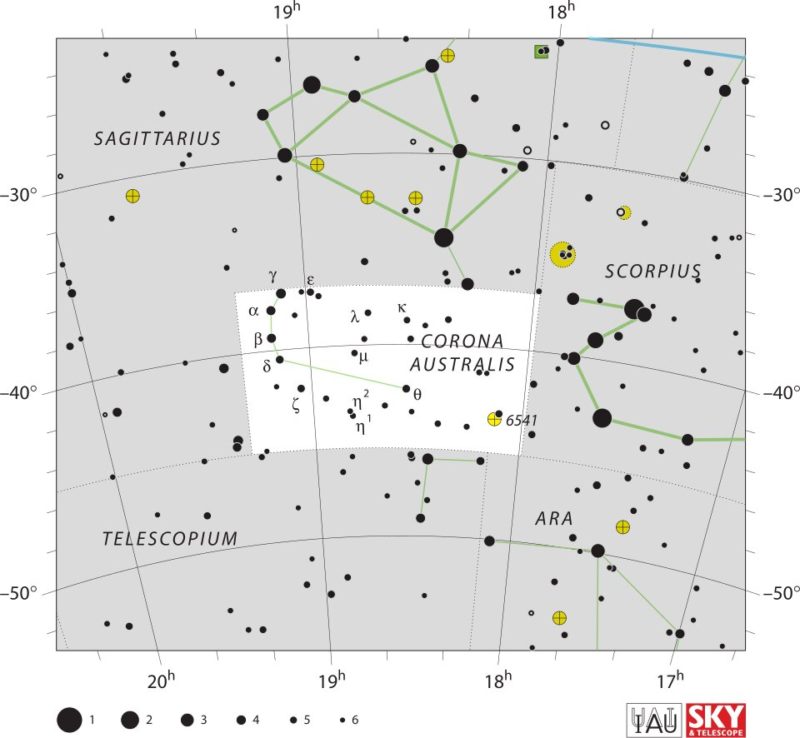
Corona Australis can feel like a constellation that almost escaped the map. It is small, faint, and easily overshadowed by Sagittarius and Scorpius, yet this southern crown contains a nearby stellar nursery, intricate dust lanes, and a history reaching back to ancient Greek astronomy. Its real appeal appears when you stop hunting for one spectacular star and begin noticing the whole region.
What Is Corona Australis?
Southern Crown
Corona Australis, abbreviated CrA, means “Southern Crown.” The International Astronomical Union preserves that official Latin name among the modern constellations. It is also called the Southern Crown to distinguish it from Corona Borealis, the Northern Crown, which lies much farther north in the sky. The two constellations share a crown-like idea, but they are separate constellations with no physical connection.
Compact Shape
The constellation forms a shallow, curved arc of stars rather than a perfectly closed ring. Its outline is modest, but recognizable under a dark sky. Several component stars trace the southern edge of the Milky Way, where dense stellar fields mingle with opaque interstellar dust.
Corona Australis is not one of the sky’s bright showpieces. Its principal stars hover around fourth magnitude, so urban light pollution can erase the shape almost completely. Under rural conditions, though, the curve becomes a pleasing little wreath.
Ptolemaic Origins
Corona Australis was listed by the second-century astronomer Claudius Ptolemy in the Almagest. Ancient Greek sky traditions sometimes associated the pattern with a crown or wreath, although the exact mythological interpretation varies among sources. Later star maps retained it, and modern astronomers now define it through fixed International Astronomical Union constellation boundaries.
Where Is Corona Australis Located?
Sagittarius Border
Corona Australis sits immediately south of Sagittarius. The familiar Sagittarius Teapot is the best starting landmark, especially when it is high in the evening sky during late summer. Look below the Teapot’s handle and toward the southern horizon.
Scorpius Neighbor
Scorpius lies to the west and northwest, making its curved body and bright Antares useful reference points. Corona Australis occupies a quieter patch between the more dramatic patterns of Sagittarius and Scorpius. The surrounding Milky Way is rich, but the crown itself is relatively compact.
Southern Coordinates
The constellation spans roughly right ascension 17h 58m to 19h 19m and declinations near 36 to 45 degrees south. Those coordinates explain its identity as a southern constellation: observers in the Southern Hemisphere see it prominently, while northern viewers must catch it low in the south.
When Can You See Corona Australis?
August Peak
August is usually the most convenient month for viewing Corona Australis from the United States and other northern locations. It reaches its highest point in the evening during the summer Milky Way season, when Sagittarius and Scorpius are also visible.
From the Southern Hemisphere, the constellation remains available for a longer seasonal window and climbs much higher. In Australia, southern Africa, New Zealand, and southern South America, it is far easier to observe than from northern latitudes.
Latitude Limits
The Corona Australis constellation can be seen from much of the continental United States, but visibility becomes increasingly difficult north of roughly 40 degrees north latitude. At 45 degrees north, its brightest stars barely rise above the southern horizon. Farther south, the geometry improves quickly.
A useful rule is simple: the farther south you travel, the more sky appears above the horizon. At latitude 30 degrees north, the crown can reach about 15 degrees above the horizon. At latitude 35 degrees south, it climbs dramatically higher.
Horizon Height
The low altitude seen from northern locations creates two problems: atmospheric extinction dims the stars, and trees, buildings, or haze often block the view. A transparent night matters more than an unusually dark one if the constellation is scraping the horizon.
Which Stars Define Its Shape?
Alpha Coronae Australis
Alpha Coronae Australis, also called Alfecca Meridiana, is the brightest star in the constellation, with an apparent magnitude close to 4.1. It is a hot, white main-sequence star and serves as the crown’s most useful anchor.
The name Alfecca Meridiana echoes the naming tradition of Alphecca in Corona Borealis, while Meridiana indicates its southern setting. It is not an especially dramatic star through a telescope, but its position helps establish the pattern.
Beta Coronae Australis
Beta Coronae Australis is another prominent fourth-magnitude star near the arc. Together with Alpha, Gamma, Delta, and Epsilon Coronae Australis, it helps produce the compact curve visible in a finder scope or binoculars.
The stars are visually close in the sky, though that does not mean they form one physical star system. Constellations are line-of-sight patterns, assembled from stars at different distances.
R Coronae Australis
R Coronae Australis is the region’s scientific celebrity. This variable star is a young stellar object surrounded by reflection nebulosity and dust. It belongs to an active star-forming environment, where collapsing gas, magnetic fields, and energetic stellar winds complicate the birth of new stars.
What Deep-Sky Objects Does It Contain?
The most compelling targets are not bright stars but the Corona Australis molecular cloud, including the reflection nebulae NGC 6726 and NGC 6727. These clouds scatter starlight, producing subtle blue illumination across thick lanes of dust. A 570-megapixel DECam image reveals the region with far more texture than ordinary visual observing can provide.
The nearby Coronet Cluster, a compact group of young stars, sits within this star-forming complex. NASA’s Chandra observations place it roughly 420 light-years away, making it substantially closer than the Orion Nebula’s major nursery regions. X-ray observations expose magnetic activity and high-energy winds that optical images cannot show. The Chandra Coronet Cluster profile gives a useful look at that hidden violence.
NGC 6723, a globular cluster, also appears near the constellation’s boundary. It belongs to a much older and more distant population than the nearby molecular cloud. That visual overlap is a good reminder that a single sky field can contain unrelated structures separated by thousands of light-years.
Why Does Its Molecular Cloud Matter?
The cloud offers astronomers a relatively close laboratory for studying early stellar evolution. Dense cores collapse under gravity, young stars accrete material, and radiation gradually reshapes the surrounding gas. Infrared, optical, radio, and X-ray observations each reveal a different layer of the process.
Optical images alone can feel like a postcard. Millimeter observations trace cold molecular gas, while infrared data peer through obscuring dust. The ESO view of R Coronae Australis shows why the area is often compared with a cosmic watercolor: blue reflection light, dark filaments, and warm reddish emission overlap without forming a tidy picture.
How Do You Find It In The Sky?
Begin with Sagittarius and locate the Teapot. Move south from the Teapot’s handle, then search for a small arc of fourth-magnitude stars. Scorpius and its bright red-orange star Antares should remain to the right or west, depending on your orientation and observing time.
Binoculars are often better than a telescope for the first search because they provide enough magnification while retaining a broad field. Once the crown is identified, a telescope can reveal the surrounding star fields, although the faint nebulae demand dark skies and careful vision.
What Conditions Improve Your View?
Choose a moonless night with low humidity and a clear southern horizon. Let your eyes adapt for at least 20 minutes, and use a dim red light rather than a bright phone screen. From northern sites, observe when Corona Australis culminates, because every extra degree of altitude helps.
For astrophotography, broadband data can preserve the natural star colors, while H-alpha and other narrowband exposures bring out ionized gas near the young stars. High dynamic range is important. Crush the shadows during processing and the brownish dust lanes vanish; overexpose the reflection nebulae and their blue structure turns into a white smear.
FAQ
Is Corona Australis visible from the Northern Hemisphere?
Yes. It is visible from much of the United States and southern Europe, but it stays low in the southern sky. Northern observers need an unobstructed horizon and excellent transparency.
Is Corona Australis part of Sagittarius?
No. It is a separate constellation located south of Sagittarius and near Scorpius. Their borders are adjacent, which makes Sagittarius a convenient guide.
What is the brightest star in Corona Australis?
Alpha Coronae Australis, or Alfecca Meridiana, is generally the brightest star, at about magnitude 4.1.
Can you see the molecular cloud without a telescope?
The brightest portions are difficult to detect visually, even through small telescopes. Dark skies and long-exposure astrophotography reveal far more than the human eye.
Conclusion
The Corona Australis constellation’s compact crown is only the doorway; behind it lies a nearby nursery of young stars, reflection nebulae, cold molecular gas, and energetic magnetic activity. Find it below Sagittarius in August, protect your night vision, and let the faint southern sky do its quiet work.
Would you like to receive similar articles by email?

Paul Tomaszewski
Paul Tomaszewski is a science & tech writer as well as a programmer and entrepreneur. He is the founder and editor-in-chief of CosmoBC. He has a degree in computer science from John Abbott College, a bachelor's degree in technology from the Memorial University of Newfoundland, and completed some business and economics classes at Concordia University in Montreal. While in college he was the vice-president of the Astronomy Club. In his spare time he is an amateur astronomer and enjoys reading or watching science-fiction. You can follow him on LinkedIn and Twitter.


You May Also Like
Piscis Austrinus Constellation Guide
How Did Asteroid Hygiea Get Its Name